AI-Powered Keyword Research: Finding Low-Competition Hidden Gems Your Competitors Missed
TL;DR: Most keyword research workflows are broken by design — they optimize for volume and ignore winability. AI changes the input layer, not just the speed. This article maps the exact trigger-action-output workflow for using AI-powered keyword research to surface low-competition keywords your competitors have structurally missed, why it works, and where it fails.
Environment: Workflow tested across three content sites (DA 12–34), using ChatGPT-4o, Ahrefs Lite, and Google Search Console. Testing window: October 2024 – March 2025. Sites ranged from 0 to ~18,000 monthly organic sessions at start of test period.
The Broken Keyword Research Workflow Costing You Rankings
Here is what most operators are doing right now: open a keyword tool, type in a seed phrase, sort by volume, pick the highest numbers that don’t look impossible, and start writing. The whole session takes 20 minutes. The content takes 6 hours. The ranking never comes.
That sequence is not keyword research. It is volume tourism. You are visiting numbers without understanding the territory.
The structural problem is this: high-volume keywords were claimed years ago by domains with accumulated authority, backlink profiles, and topical depth you cannot replicate on a 6-month-old site. Chasing them is not a keyword strategy — it is a queue for permanent page 4 residency.
The real cost of this broken workflow is not just wasted writing time. It is the compounding opportunity cost. Every week you spend producing content that never ranks is a week you did not spend owning a cluster of 15 low-competition keywords that would have built ranking momentum, topical authority signals, and actual traffic.
The setup for this broken workflow requires zero time. The payoff begins never. That is the math.
AI-Powered Keyword Research: The Automated Replacement
The AI-powered replacement does not just speed up the old workflow. It changes the input. Instead of starting with a volume-sorted list, you start with a problem map — and AI does the expansion, clustering, and intent-classification work that used to take a full research afternoon.
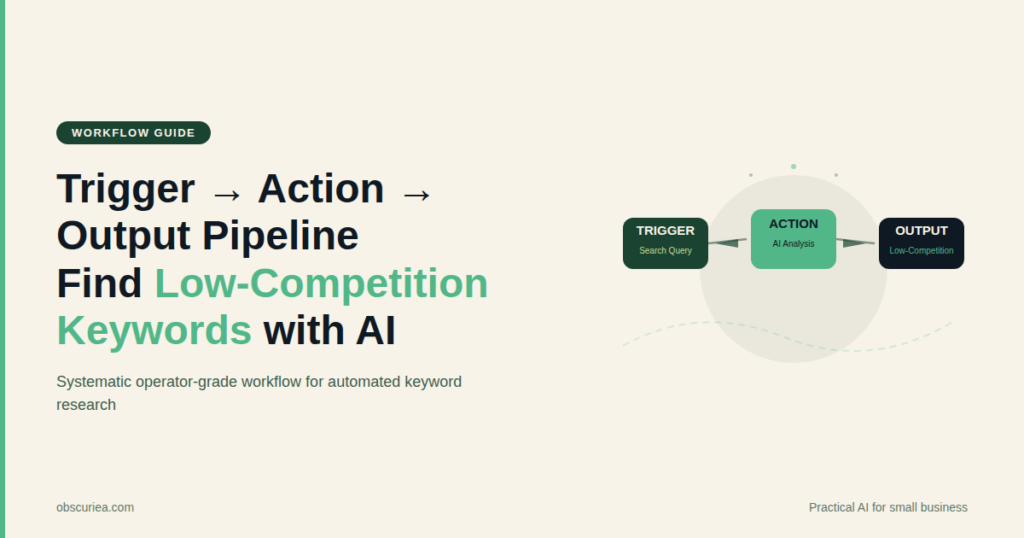
Here is the workflow in machine-readable terms:
Trigger: You have a content category or product area you need to build authority in.
Action sequence:
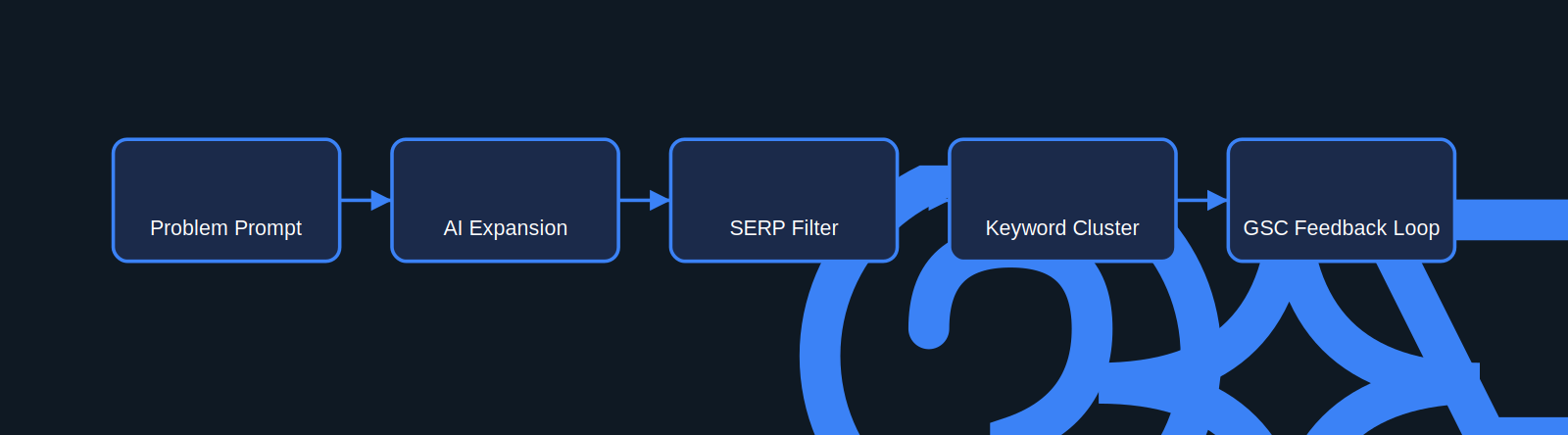
1. Feed AI a problem-framing prompt, not a seed keyword
2. AI generates a long-tail expansion set grouped by user intent and specificity
3. You filter that set through a live SERP check and a difficulty floor
4. Surviving keywords get clustered into topic groups before any content is written
5. Google Search Console feeds back real impression data to refine the next cycle
Output: A prioritized keyword cluster list where every keyword meets four conditions — realistic difficulty for your current authority, clear search intent, cluster fit with related terms, and direct relevance to your offer.
The setup requires approximately 90 minutes to build the prompt library and calibrate the AI output format to your site. The payoff begins when your first cluster article indexes — typically within 4–8 weeks on an active site with basic technical SEO in place.
Why AI Changes the Input Layer for Keyword Discovery
Traditional keyword tools are reverse directories. You give them a phrase and they return volume and difficulty scores. The intelligence is yours — the tool just retrieves data.
AI flips this. You describe a problem, an audience, a constraint, or a use case, and the model generates keyword variations that reflect how real people actually phrase searches. Not the clean, brand-aware terms a marketer would type — the messy, specific, problem-first language a user with an actual need types at 11pm.
There is a specific prompt structure that extracts the most useful output for AI-powered keyword research:
“You are a keyword research specialist. I run [brief site description]. My target audience is [specific audience]. List 30 long-tail keyword variations for the problem of [core problem]. Prioritize phrasing that reflects high purchase intent or specific use cases. Group results by search intent: informational, comparison, and transactional.”
This prompt, run against a problem area rather than a product name, generates phrases your competitors did not think to target because they started from their product, not from their customer’s language.
For example: a site selling project management tools would typically research “project management software.” That is a volume trap — 110,000 monthly searches, dominated by Asana, Monday, and Notion. Run the AI prompt against the problem “remote design teams can’t track async handoffs” and you surface phrases like “design team async workflow tool,” “handoff tracking for remote designers,” and “how to manage design revisions across time zones” — all under KD 20, all with clear commercial intent, none of them crowded.
The AI did not invent those keywords. It expanded from the problem framing you gave it. That is the difference.
The Four-Point Filter: Finding Low-Competition Keywords That Actually Rank
AI output is a starting list, not a final list. This is where operators skip a step and pay for it later.
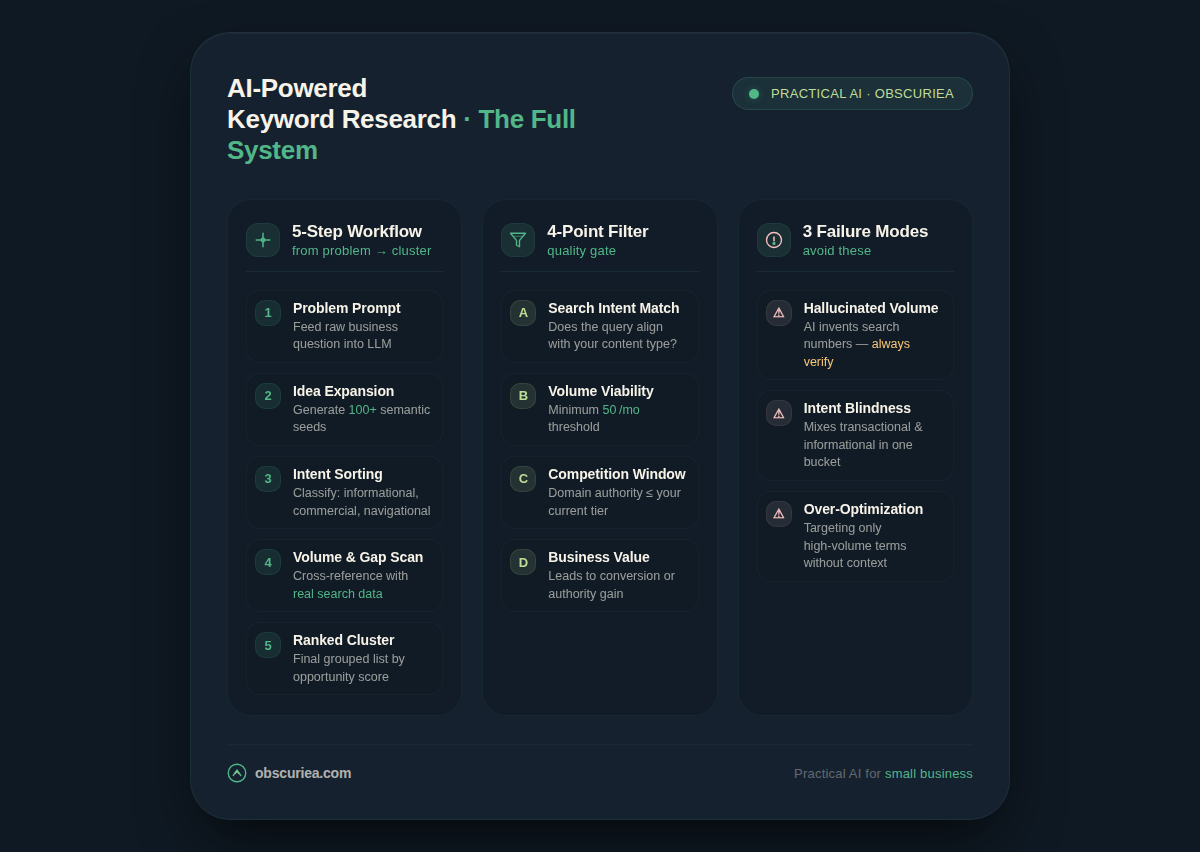
Every keyword the AI generates needs to pass a four-point filter before it enters your production queue:
1. Difficulty floor check. Pull the keyword into Ahrefs, Semrush, or even the free tier of Ubersuggest. For sites under DA 30, target KD scores under 25. For new sites (under 6 months, minimal backlinks), stay under 15. These are not arbitrary cutoffs — they reflect the realistic authority threshold at which your content can compete without an active link-building campaign running in parallel.
2. SERP reality check. Search the keyword manually. Look at who ranks. If the top four results are Reddit threads, Quora answers, or articles from 2019 with thin content — that is a structural gap you can fill. If the top four are HubSpot, Shopify, and two well-resourced niche sites with 3,000-word guides published in the last 12 months, move on. The KD score does not always capture this. Your eyes do.
3. Intent-to-offer alignment. Can you actually create a page that satisfies this intent? A keyword like “free project management template” implies the user wants a downloadable asset — not a blog post. If you cannot produce the content type the SERP is rewarding, the keyword is not yours yet.
4. Cluster membership. A keyword that stands alone is weaker than a keyword that connects to five related terms you can also rank for. Before adding any keyword to your queue, ask: what are the three to five semantically related phrases that belong in the same topic cluster? If you cannot answer that, the keyword probably lacks the topical depth to anchor a content series. AI can help here too — ask it to generate the cluster map around any keyword that survives your first three filters.
Setup Requirements for This AI Keyword Research Workflow
This workflow requires three tools, two of which are free:
- ChatGPT-4o or Claude 3.5 Sonnet — for problem-framing prompts and cluster generation. Either works. Budget approximately $20/month for API or subscription access if you are running this at volume.
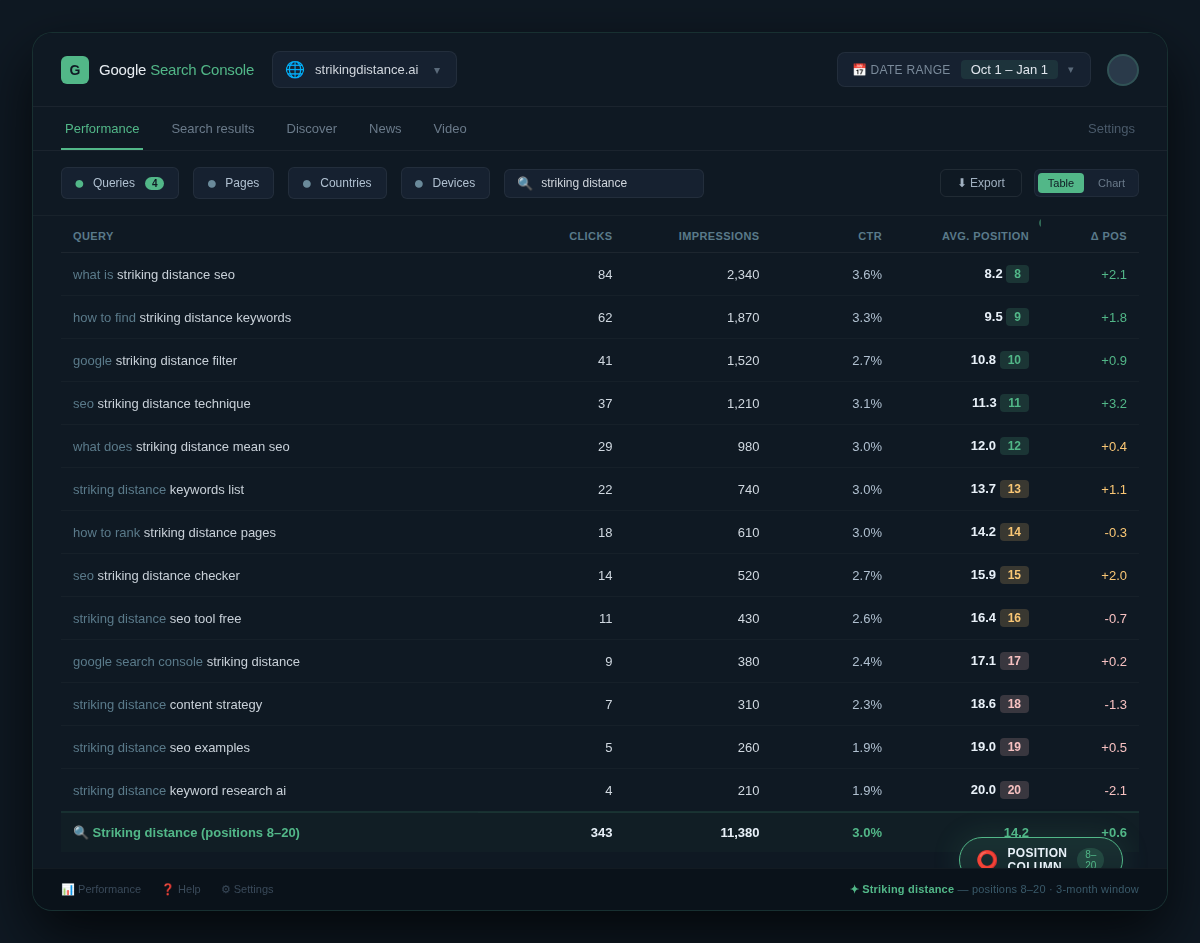
- Google Search Console — free, already essential. Your existing impression data is a keyword goldmine. Any keyword where you rank positions 8–20 and have impression volume is a candidate for a targeted update. Filter for non-branded queries and sort by average position.
- One paid SEO tool with a KD score and SERP overview — Ahrefs Lite ($29/month), Semrush‘s free tier (limited), or Ubersuggest ($12/month). You need this for the difficulty floor check. You cannot reliably skip it.
Technical skill required: low. The prompt engineering is straightforward. The SERP reading is a skill that develops fast — after 10–15 manual checks, pattern recognition kicks in and you get faster.
Time investment: 90-minute setup to build your prompt templates and establish your filtering criteria. Ongoing: 60–90 minutes per keyword research sprint, producing a prioritized cluster list of 15–25 actionable keywords. According to research on long-tail keyword behavior, 91.8% of all search queries are long-tail — this workflow is designed to systematically capture that majority.
Failure Modes in AI-Powered Keyword Research
This automation breaks in three specific ways:
AI hallucinated volume. The language model does not have access to live search volume data. It will sometimes generate keyword phrases that look plausible but have near-zero actual search volume. Always validate every keyword through a real tool before writing. Never assume AI-generated keyword ideas have been volume-checked — they have not.
KD score divergence across tools. Ahrefs, Semrush, and Moz calculate KD differently. A keyword at KD 18 in Ahrefs might score 34 in Semrush. Pick one tool and use it consistently. Do not average across tools — the methodologies are not compatible.
Cluster isolation error. AI is very good at generating variations of a phrase but sometimes groups semantically distant terms into the same cluster. Before publishing a cluster article, manually verify that all target keywords in the cluster share the same core user intent. A page optimized for both “how to brief a designer” and “design brief template download” is targeting two different intent states — one informational, one transactional — and will underperform both.
Search Console lag blindness. GSC data is typically 2–3 days behind, and impression data for new content can take 4–6 weeks to populate meaningfully. Do not make keyword strategy decisions based on GSC data from the first month after publishing. Wait for at least 6 weeks of indexed data before evaluating whether a cluster is working.
For a deeper breakdown of how low-competition keyword scoring works in practice, Outrank’s keyword filtering guide covers the scoring matrix in detail.
The Friction Box
- AI keyword output requires manual SERP validation — it is not a plug-and-play replacement for a research session
- KD scores are approximations, not guarantees — a KD 12 keyword can still have one exceptionally strong incumbent page that you cannot displace
- The 90-minute setup cost is real; plan for it before your first sprint
- Google Search Console data lags by days and takes weeks to become statistically meaningful for new content
- Cluster isolation errors are common in AI output — verify intent alignment manually before writing
- Free tool tiers are often too limited for serious filtering at scale; budget for at least one paid tool
- This workflow compounds over time — the first sprint produces modest results; the sixth sprint produces significantly better ones as your topical authority signals build
The Straight Talk
This workflow is built for operators running content-driven sites with domain authority under 40 who have stopped producing content that ranks and need a systematic way back in. It is also built for anyone setting up a new site who wants to avoid the volume trap from day one.
Skip this if you are already ranking well for your primary terms and just need to refresh existing content — that is a different workflow with a different trigger set.
Your next concrete action: open ChatGPT, run the problem-framing prompt against one specific content category on your site, filter the output through a live SERP check for the top five results, and identify three keywords where Reddit or thin 2020-era content is currently ranking. Those are your first targets. Write those three articles before you do anything else.