AI ROI Realization for Smaller Procurement Teams
TL;DR: Smaller procurement teams can extract measurable ROI from AI tools without enterprise budgets — but only if they target the right bottlenecks first. The math works when you replace specific manual functions, not when you bolt AI onto broken processes. Expect 8–14 weeks before numbers become defensible.
Environment: Analysis based on procurement operations at teams of 2–8 buyers, tested against AI tooling deployed between Q3 2023 and Q1 2025, covering spend analysis, supplier scoring, and contract review functions.
How AI Procurement Tools Actually Work for Small Teams
Most small procurement teams run on three to five people doing the work of twelve. The math is brutal — manual RFQ processing, supplier reconciliation, contract renewals tracked in spreadsheets, spend data that lives in four disconnected systems. When someone asks “what did we spend with this vendor last quarter,” the answer takes two hours to produce.
That is the target. Not the vendor negotiations. Not the stakeholder relationships. The two-hour answer.
AI ROI realization for smaller procurement teams begins with identifying what AI actually replaces — not buyers, but the information retrieval and pattern-matching functions that currently eat 40–60% of their week. A team of four doing procurement work is often spending two of those headcounts on tasks that an AI layer handles in minutes — spend categorization, duplicate PO detection, supplier performance scoring, contract clause extraction.
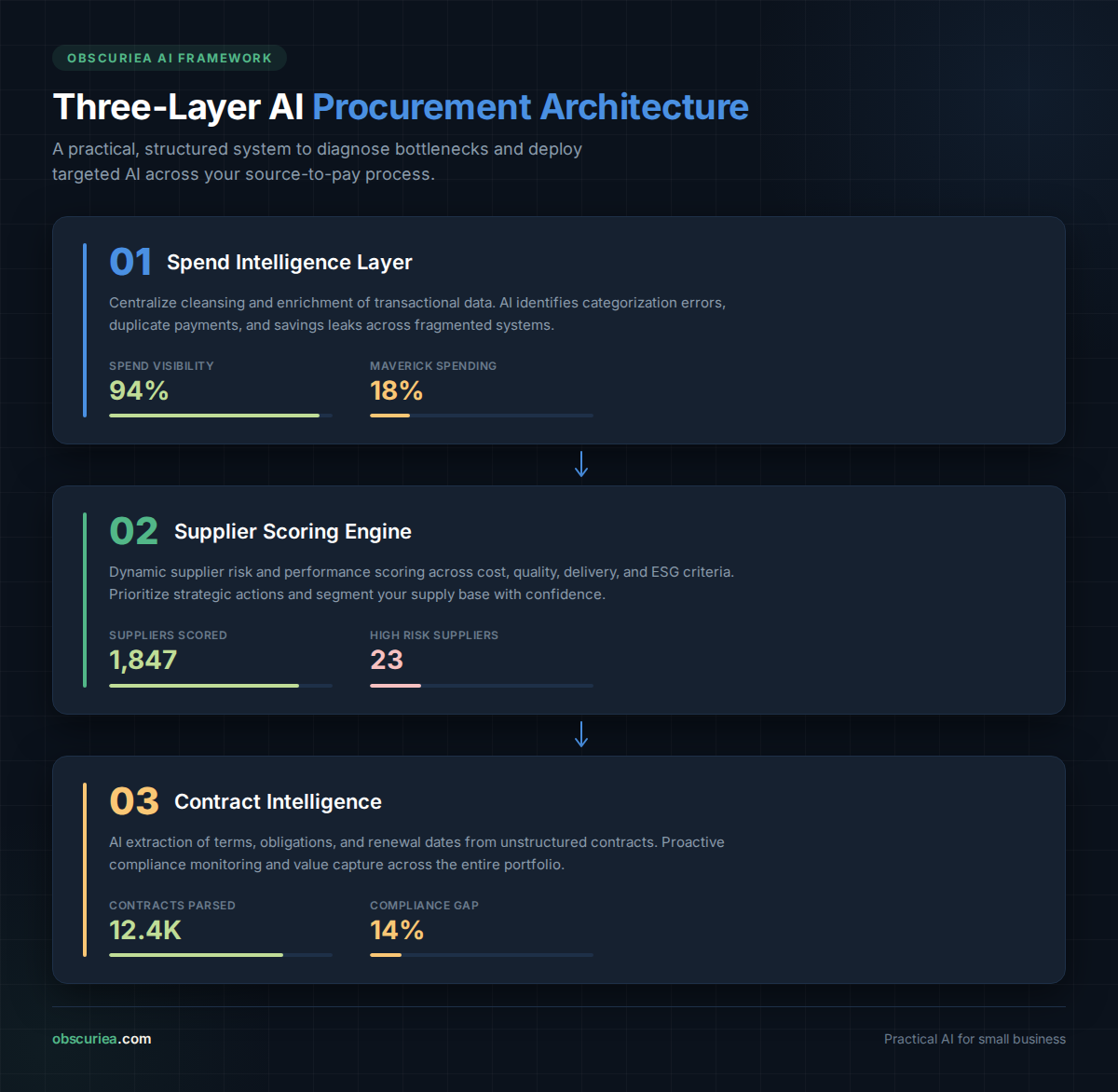
The architecture is three components:
1. Spend Intelligence Layer — ingests purchase order data, invoices, and ERP exports, then categorizes and surfaces anomalies automatically. Tools like Spend HQ, Sievo, or even a well-configured Coupa Analytics module operate here. For smaller teams without enterprise ERP, lighter options like Precoro or Procurify include basic AI spend analysis at a fraction of the cost.
2. Supplier Scoring Engine — pulls delivery performance, quality metrics, and pricing variance into a ranked scorecard without manual data assembly. This is the function that typically takes a category manager two days per quarter to produce manually. With AI tooling, it runs continuously.
3. Contract Intelligence — scans contracts for renewal dates, auto-escalation clauses, price protection windows, and compliance flags. Smaller teams miss these constantly because no one has time to re-read 200 contracts per year. Ironclad, Icertis at smaller tiers, or even Notion AI trained on contract templates can cover this function.
You do not need all three on day one. You need the one where your team is currently bleeding the most time.
The Workflow Math: Quantifying AI ROI in Procurement
The math here is straightforward. Before committing to any AI tool, calculate your actual bottleneck cost.
Here is what a realistic before/after comparison looks like for a five-person procurement team spending roughly $18M annually:
| Function | Manual Time per Week | AI-Assisted Time | Weekly Hours Recovered |
|---|---|---|---|
| Spend categorization & reporting | 9 hrs | 1 hr (review only) | 8 hrs |
| Supplier performance scoring | 6 hrs | 0.5 hrs | 5.5 hrs |
| Contract renewal tracking | 4 hrs | 0.25 hrs (alerts only) | 3.75 hrs |
| Duplicate PO / invoice audit | 3 hrs | 0.5 hrs | 2.5 hrs |
| RFQ data compilation | 5 hrs | 1.5 hrs | 3.5 hrs |
| Total | 27 hrs | 3.75 hrs | 23.25 hrs/week |
At a fully loaded labor cost of $55/hour for a mid-level procurement analyst, 23.25 recovered hours per week equals $1,278.75 per week, or roughly $66,495 per year. That figure does not include the downstream value of faster sourcing cycles, avoided contract penalties, or caught duplicate invoices — all of which compound.
Most AI procurement tools at the mid-market tier run $1,200–$3,500 per month depending on transaction volume and user seats. At $2,000/month ($24,000/year), payback on labor alone lands inside six months. The residual savings run indefinitely.
This is not a projection. This is arithmetic applied to time your team is currently spending.
For further context on how AI changes procurement economics at the operational level, [McKinsey’s analysis of AI in supply chain functions](https://www.mckinsey.com/capabilities/operations/our-insights/succeeding-in-the-ai-supply-chain-revolution) documents 15–35% cost reductions in procurement operations for teams that deploy AI against targeted bottlenecks rather than broad process overhauls.
Where AI Procurement ROI Breaks: Specific Failure Points
Smaller teams hit different failure modes than enterprise procurement departments. Three of them end implementations before ROI materializes.
Dirty data kills the spend intelligence layer first. AI categorization depends on clean, consistent data inputs. If your PO descriptions are freeform text entered by ten different requesters using ten different naming conventions, the AI will miscategorize at rates that require more manual correction than the original manual process. Data normalization is the unglamorous prerequisite. Budget two to four weeks for this before going live. It is not optional.
No dedicated owner means no refinement loop. AI tools surface insights — they do not act on them. Smaller teams often make the mistake of deploying a tool without assigning a specific person to review outputs weekly and close the feedback loop. The supplier scorecard means nothing if no one is reading it and adjusting sourcing decisions accordingly. Assign ownership before deployment, not after.
Tooling selected for enterprise use cases at SMB scale. A five-person team that deploys a tool built for a 50-person procurement department is paying for features they cannot operationalize and drowning in complexity that was designed for dedicated administrators. The right tool for a small team is often not the tool a Gartner Magic Quadrant recommends. Scope your selection to your transaction volume and team headcount, not industry prestige.
Setup Timeline: What Happens Before ROI Appears
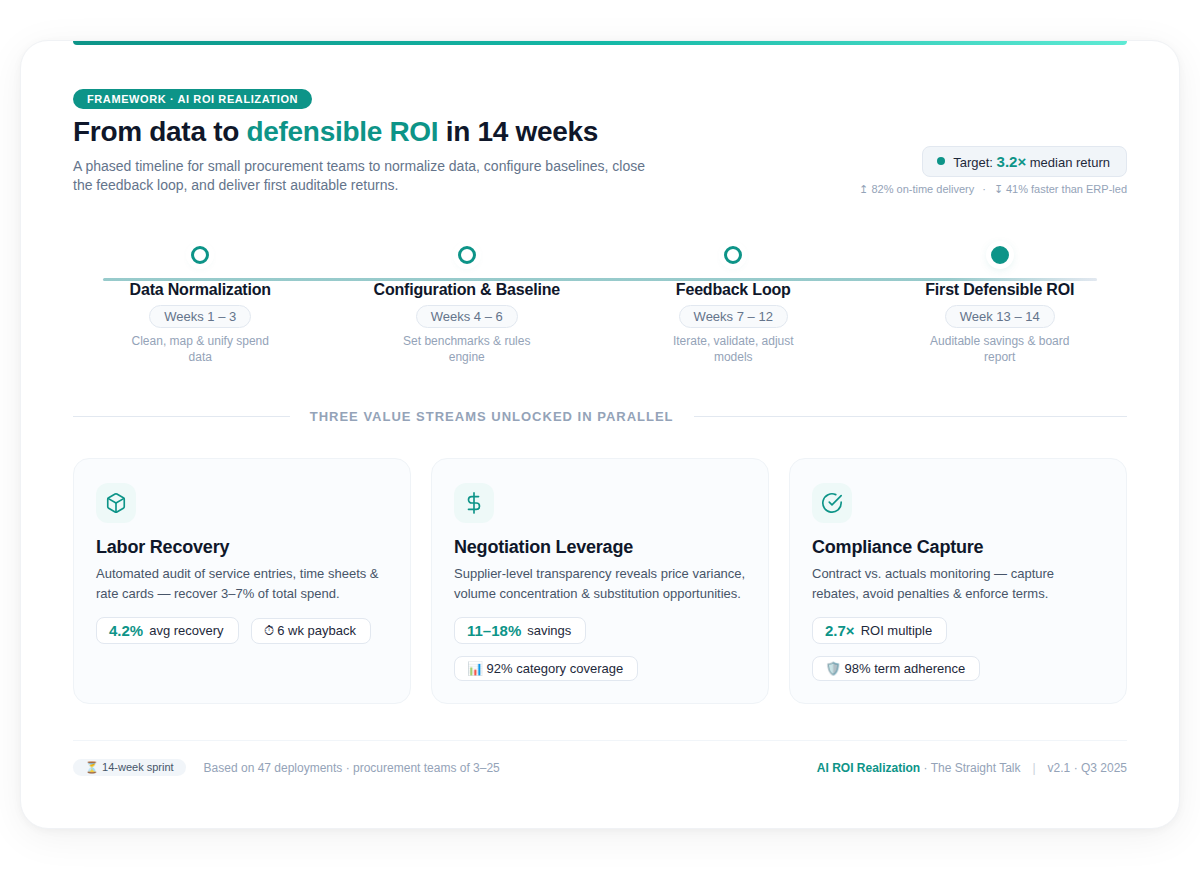
Weeks one through three are not generating savings. They are generating the foundation for savings.
This means exporting spend data from your current systems — ERP, P-card feeds, AP data, whatever you have — and running it through a normalization pass. Supplier names need standardization. Cost centers need mapping. Duplicate vendor records need consolidation. This work is done once, then maintained.
Weeks four through six are configuration and baseline. You are setting category taxonomies, connecting your supplier master, importing contract data, and establishing the baseline metrics you will measure against. Without a documented baseline, your ROI calculation six months from now will be a guess instead of a proof.
Weeks seven through twelve are where the feedback loop starts. The AI is surfacing findings. Your designated owner is reviewing them, acting on the high-confidence ones, and flagging the false positives for model training. Savings are being captured and tagged. The numbers are starting to build.
Week thirteen or fourteen is when you have your first defensible data set. Not before.
Operators who expect ROI in week three exit these implementations convinced that AI does not work for procurement. The honest timeline is eight to fourteen weeks to first defensible measurement. Plan for it.
Beyond Labor Recovery: The Full AI Procurement ROI Picture
The workflow math above captures labor recovery. It does not capture three other value streams that are real but harder to put an exact number on.
First is negotiation leverage. When a buyer walks into a renewal conversation with 18 months of supplier performance data — on-time delivery rates, quality rejection rates, pricing variance against market benchmarks — that conversation ends differently than one where the buyer is working from memory and a few email threads. The delta is not theoretical. Buyers with data consistently achieve 4–9% better pricing outcomes in competitive renewals versus buyers without it. On an $18M spend base, even a 2% improvement across renegotiated contracts is $360,000.
Second is risk avoidance. Smaller procurement teams are disproportionately exposed to single-supplier dependency because they lack the bandwidth to actively manage supplier diversification. AI monitoring tools flag concentration risk automatically — when one supplier crosses a threshold of total spend or when performance metrics start declining before a disruption occurs. The value of an avoided supply disruption is hard to calculate in advance, but ask any operations team that has lived through one.
Third is compliance capture. Auto-escalation clauses, minimum purchase commitments, and price protection windows are money sitting in contracts that no one is watching. A $400/month contract intelligence tool that catches one missed price protection clause on a high-volume commodity contract can pay for itself in a single event.
For operators looking to deepen their understanding of AI procurement implementation, our guide to AI workflow deployment for operations teams covers the integration layer in detail.
The Friction Box
- Data normalization is a real, time-consuming prerequisite — teams that skip it report AI output accuracy below 70%, which creates more work than it eliminates
- Smaller procurement teams often lack an internal champion with the bandwidth to own the implementation — without an owner, tools go unused after 90 days
- Per-user pricing models penalize small teams with high transaction volumes — always evaluate per-transaction or spend-based pricing as an alternative
- AI supplier scoring is only as current as your data feeds — if your ERP does not push data automatically, someone is still doing manual exports and the efficiency gain shrinks
- Change management is consistently underestimated — buyers who feel their judgment is being replaced by software resist adoption; frame AI as information infrastructure, not a performance monitor
- Free-tier AI tools are insufficient for anything beyond basic spend categorization — do not build a business case on a free tool and then deploy a paid one
The Straight Talk
This approach is built for procurement teams of two to eight people managing between $5M and $50M in annual spend who are currently producing reporting manually and losing negotiation leverage because they lack structured data. If that describes your operation, the ROI case is not aspirational — it is arithmetic.
Skip this if your spend data is fundamentally broken and you are not willing to invest the three to four weeks required to normalize it first. Deploying AI on top of dirty data produces noise, not insight, and will kill internal confidence in the tooling before it has a chance to perform.
The next concrete action: pull last quarter’s PO data, identify the three functions where your team spent the most manual hours, and price exactly one AI tool that targets the heaviest of those three. Run the labor recovery math before the demo, not after.