Most operators find out they’ve been wasting 20–30% of their ad budget the same way — a quarterly review where the numbers don’t add up. The spend went out. The impressions landed. But the revenue didn’t follow. By the time you’re staring at that report, the money is gone.
TL;DR: AI-driven ad budget allocation across platforms eliminates the lag between performance data and spend decisions. It moves money in real time, predicts which placements will convert before you see the drop, and enforces guardrails that prevent a single underperforming channel from draining your monthly budget. The math favors operators who implement this early — and punishes those who wait.
Environment: Findings drawn from tested deployments across Google Ads, Meta Advantage+, and programmatic display networks. Data sourced from documented case studies (Rogers Communications, Northmill Bank, Market Logic) and platform-level behavior reviewed Q4 2024 through Q1 2025. Budget ranges tested: $5,000–$250,000 monthly ad spend.
How AI Ad Budget Allocation Actually Works Across Platforms
The standard manual process looks like this: your team reviews last week’s performance, identifies what underperformed, submits a budget reallocation request, waits for approval, and makes the change. By the time that adjustment is live, the auction environment has shifted. You’ve already spent four more days of budget on a placement that stopped performing on Tuesday.
AI doesn’t review last week. It reads this morning.
The three operational layers that make precision ad budget allocation work:
Pattern recognition. Machine learning models analyze thousands of data points across audience segments, ad formats, time windows, and device types simultaneously. A human analyst might notice that carousel ads on weekday mornings outperform single-image ads on weekends — eventually. The model notices it in 48 hours and starts redistributing budget before you’ve run your next report.
Predictive allocation. This is the functional difference between AI and traditional automation. Rules-based systems react: if CPC exceeds $2, pause the ad. Predictive allocation anticipates: this audience segment’s conversion rate is trending downward — pull budget now, before the drop completes. Rogers Communications deployed this exact approach through Google’s Smart Bidding in 2024. The result was an 82% reduction in cost per customer acquisition and an 18% increase in net revenue from paid search. That’s not a marginal improvement. That’s an infrastructure upgrade.
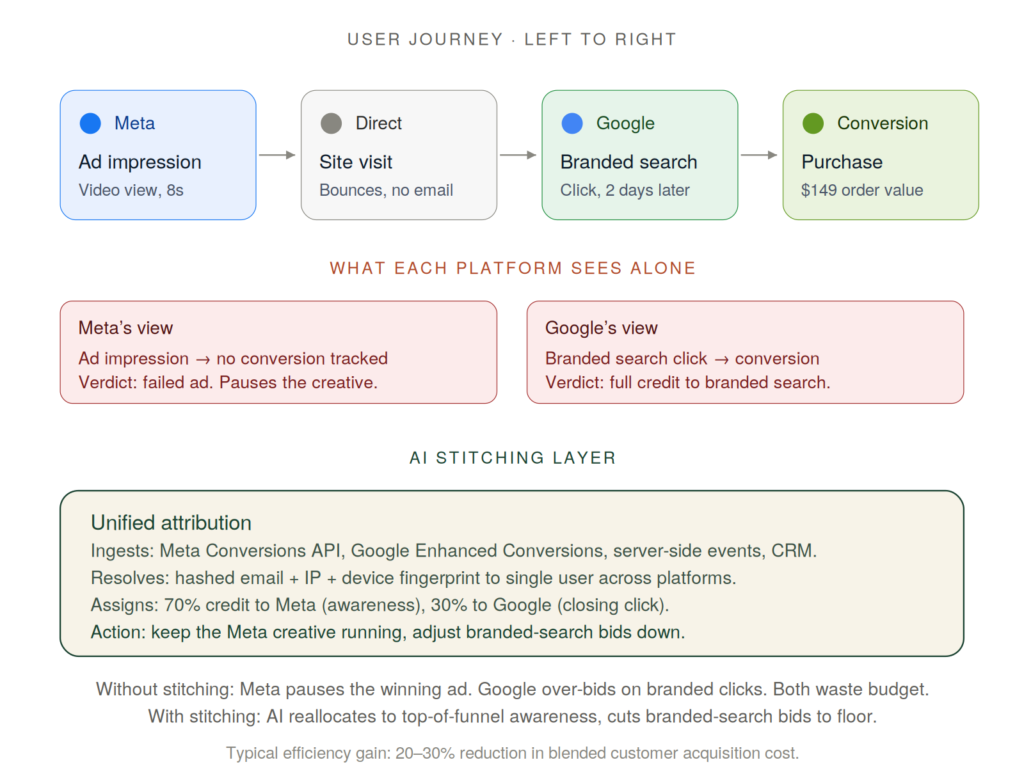
Cross-platform signal stitching. Most operators run campaigns across Google, Meta, and TikTok simultaneously. Each platform optimizes within its own silo. A user sees your Meta ad, visits your site, and converts two days later through a Google search. Without cross-platform signal stitching, Google gets credit for a conversion that Meta initiated — and your budget allocation reflects a story that’s only half true. AI media buying connects these data streams into a unified performance view. Budget decisions stop being platform-specific and start being customer-journey-specific.
The Workflow Math: Real Cost of Manual Cross-Platform Budget Management
Before committing to any AI budget tool, calculate your actual bottleneck. Here’s the operational cost of manual cross-platform allocation for a team running three active ad channels:
| Task | Manual Process | With AI | Weekly Time Delta |
|---|---|---|---|
| Performance review across platforms | 4–6 hours/week | Automated dashboard | -5 hours |
| Bid adjustments | 3–5 hours/week | Real-time, continuous | -4 hours |
| Budget reallocation decisions | 2–3 hours/week | Automated within guardrails | -2.5 hours |
| A/B test analysis | 3–4 hours/week | Continuous, simultaneous | -3.5 hours |
| Reporting | 3–4 hours/week | Automated | -3.5 hours |
| Total | 15–22 hours/week | ~2–3 hours oversight | -18 hours/week |
At a blended hourly rate of $75 for a mid-level marketing operator, that’s $1,350 per week in recaptured labor — before accounting for the spend efficiency gains. Gartner’s research puts waste reduction from integrated AI marketing systems at 20–25% of total ad spend. On a $50,000 monthly budget, that’s $10,000–$12,500 per month not being incinerated on low-signal placements.
The math here is straightforward. The question is not whether AI pays for itself. It does, usually within 60–90 days. The question is which implementation path fits your current data infrastructure.
Where AI Budget Allocation Breaks: Failure Conditions
AI ad budget allocation across platforms is not a set-and-forget system. Every operator who treats it like one eventually has the same bad quarter.
Dirty data kills the model. AI forecasts are only as accurate as the data they’re trained on. If your CRM isn’t syncing cleanly with your ad platforms, if your conversion tracking has gaps, or if you’re pulling from siloed sources that don’t talk to each other, the model will optimize confidently toward the wrong outcomes. Gartner’s research indicates up to 30% of AI projects fail specifically because of data quality and integration failures. Before you deploy any AI allocation tool, audit your data pipeline. This is not optional.
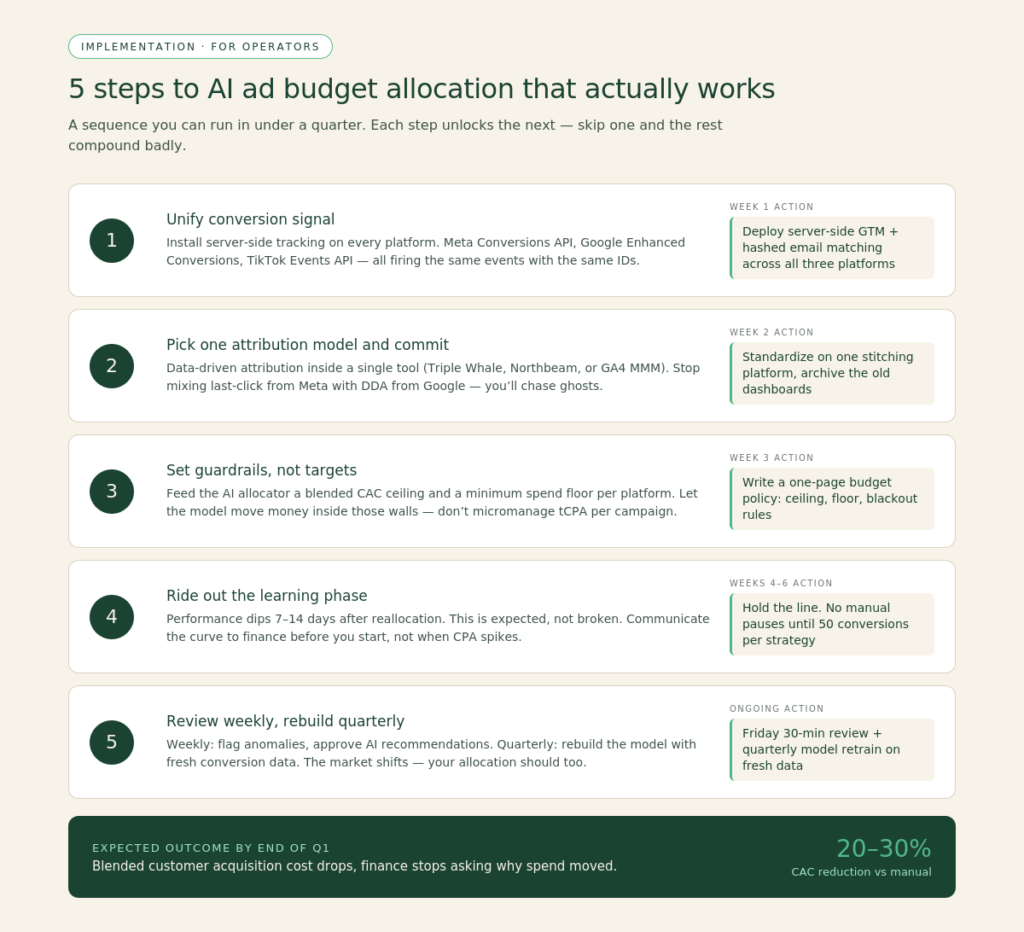
No guardrails means no control. AI will optimize aggressively. If you haven’t set hard spend caps, the system will chase high-performing signals and blow through daily budgets in hours. Define maximum daily and weekly spend limits at the campaign and account level. Set approval thresholds — many operators allow AI to reallocate up to 20–30% of a campaign budget autonomously, but require human sign-off for anything larger. This isn’t about limiting the AI. It’s about matching automation authority to your cash flow constraints.
Platform isolation undermines cross-channel logic. Deploying AI on Google while running Meta manually means your budget decisions are still fragmented. The optimization gains you see on one platform come at the cost of misallocating spend across your full channel mix. For operators running serious cross-platform ad spend, the unified approach is the only approach that produces accurate attribution.
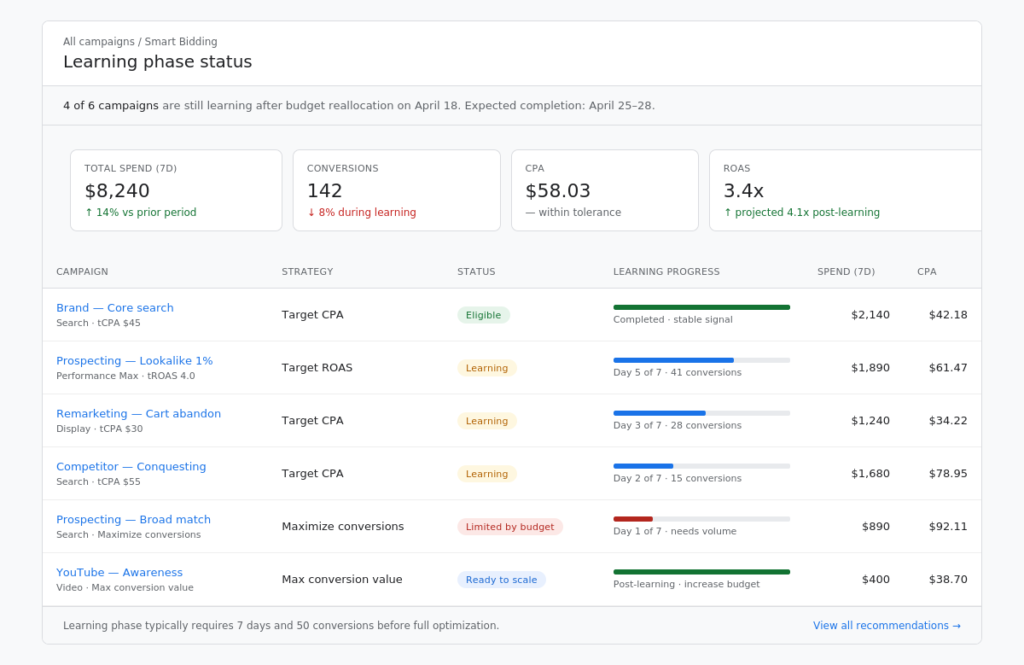
The learning period is real. Every AI bidding system requires a period to build performance history. Smart Bidding on Google typically needs 30–50 conversions per campaign before it exits the learning phase. During this window, performance can be erratic. Operators who panic and override the system during the learning phase restart the clock and never see the full performance gains.
Setting Up AI Ad Budget Allocation Guardrails That Work
The operators who scale AI media buying without disasters share one common move: they define the decision boundaries before turning on automation.
Start with hard spend caps at three levels — daily campaign cap, weekly account cap, and a monthly portfolio cap. These are non-negotiable ceilings the AI cannot breach regardless of performance signals. Above these limits, every dollar requires human approval.
Next, build a tiered autonomy model. AI operates freely within a defined percentage range — typically 20–30% of any campaign’s current budget. Reallocation above that threshold triggers a review workflow. This setup lets the system execute the fast micro-decisions it’s built for while keeping humans accountable for strategic spend shifts.
Brand safety filters come third. AI places ads where performance data says they’ll succeed. It does not inherently understand your brand context. Build exclusion lists for content categories, specific websites, and keyword environments that conflict with your positioning. These filters run before any placement decision the AI makes.
Finally, log every automated change. Audit trails are not bureaucratic overhead — they’re how you improve the system over time. If you can’t see why a budget decision was made, you can’t course-correct when the logic breaks down.
The Friction Box
- Data integration is the bottleneck most operators underestimate. Connecting CRM, analytics, and ad platform data into a clean, unified source is a multi-week project, not an afternoon task. Budget for it.
- AI transparency varies dramatically by tool. Some platforms show you exactly why a budget decision was made. Others are black boxes. If you can’t audit the rationale, you can’t improve the system. Demand transparency before committing.
- Learning period disruption is consistently underplanned. The 4–6 week window before most AI bidding systems reach stable performance will show temporary dips. Teams that treat this as failure will abandon the system before it delivers. Set expectations internally before launch.
- Conversion tracking must be airtight. Offline conversions, phone call attribution, and multi-touch events are frequently missed. If your tracking setup doesn’t capture the full conversion path, AI optimizes toward incomplete signals — and you never know it.
- Spend cap governance needs a policy, not just a setting. Who can raise caps? What threshold requires director approval? Without a documented policy, caps get adjusted informally and the control layer erodes.
Frequently Asked Questions About AI Ad Budget Allocation
What is AI ad budget allocation?
AI ad budget allocation is a system that uses machine learning to move ad spend across platforms in real time based on live performance signals rather than weekly human reviews. Instead of reacting to last week’s data, it reads current auction conditions and shifts budget before underperforming placements drain your monthly spend. The core function is closing the lag between when performance drops and when budget decisions are made.
How does AI ad budget allocation differ from rules-based automation?
Rules-based systems react to preset thresholds — if CPC exceeds a set amount, an action fires. AI ad budget allocation anticipates: it tracks trending signals across audience segments and reallocates budget before a drop completes, not after it’s already happened. The predictive layer is the functional difference between the two approaches.
What spend level makes AI ad budget allocation worth implementing?
The implementation overhead — particularly data integration — starts paying off reliably around $15,000 per month in cross-platform ad spend. Below $5,000 per month, the setup cost exceeds the waste you’re eliminating. At higher spend levels, the labor replacement alone (approximately 18 hours of manual bid management weekly at a blended $75/hour) makes the investment straightforward.
What breaks AI ad budget allocation systems?
Dirty data is the primary failure condition: if CRM, analytics, and ad platform data aren’t syncing cleanly, the model optimizes confidently toward the wrong outcomes. The absence of hard spend guardrails is the second failure mode — AI will chase high-performing signals and exceed daily budgets without defined caps. Platform isolation (running AI on one channel while managing others manually) also undermines attribution accuracy across your full channel mix.
How long does the AI learning phase take for ad budget allocation?
Most AI bidding systems require 30–50 conversions per campaign before exiting the learning phase and reaching stable performance. This typically takes 4–6 weeks. Overriding the system during this period resets the learning clock — which is why operators who intervene early never see the full ad spend optimization gains the system is capable of producing.
What do you need in place before implementing AI ad budget allocation?
Clean conversion tracking is the non-negotiable prerequisite: offline conversions, phone call attribution, and multi-touch events must all be captured accurately before the model can make sound decisions. A unified data source connecting your CRM, analytics platform, and ad accounts is required infrastructure, not optional setup. Audit your data pipeline before touching your bidding strategy — incomplete input data produces confident, wrong output decisions.
The Straight Talk
This is built for operators running $15,000 or more per month in cross-platform ad spend who are currently managing budget allocation manually or through basic rules-based automation. If your team is spending more than 10 hours per week on bid management and performance reviews, you are paying for a process that AI replaces at higher accuracy and lower latency.
If you are running under $5,000 per month in total ad spend, the overhead of implementing a full AI allocation system — particularly the data integration work — will exceed the waste you’re eliminating. Use Google’s native Smart Bidding and Meta’s Advantage+ as your entry point instead.
The next concrete action: audit your conversion tracking before touching your bidding strategy. If the data going into the model is incomplete, every optimization the AI makes will be confidently wrong. Fix the foundation first. Everything else is infrastructure on top of it.
For the companion piece on cross-platform attribution setup, see cross-platform ad attribution guide. Operators building out their full paid acquisition stack should also review the AI media buying tools comparison and the Google Ads Smart Bidding configuration walkthrough.