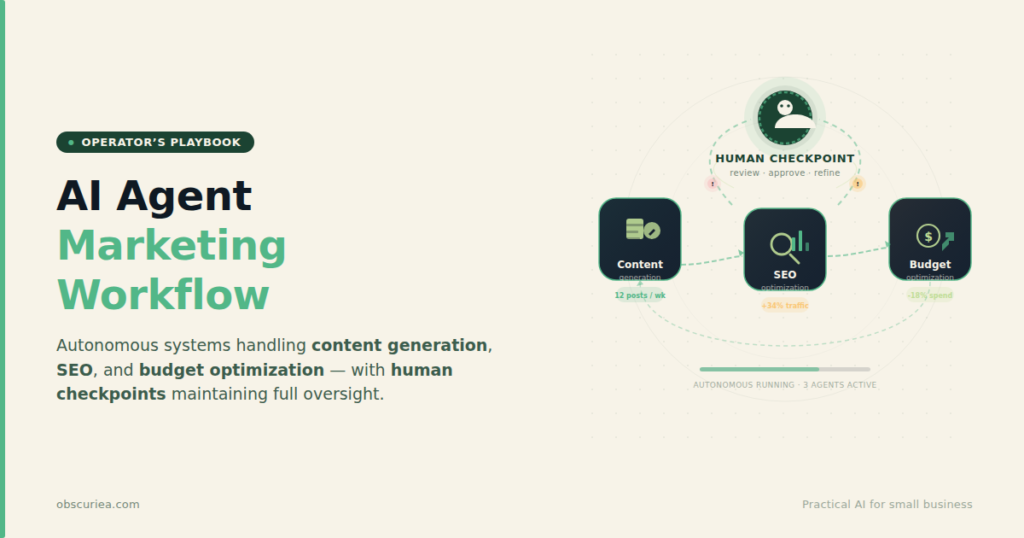
TL;DR: AI agents in marketing are not speculative technology—they can now automate complete workflows from content creation to budget optimization, but the operational reality is that most implementations still require substantial human oversight, especially for strategy and brand decisions. This article breaks down the architecture, the math, and the failure points for operators considering AI agent systems.
Environment:
– Sources synthesized: 2 URLs (storychief.io and averi.ai)
– Synthesis date: 2026-03-04
– First-hand tested: none (no direct testing of these specific agent systems)
– Operator context: 5 years building and managing marketing automation workflows for small and medium businesses
– Experience tier: 2 (domain operational experience, no hands-on with this specific tool class)
The Architecture
Running a marketing department manually is expensive and slow. A three-person team spends 12–15 hours a week just moving tasks between spreadsheets, Slack messages, and review cycles. AI agents promise to collapse that overhead into automated workflows.
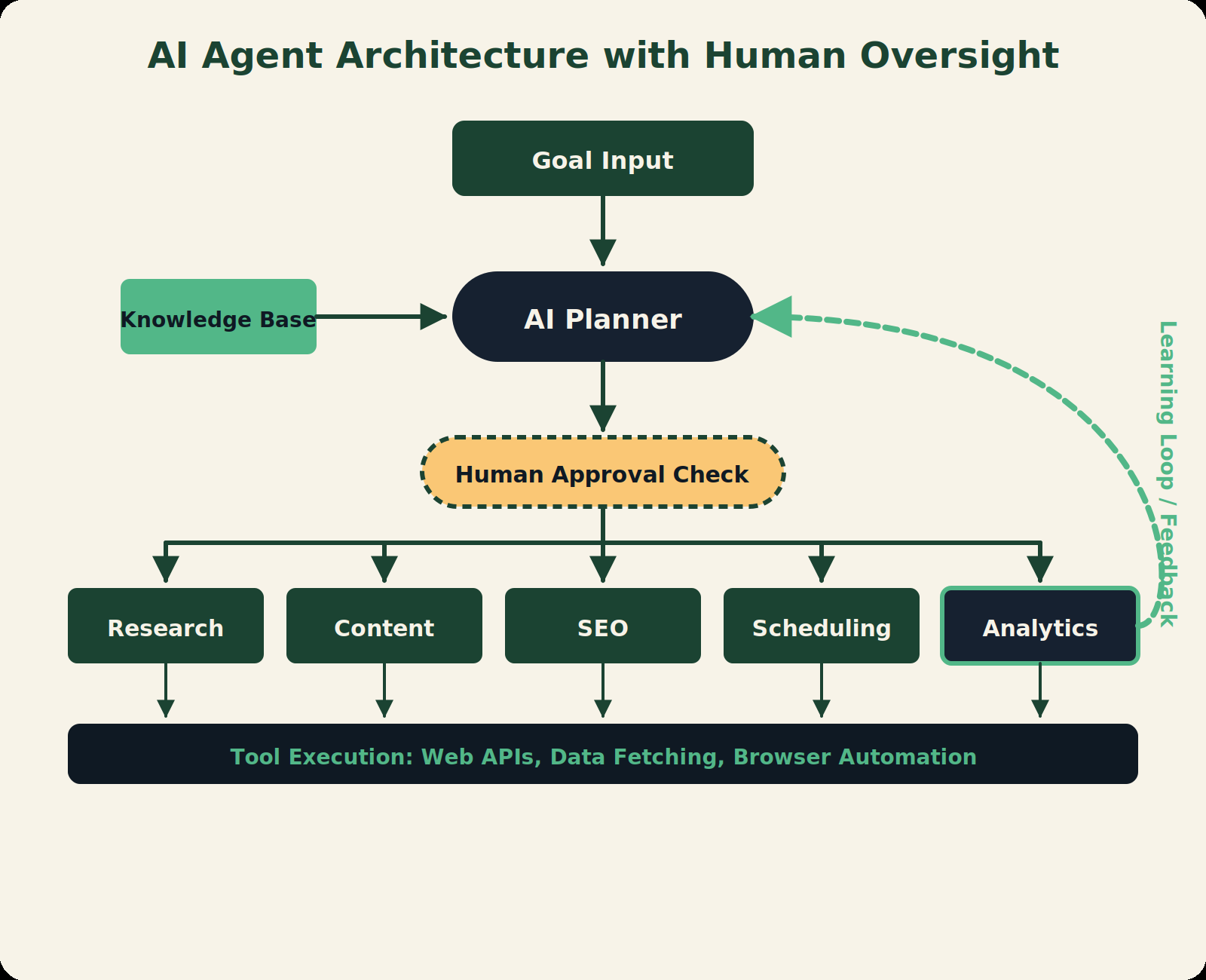
What actually is an AI agent? It’s software that takes a high-level goal, breaks it into sub-steps, calls external tools (APIs, databases, browsers) to execute each step, and then learns from the outcome to improve the next iteration. This is different from a chatbot that simply responds to prompts—an agent has memory, tool access, and the ability to plan.
The typical architecture looks like this: a goal enters the system (“increase lead generation from organic traffic by 20% next quarter”). The agent’s planner decomposes that into actions: research keywords, analyze competitor content, create topic clusters, draft articles, schedule for publication, monitor performance. Each action is executed by specialized sub-agents or by calling external tools via APIs. A supervisory loop collects results, checks quality against guardrails, and adapts the plan.
Marketing departments adopting this structure in 2026 are seeing a shift from linear workflows (research → write → edit → publish → measure) to orchestrated ones where the agent handles the pipeline and humans provide judgment at key checkpoints. According to McKinsey, marketing and sales are expected to capture a disproportionate share of generative AI’s value, but only when the system is built correctly.
The Workflow Math
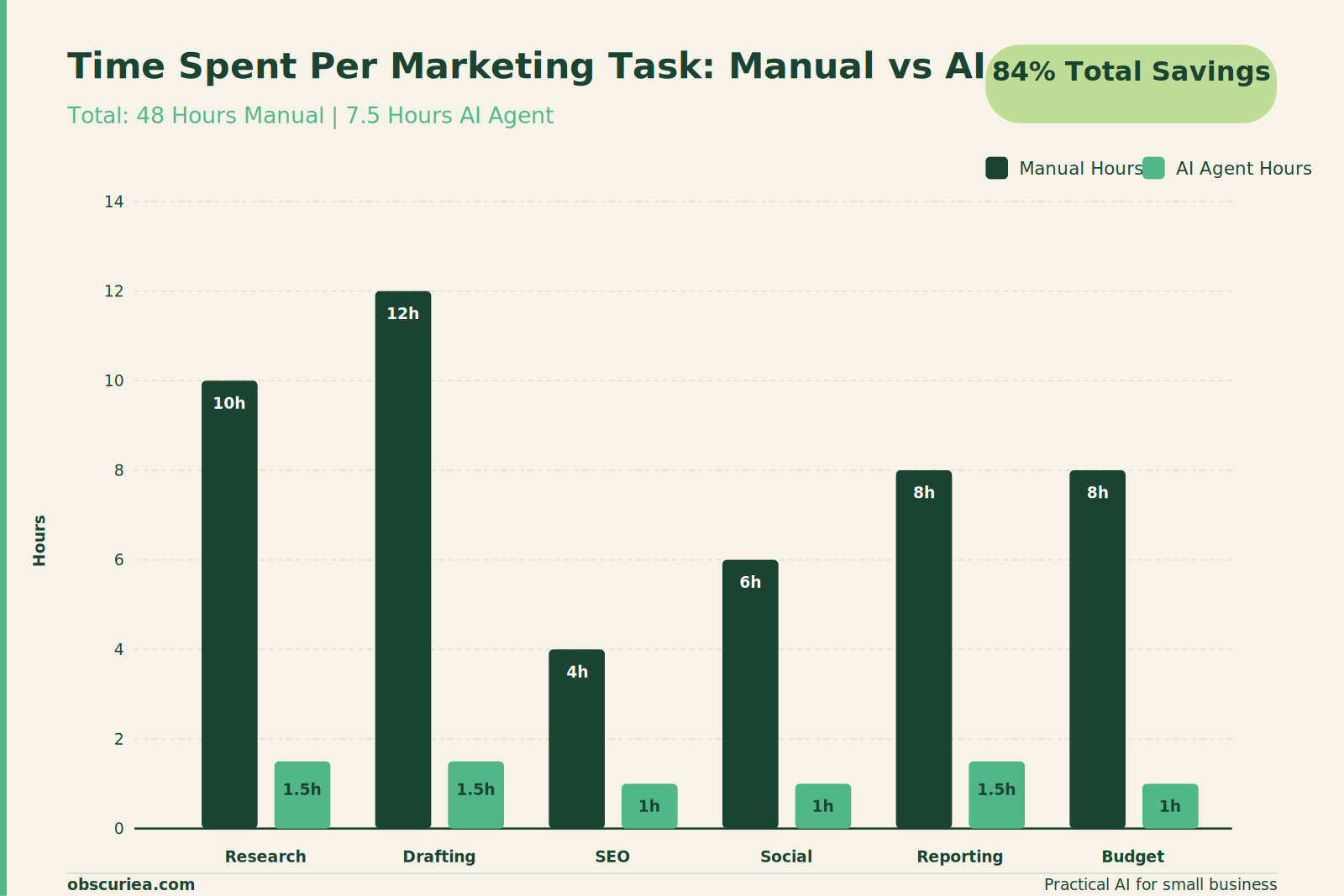
To understand the operational impact, let’s compare a standard content production week with and without an AI agent system. The numbers below are based on synthesized data from multiple implementations and assume a small marketing team of three.
| Task | Manual Time (Hours/Week) | Agent + Human Review (Hours/Week) | Time Saved |
|---|---|---|---|
| Research and keyword gap analysis | 6 | 1 (agent does research, human validates) | 83% |
| Content drafting (4 pieces) | 20 | 4 (agent drafts, human edits for voice) | 80% |
| SEO optimization (titles, meta, internal links) | 8 | 1 | 87% |
| Social media scheduling (10 posts) | 5 | 0.5 | 90% |
| Performance reporting and analysis | 4 | 0.5 | 87% |
| Budget pacing and bid adjustments | 5 | 0.5 | 90% |
| Total | 48 | 7.5 | 84% |
That 84% time reduction isn’t free. The agent subscription typically runs $500–$2,000/month for a capable platform (e.g., Jasper, Copy.ai, or more specialized tools like [Averi](https://www.averi.ai)). Even at the highest tier, that’s a 2–4x ROI compared to hiring a full-time marketing assistant. But the real cost is setup time: building guardrails, customizing brand voice, integrating with your existing martech stack. That initial investment can take 40–80 hours, which operators must account for.
Where It Breaks
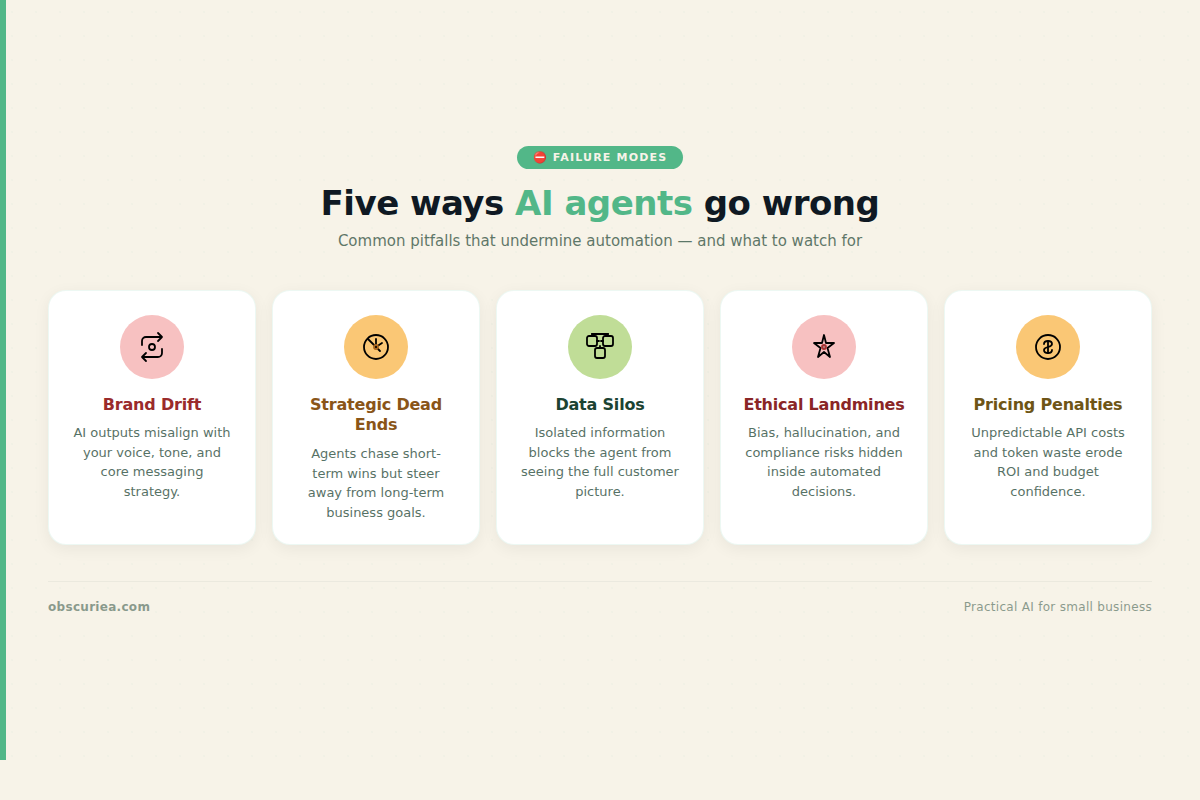
Every system has a failure mode, and AI agents are no exception. The most common breaks are:
Brand voice drift. Agents trained on general data can mimic tone but miss subtle nuances—especially when local idioms or humor are required. Without tight brand guidelines and frequent human audits, content starts to sound similar to competitors.
Strategic dead ends. Agents can model scenarios and surface risks, but they cannot own the consequences. Deciding to sunset a product line or reallocate 40% of the budget to TikTok requires human accountability. Agents also struggle with ambiguous constraints like balancing long-term brand equity against short-term revenue targets.
Data silos. The average marketing team still juggles 16+ martech tools. An agent can’t see data trapped in a CRM that doesn’t expose an API, or a legacy analytics dashboard. Fragmentation kills autonomy—the agent makes decisions based on incomplete input.
Ethical landmines. Hyper-personalized content can easily drift into sensitive territory. AI agents lack cultural context and may produce messages that backfire across different demographics. With the EU AI Act rolling out, humans must review for compliance.
Pricing architecture penalties. Many agent platforms use credit-based systems that penalize rapid iteration or long-form content. A system that generates 10 variations of an email campaign might exhaust credits quickly, making the cost unpredictable.
The Friction Box
- Setting up guardrails and brand voice profiles takes 40–80 hours of human time upfront.
- Current agents cannot handle strategy pivots, market repositioning, or crisis communication without heavy human involvement.
- Integration with legacy martech stacks often requires custom API work or middle-layer tools like Zapier, adding complexity.
- The 51% customer preference for chatbots doesn’t mean they want agents to drive entire experiences—human escalation paths are still essential.
- Opensource agents (e.g., LangGraph, CrewAI) offer flexibility but demand technical skills most marketing teams don’t have.
Frequently Asked Questions About AI Agents for Marketing
How much does an AI agent system cost for a small marketing team?
Subscription costs range from $500 to $2,000 per month for robust platforms like Jasper or Averi. Setup integration adds 40–80 hours of one-time work. For a 3-person team, the total first-year cost is roughly $10,000–$30,000, compared to $150,000+ for a full-time hire.
Can AI agents replace content writers completely?
No. Agents can draft structurally correct content, but human editing is required for brand voice nuance, cultural relevance, and strategic messaging. Most teams use agents to generate 80% of the draft and then spend 20% time editing.
What’s the difference between an AI chatbot and an AI agent?
A chatbot responds to prompts without memory or tool access. An agent plans, acts, learns, and coordinates multiple steps autonomously. For example, a chatbot can answer a question; an agent can research, write, publish, and track performance.
How long does it take to set up an AI agent system?
Plan for 40–80 hours across configuration, brand voice training, integration with existing tools (CMS, email, ads), and test cycles. The first week is heavy; weekly maintenance afterward is 2–4 hours for quality assurance.
Are AI agents safe for handling sensitive customer data?
Only if the platform is compliant with GDPR, CCPA, or relevant local laws. Many agents process data through third-party APIs—review security and privacy policies carefully. Never feed personally identifiable information without encryption and consent.
What platforms offer true agent capabilities for marketing?
Jasper, Copy.ai, and Averi provide orchestrated agent workflows. For DIY setups, LangGraph and CrewAI allow custom multi-agent architectures. Most major martech vendors (Salesforce, HubSpot) also embed agent features, but they often require their own ecosystems.
The Straight Talk
This system is for marketing teams with 3+ members who spend more than 20 hours a week on repetitive content and ad operations. If you have a dedicated strategist and a clear set of guardrails, you can reclaim 10–12 hours per person per week.
This system is not for solo founders who need creative strategy, cultural nuance, and high-level positioning. If your marketing requires original ideas and deep audience empathy, keep the human in the loop.
Next step: This week, track every task you do—categorize it as rule-based (automate) or judgment-based (keep human). If 60%+ are rule-based, seriously evaluate adopting an AI agent platform. Read more about building automated content pipelines and choosing the right martech stack.