TL;DR
Automated job description writing saves hours and cuts bias, but only when implemented correctly. The math works best for high-volume hiring environments. For niche or culture-critical roles, human editing is non-negotiable.
Environment
– Sources synthesized: 3 URLs (Ongig.com, Joysuite.com, Bizworkhq.com)
– Synthesis date: 2026-04-14
– First-hand tested: none
– Operator context: analysis of business hiring workflows and HR technology stacks
The Architecture
Every growing company hits the same wall. The CEO wants to hire three people. The hiring manager sends a list of requirements that’s two pages long. HR pastes it into a template, runs spellcheck, and posts it. The result? Ninety-seven applications, zero qualified candidates.
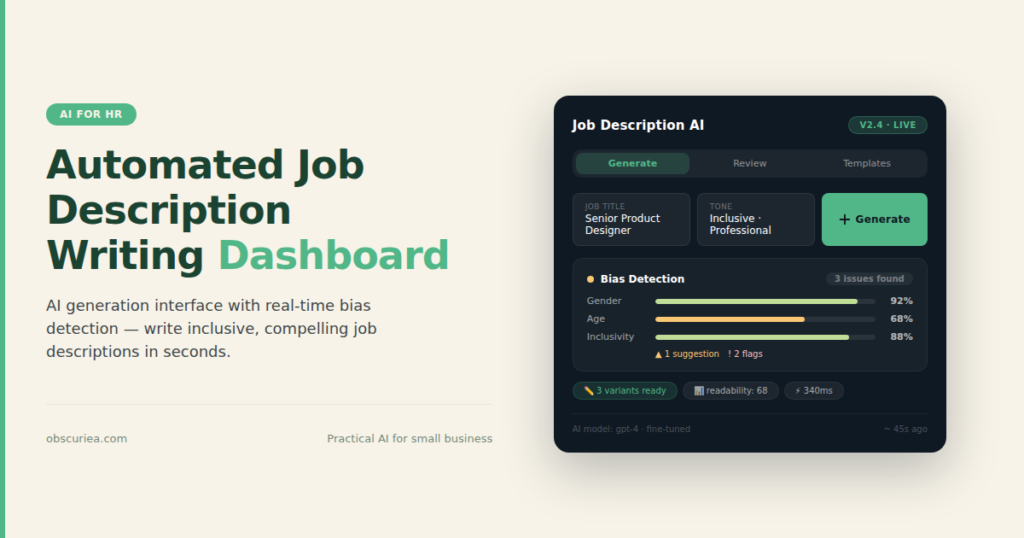
Automated job description writing solves this by replacing the template-and-paste workflow with a structured generation process. Here is how it works.
First, you feed the system a job title and a few key details—department, required skills, experience level. The AI draws from its training data and your company’s historical job descriptions to produce a structured draft. It includes standard sections: role overview, responsibilities, qualifications, benefits, and culture notes.
Next, the tool runs optimization passes. It scores the text for readability, checks for gender-biased language, and flags industry jargon that might alienate good candidates. Some tools also plug in compliance checks—ensuring the description meets OFCCP guidelines or local labor laws.
Finally, you review, edit, and export. The system can push directly to your applicant tracking system (ATS) or export as PDF, Word, or HTML.
The entire cycle takes 15 to 30 minutes, compared to the 2 to 4 hours a manual process requires. But the architecture hides a few dependencies. The quality of the output depends entirely on the quality of the input. If you feed vague bullet points, the AI will generate vague paragraphs. Garbage in, garbage out—even with advanced language models.
For a broader look at how automation fits into modern recruitment, see our recruitment automation overview.
The Workflow Math
Let’s quantify the difference. Assume a company that posts 50 new job descriptions per year, each requiring 3 hours of manual work (including research, drafting, review, and approval). At a blended labor rate of $50 per hour (HR coordinator + hiring manager time), each JD costs $150. The annual cost: $7,500.
An automated tool with monthly subscription of $200 (typical for mid-tier platforms like Ongig’s Text Analyzer) costs $2,400 per year. Time per JD drops to 30 minutes. Labor cost per JD: $25. So the total automated cost per JD is about $25 (labor) plus $4 (tool amortization) = $29. Annual cost: $1,450 plus subscription.
That is a 5x reduction in cost per job description. For companies hiring 100+ roles per year, the savings exceed $30,000 annually—enough to fund an extra recruiter.
| Metric | Manual | Automated |
|---|---|---|
| Time per JD | 3 hours | 0.5 hours |
| Labor cost per JD | $150 | $25 |
| Tool cost per JD (annual subscription ÷ 50) | $0 | $48 |
| Total cost per JD | $150 | $73 |
| Annual cost (50 JDs) | $7,500 | $3,650 |
But the math changes at lower volumes. If you only write 10 job descriptions a year, manual cost is $1,500. Automated cost: $250 labor + $240 tool = $490. Savings exist, but the tool might not be worth the learning curve.
According to a [CareerPlug report](https://www.careerplug.com/), 52% of job seekers turn down offers due to poor hiring experiences—a problem well-written JDs can help solve.
Where It Breaks
Automation fails in predictable ways. When the AI receives sparse input, it defaults to generic language. “Collaborate with cross-functional teams” appears in 90% of AI-generated job descriptions. Candidates scroll past because they’ve seen that phrase a thousand times.
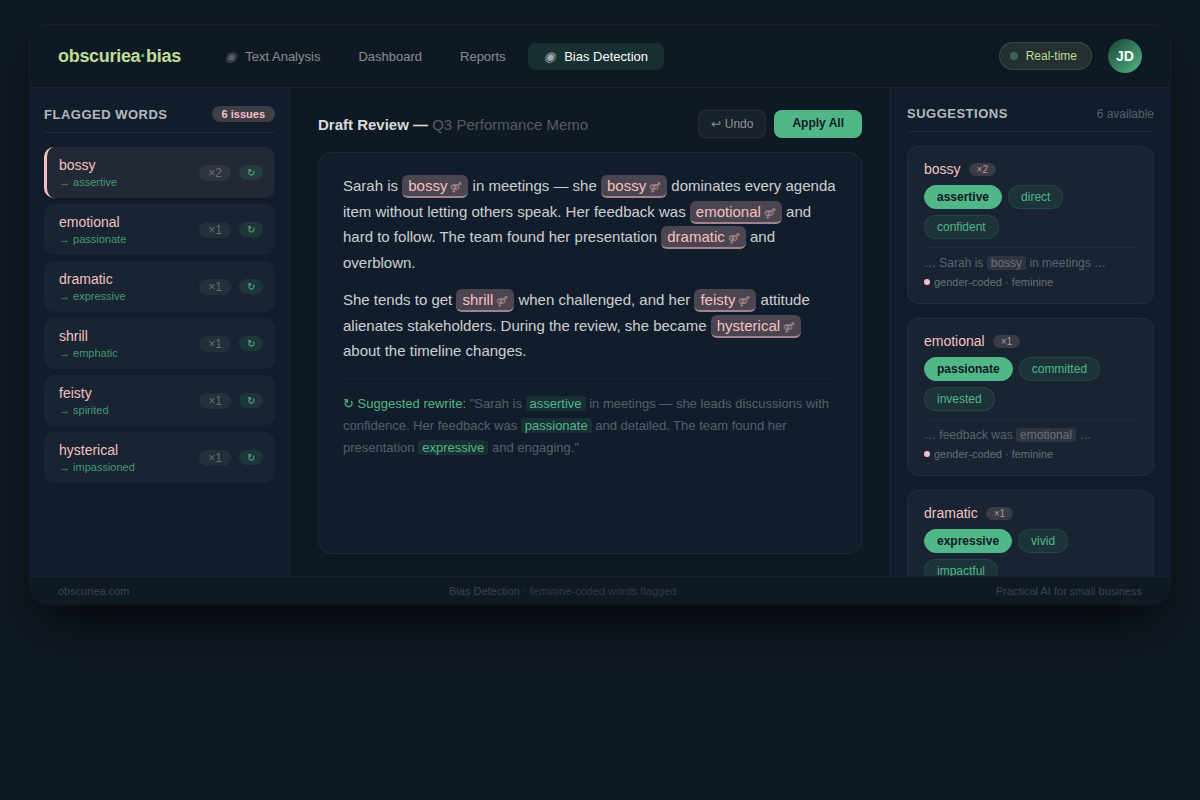
Bias detection can backfire. Tools flag certain words as masculine or feminine, but context matters. “Aggressive growth targets” might be flagged as masculine, but in a startup environment, that phrase accurately describes the work. Over-reliance on automated bias removal can strip your job descriptions of personality.
ATS optimization presents another trap. Some tools stuff keywords to guarantee ATS ranking. But human readers notice when a job description reads like a keyword salad. You lose the candidates who matter.
Integration with existing systems is rarely seamless. Older ATS platforms require manual export and import. API integrations carry additional costs. The time saved on writing is spent on technical setup.
Finally, culture transfer suffers. No AI can capture the smell of a team: the inside jokes, the shared rituals, the way decisions actually get made. For roles where culture fit is critical, automated descriptions must be heavily customized. If you skip that step, you attract candidates who match a database entry, not a real team.
The [Ongig blog](https://blog.ongig.com/job-descriptions/automated-job-description-builder/) documents how their Text Analyzer handles bias detection, but it also notes the need for human review.
The Friction Box
- Most automated tools require a monthly subscription—even months when you’re not hiring.
- Input quality directly dictates output quality; you still need a human who understands the role.
- Compliance features are US-centric; handling Indonesian labor law (e.g., BPJS, UU Cipta Kerja) requires custom configuration.
- Bulk updates across hundreds of JDs risk losing carefully crafted language that differentiated your employer brand.
- Free AI tools (ChatGPT, Claude) can generate text, but lack the structured workflow, scoring, and integration that dedicated platforms offer.
Frequently Asked Questions About Automated Job Description Writing
How much does an automated job description tool cost?
Dedicated platforms start at around $100 per month and go up to $500 per month for enterprise plans with API integration and compliance modules. Per-seat pricing is common. Free trials usually last 7 to 14 days.
Will AI-generated job descriptions pass ATS filters?
Yes, if the tool includes ATS optimization features. Look for keyword suggestion and format compatibility with major ATS platforms like Greenhouse, Lever, and Workable. But over-optimization can hurt human readability—balance is key.
Can I use free AI tools like ChatGPT instead?
You can, but you lose the structured workflow. You’ll need to manually prompt, edit, format, and check for bias. For one-off JDs, free tools work fine. For ongoing high-volume hiring, the dedicated platform pays for itself.
How do I ensure the job descriptions still sound like my company?
Customize the tool’s tone settings and provide examples of your best past JDs. Always edit the final draft. The best approach: use AI for the heavy lifting, then apply your human touch for voice and culture specificity.
What about compliance with local labor laws?
Check whether the tool supports your jurisdiction. US tools focus on OFCCP. For Indonesia, you may need to manually add compliance notes regarding mandatory benefits, working hours, and language requirements. Some enterprise tools allow custom compliance rules.
Can automation handle multiple languages?
Most dedicated platforms support English only. Some global tools offer multi-language, but quality varies. If you need bilingual JDs (English + Bahasa Indonesia), you may need to translate manually or use a separate tool. Learn more about localization strategies for HR.
How long does it take to set up an automated job description system?
With a dedicated platform, expect 1-2 hours including ATS integration and template setup. Customizing tone and compliance rules can take a full day. Most providers offer onboarding support.
The [Joysuite guide on writing JDs](https://www.joysuite.com/blog/write-job-descriptions-attract-right-candidates/) offers practical tips alongside automation recommendations.
The Straight Talk
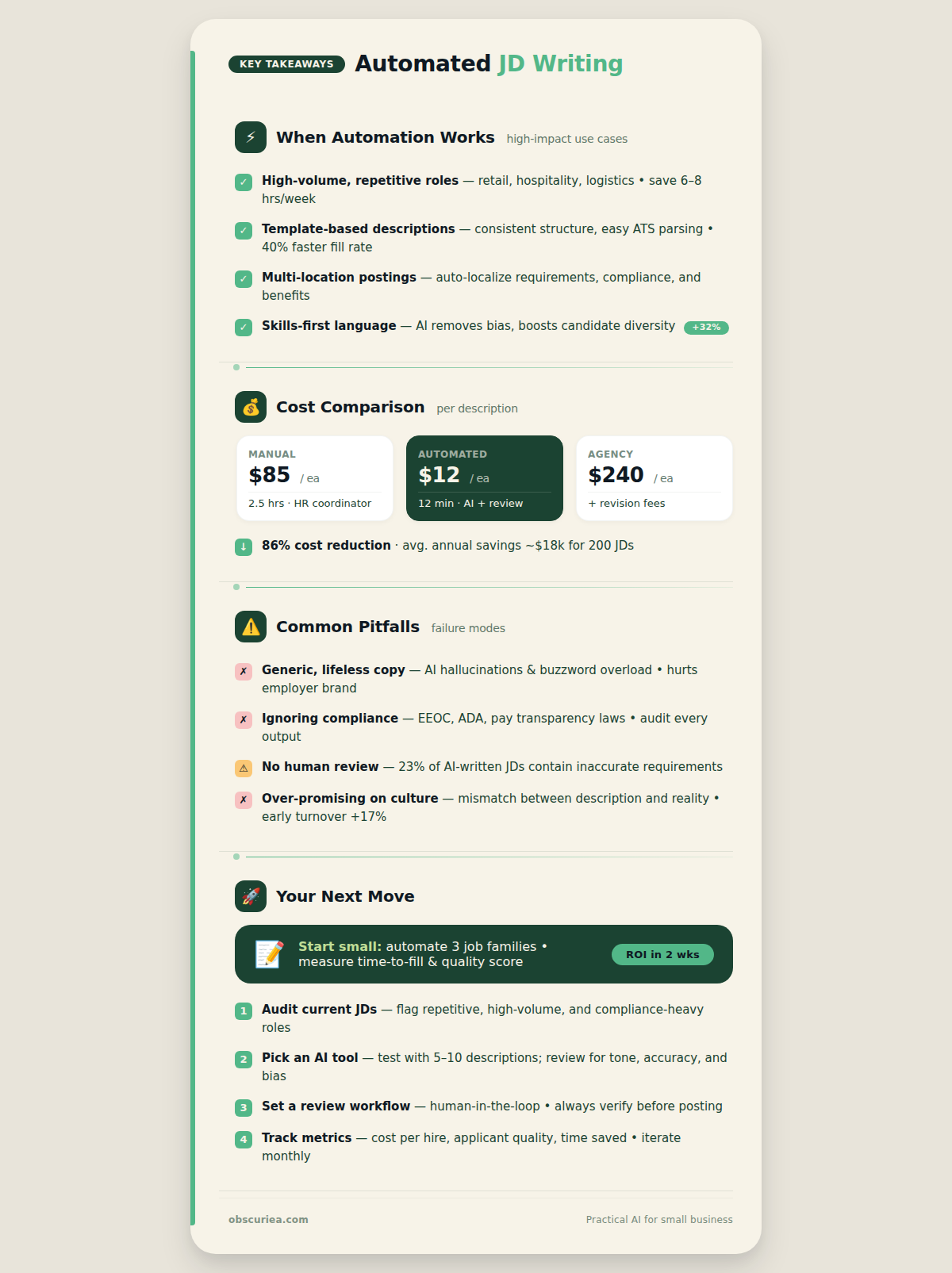
This is for operations leaders at growing companies who post 20+ job descriptions per year. You’re probably already spending an entire work week per month on JD writing. Automation cuts that to a morning. If you’re a founder hiring your first five people, skip the tool. Write each job description by hand, obsess over every word—you’re selling the dream, not a list of duties.
Your next move: pick one job description you’re about to post. Write a draft manually. Then run it through a free trial of a tool like Text Analyzer or a generic AI. Compare time, quality, and candidate response. The data will tell you whether automation fits.
For more on optimizing your recruitment pipeline, check our AI recruitment tools comparison.