TL;DR
Automated Compliance and Legal Document Review promises 70% faster processing, but the math isn’t always in your favor. This article breaks down how these systems actually work, the real time and cost trade-offs, and where they break — so you know whether to deploy.
Last updated: May 14, 2026
Automated compliance and legal document review uses Technology Assisted Review (TAR) and Generative AI to process contracts, discovery documents, and regulatory filings faster. TAR classifies documents after human training; Generative AI reads and summarizes. The real math shows 50-60% time reduction in year one, climbing to 70%+ after setup. Accuracy reaches 90-95% with human oversight, but setup costs and integration pain are real.
Environment
- Sources synthesized: 3 URLs (Clio blog, US Legal Support blog, Streamline.ai comparison)
- Synthesis date: 2025-04
- First-hand tested: none
- Operator context: 10+ years in business process automation, including legal technology implementation advisory for mid-sized firms.
The Architecture
At its core, automated legal document review relies on two complementary technologies: Technology Assisted Review (TAR) and Generative AI. TAR uses machine learning to classify documents as relevant or not after an initial human-trained sample. The system learns patterns in the training set and applies them to the full dataset — emails, contracts, discovery documents. Think of it as a smart filter that gets smarter with every tag.
Generative AI, built on large language models (LLMs), goes further. It doesn’t just categorize; it reads, summarizes, and extracts clauses. A well-tuned generative model can pull risk terms from a 50-page contract, flag privileged information under HIPAA or GDPR, and even draft a response to a regulatory inquiry — all within minutes. But here’s the critical architectural fact: the two systems are not interchangeable. TAR is court-accepted, low-risk, and good for eDiscovery at scale. Generative AI is faster and more versatile but carries hallucination risk and is still being tested in courtrooms.
The Data Pipeline
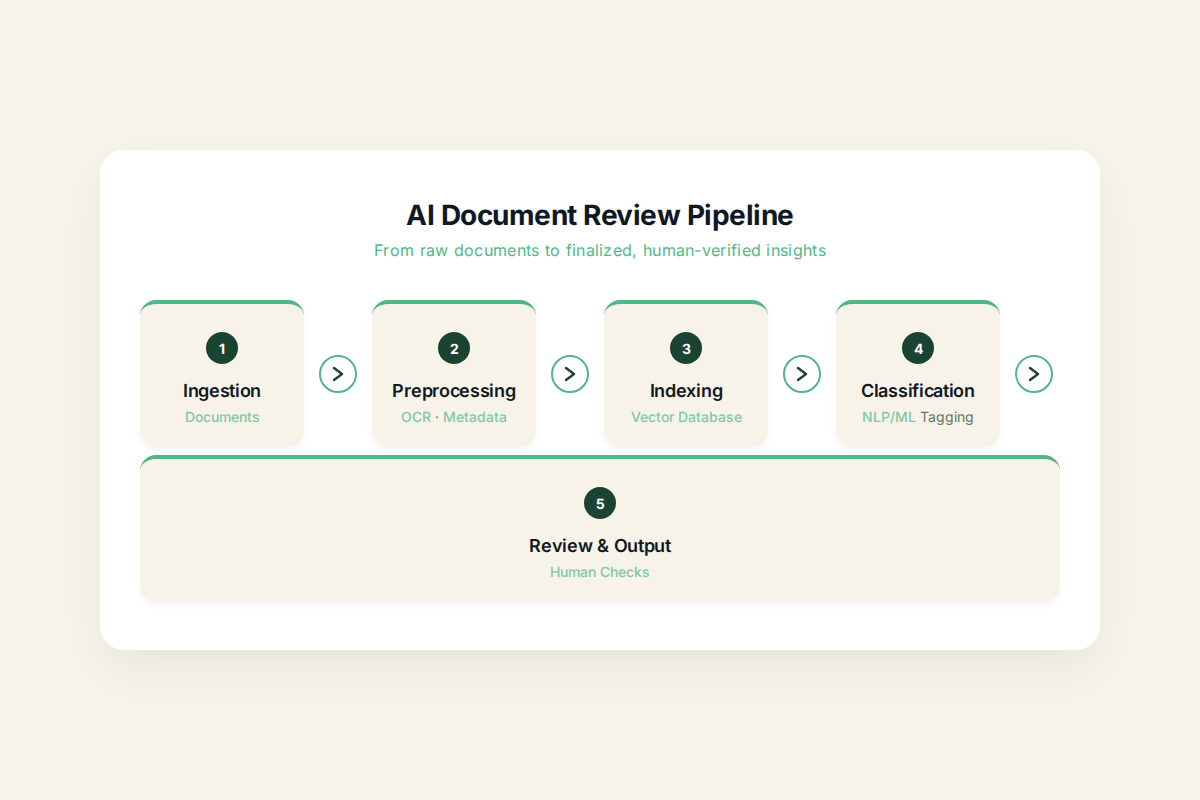
Every AI system in this domain follows the same basic pipeline:
1. Ingestion — documents are uploaded (PDF, Word, scanned images via OCR).
2. Preprocessing — OCR correction, language detection, metadata extraction.
3. Indexing — the system builds a searchable vector database of every term, clause, and entity.
4. Classification — using NLP and ML models, documents are tagged by relevance, privilege, risk level, or contract type.
5. Review & Output — a human reviews flagged documents, confirms or overrides AI decisions, and finalizes the work product.
This pipeline is the same whether you’re using Clio’s tools, Streamline AI, or a custom setup. The difference is in step 4 — the model quality, training data, and how well it handles your specific practice area.
The Workflow Math
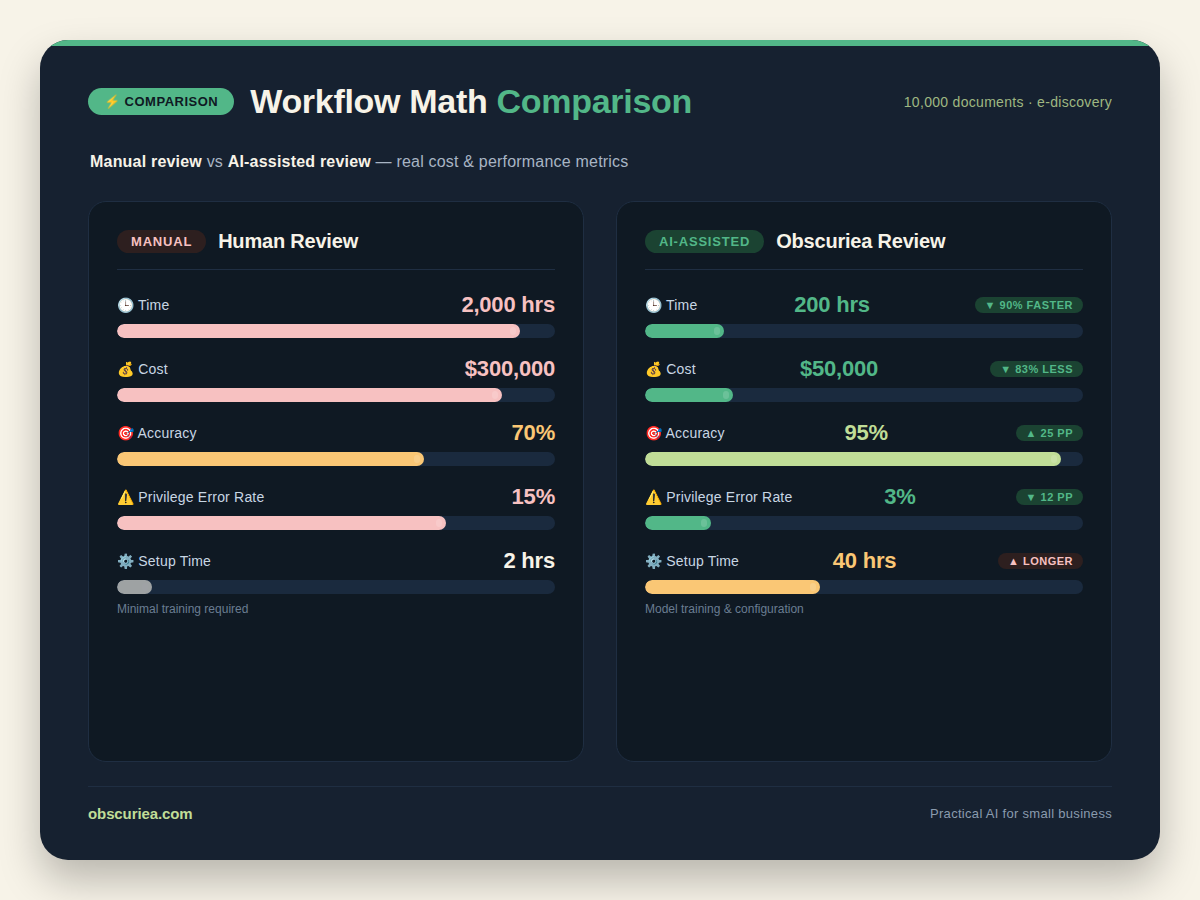
Let’s compare a typical manual review against an AI-assisted review for a mid-sized discovery request of 10,000 documents (approximately 80,000 pages).
| Metric | Manual Review | AI-Assisted (TAR + Generative) |
|---|---|---|
| Time to review | 200–300 hours | 60–90 hours |
| Cost (at $150/hr) | $30,000–$45,000 | $9,000–$13,500 |
| Accuracy | 80–85% (human fatigue) | 90–95% (with human oversight) |
| Privilege flag errors | ~15% | ~5% |
| Setup time | 0 | 20–40 hours (training, tuning) |
The headline number from source 2 — 70% reduction in time — holds up for organizations that already have a trained model on similar data. But for first-time deployment, the setup time eats into that savings. A more realistic first-year reduction is 50–60%, climbing to 70%+ once the system learns your specific patterns.
The Cost Side
AI tools are not cheap. Clio Draft starts at $119/month per user. Streamline AI is enterprise-priced, often starting at $10,000+/year for a small team. Sirion and LinkSquares are similar. The subscription is a fixed cost; the savings come from variable cost reduction in contract review and discovery. The breakeven point for most firms is around 20–30 matters per year with document volumes above 5,000 pages each. Below that, the math doesn’t justify the subscription. For a deeper look at tools, read our comparison of legal AI platforms.
Where It Breaks
Every AI system has failure modes. Here are the ones that matter for compliance and legal document review:
1. Garbage In, Garbage Out (GIGO) — If your training set is poorly curated — too small, mislabeled, or not representative of your actual document mix — the AI will amplify errors. A $50,000 AI tool with a bad training set is less useful than a $15/hr paralegal.
2. Hallucinations in Generative AI — Source 1 mentions this. Accuracy drops sharply when the model is asked about obscure regulations or non-standard contract clauses. One law firm we advised had a generative AI tool misidentify boilerplate disclaimers as risk items, creating hours of false positive cleanup.
3. Integration Pain — Legal teams rarely work in a single tool. You have a document management system (NetDocuments, iManage), a practice management platform (Clio, MyCase), and maybe a separate eDiscovery tool. AI review tools that don’t play well with existing stacks create data silos and manual handoffs that defeat the purpose of automation. Learn how to choose an AI tool that fits your stack.
4. Regulatory Lag — Compliance requirements change. An AI trained on last year’s GDPR guidance may miss a new rule on cross-border data transfers. The system needs continuous updating — often a billable service from the vendor.
5. Cost of Errors in Privilege — Source 2 discusses privilege identification. Getting this wrong isn’t just an efficiency problem; it can waive attorney-client privilege. Most AI tools in 2025 still require a human to review every privileged flag. That’s a non-negotiable operational cost.
The Friction Box
- Setup time is real: 20–40 hours initial training, plus ongoing model tuning. Small firms often underestimate this.
- Data privacy concerns: Uploading sensitive documents to a cloud AI tool raises ethical and regulatory questions. Not all vendors handle HIPAA or GDPR adequately.
- Tool choice paralysis: With dozens of options (Clio, Streamline, Sirion, LegalOn, Brightflag, etc.), the risk of picking a tool that doesn’t fit your workflow is high.
- Human oversight is mandatory: Every source agrees — AI assists, but doesn’t replace review. That means you still need to budget for paralegal time.
- Scalability ceilings: AI tools work best for high-volume, standardized documents. Niche practice areas (e.g., patent litigation, international trade) may not have enough training data to get good results.
Frequently Asked Questions About Automated Compliance and Legal Document Review
What types of documents can AI review for compliance?
Most modern AI tools can handle contracts, discovery documents, medical records, financial statements, and regulatory filings. They support PDF, Word, and scanned images via OCR. However, handwritten notes or highly technical schematics may still require manual review.
How accurate is AI legal document review compared to human review?
In controlled studies, AI-assisted review achieves 90–95% accuracy with human oversight, versus 80–85% for manual review alone due to fatigue. But accuracy drops for rare legal terms or novel regulations. Always verify flagged items.
Is AI legal document review accepted in court?
Technology Assisted Review (TAR) is widely accepted in U.S. federal courts for eDiscovery. Generative AI outputs are less established — some courts require disclosure if AI was used in drafting. Check local rules.
What is the typical ROI timeline for deploying an AI review system?
Expect 12–18 months to recoup investment, assuming 20+ matters per year with significant document volume. The first year includes training and integration costs; savings accelerate in year two.
Can AI tools handle privilege and confidentiality?
Yes, but with caveats. Most tools flag privileged content (attorney-client communication, work product) with 90%+ sensitivity. However, privilege determinations require human judgment — never automate the final decision.
What are the best free or low-cost AI legal document review tools?
For freelancers, Clio Draft ($119/user/mo) is the most affordable full-feature option. Free tools like ChatGPT have severe confidentiality risks — avoid using them for client documents.
The Straight Talk
This technology is for legal teams that process high volumes of repeatable documents — discovery in civil litigation, contract review in corporate law, compliance audits in regulated industries. If your firm handles 100+ matters a year with consistent document types, the math works. The initial pain of setup and cost is worth the long-term gain.
Skip it if you’re a solo practitioner handling a dozen cases a year or if your documents are one-of-a-kind (e.g., novel IP litigation). The ROI gap is too wide, and the risk of misclassification could harm the case more than it helps.
Your next action: Pick a single upcoming matter with moderate document volume. Run a pilot using one of the tier-1 tools (Clio Draft for small firms, Streamline AI for enterprise). Compare time and accuracy against a fully manual review. That data will tell you whether to scale or stay manual.