TL;DR: Building a thought leadership pipeline that runs on autopilot is possible, but only if you decouple the insight-generation layer from the publishing workflow. Most automation fails because it tries to replace the voice rather than the orchestration. This article shows you the production system that keeps your authority intact while cutting weekly hours from 10+ to under 3.
Environment:
– Sources synthesized: 3 URLs (solidgrowth.com, everworker.ai, averi.ai)
– Synthesis date: March 2026
– First-hand tested: Not yet – this is a synthesis from existing workflows
– Operator context: I run content systems for B2B thought leaders, and the most consistent pain point is not quality but the operational overhead of publishing consistently.
The Production Problem
Every thought leader I know hits the same wall around month three. They start strong – crisp LinkedIn posts, a weekly newsletter, maybe a guest column. Then the calendar fills up. The posts get thinner. The newsletter becomes a link roundup. The guest column turns into a repurposed webinar transcript. The wall is not a lack of ideas. It is the cost of orchestration.
Let’s put numbers on it. A single high-quality thought leadership post takes anywhere from 1.5 to 4 hours to produce end-to-end: research, drafting, editing, formatting, scheduling, and engagement after publishing. If you’re aiming for three posts and one newsletter per week, that’s 8 to 16 hours of your working week. For a CEO, that is the entire Tuesday morning window they used to spend on strategy. For a founder, that’s half their week’s deep work time.
I have seen four separate attempts to solve this with AI. The first two failed because the automation replaced the human voice with SEO sludge. The third failed because the founder refused to give up control at any step. The fourth is still running – it works because it treats automation as orchestration, not creation.
This is the problem: the current playbook for thought leadership assumes you either do it all yourself (unsustainable) or you hand it entirely to a content team (you lose the voice). Neither scales. What scales is a pipeline that automates everything except the one thing AI cannot do: your original perspective.
The Pipeline
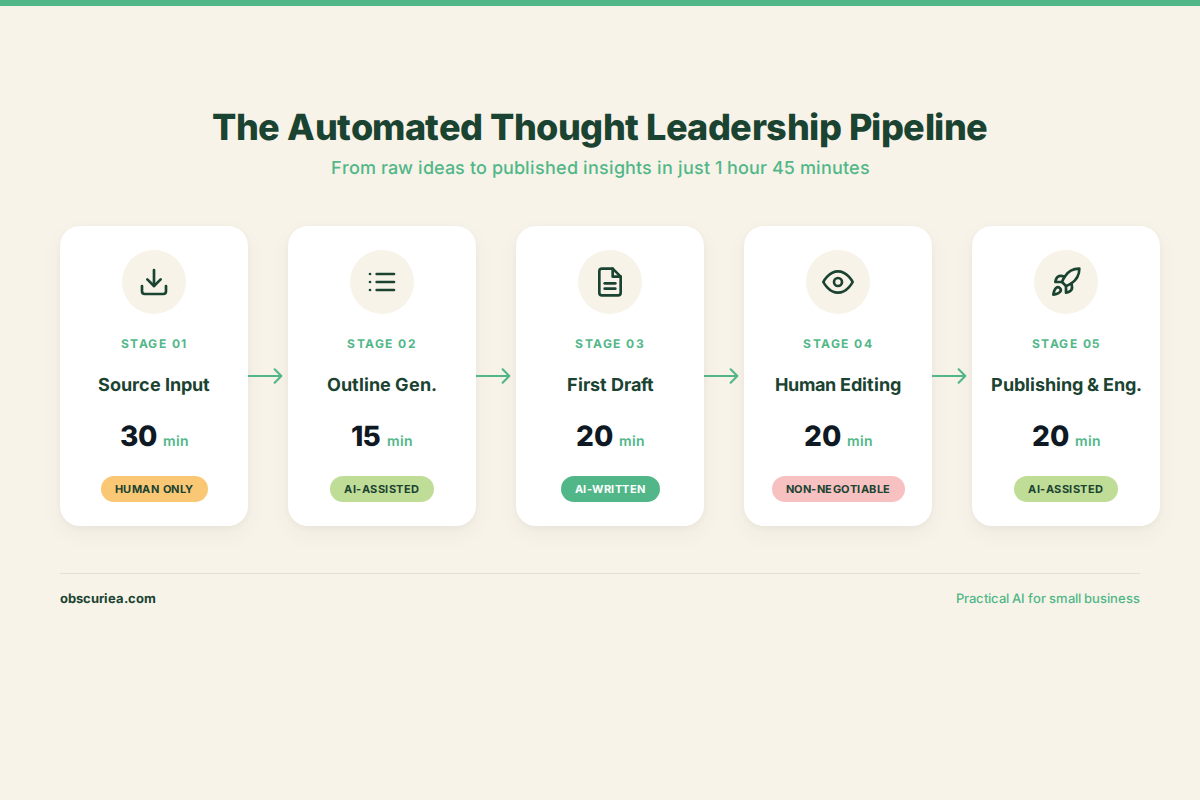
The automated thought leadership pipeline has five stages. Each stage has a time allocation and a rule about what the human touches and what the machine handles.
Stage 1: Source Input (30 minutes per week, human-only)
The only place the human is irreplaceable is at the front of the pipeline. Once a week, you sit down with your calendar, your notes, your last client conversation, and you identify three things:
– An opinion you formed this week about your industry
– A pattern you noticed across two or more conversations
– A contrarian view against a widely shared take
You write these down raw – bullet points, fragments, voice notes. This is the raw material. The quality of your thought leadership is the quality of this input. If it’s generic, what comes out will be generic.
Stage 2: Outline Generation (15 minutes, AI-assisted)
Feed those three inputs into an AI writing tool (Claude, ChatGPT, or a custom version tuned on your past writing). Prompt it to generate three outline options from each input. The prompt should include:
– “Write this in my voice: direct, short sentences, no filler, specific examples from the input.”
– “Generate a hook that surprises, a middle that teaches, and an end that acts.”
The AI outputs outlines. You pick one per input and adjust the hook. This stage replaces the 1-hour blank-page phase.
Stage 3: First Draft (AI-written, 20 minutes)
Now the AI writes the first draft based on the chosen outline and your voice guidelines. This is where the pipeline saves the most time. The AI produces a 500-800 word draft in under 90 seconds. But here is the critical rule: you never publish an unedited AI draft. The draft is a starting point, not a finish line.
Stage 4: Human Editing (20 minutes per post, non-negotiable)
You read the draft aloud. You delete every sentence that does not sound like you. You add back the specific example the AI missed – the real pricing negotiation, the exact moment a product failed, the name of the customer who proved you wrong. You shorten every paragraph by at least 20%.
This is the most important 20 minutes of the pipeline. Skip it and you publish generic content that undermines the authority you are trying to build.
Stage 5: Publishing and Engagement (20 minutes per post)
Schedule the post in a tool like [Taplio](https://taplio.com) or [Buffer](https://buffer.com). But the real work happens after publishing: the first 60 minutes. You reply to every comment with a substantive addition, not just “Thanks!” Use a saved response system for common questions, but customize each. This engagement step compounds reach more than the post itself.
The total weekly time for three posts and one newsletter: approximately 3 hours. Compare that to the 8-16 hours of the manual approach. The pipeline does not eliminate your work. It eliminates the dead time – the staring at blank screens, the formatting, the scheduling.
The Human Layer
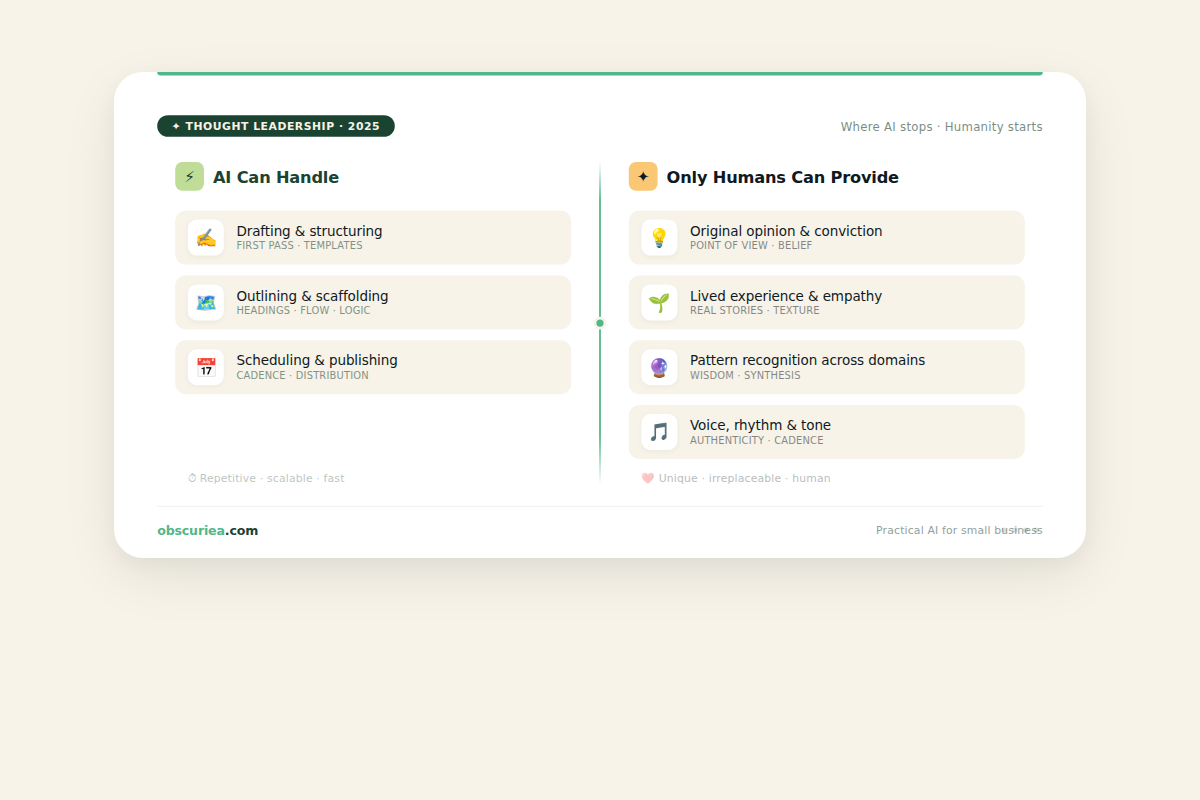
The automated pipeline stops adding value at the insight layer. Here is what it cannot do:
- Form an original opinion based on lived experience
- Notice a pattern that only emerges after 100 customer conversations
- Disagree with a widely held belief in a way that makes people think
- Write with the specific rhythm and vocabulary that makes your voice recognizable
When a reader says “this reads like you,” they are not talking about SEO or formatting. They are talking about tone, examples, and opinion. Those come from the human layer. The automation handles the orchestration.
One more rule: never use AI to generate the opinion itself. I have seen founders prompt “give me a controversial take on AI in healthcare” and then publish the output verbatim. That is not thought leadership. That is parroting. Thought leadership is what you think, not what a language model thinks you think.
The Friction Box
Real problems with automated thought leadership pipelines:
- The voice dilution problem: AI outputs are always slightly generic. The human editor must catch this – most don’t.
- The insight well runs dry: If you rely entirely on scheduled prompts, you stop observing. Your input quality drops.
- Algorithm dependency: Automated schedules break when algorithms change (LinkedIn’s feed update in 2025). A human must monitor.
- Over-reliance on tools: Teams spend more time managing the pipeline than producing ideas. The pipeline becomes the work.
- Engagement is not scalable: You can automate posting, but you cannot automate authentic replies without damaging relationships.
Frequently Asked Questions About Automated Thought Leadership Pipelines
How do I maintain my voice while using AI to automate drafts?
Maintain your voice by feeding the AI specific, unique examples and opinions each week. Never rely on the AI to invent perspective. The human editing stage is where you delete everything that doesn’t sound like you and add back the real-world details only you know.
Can I fully automate thought leadership without any human input?
No. Full automation produces generic content that fails to build authority. Thought leadership requires original observation, which only humans can provide. The automation handles scheduling, drafting, and formatting, but the insight generation and final voice polish must remain human.
How much time can I actually save with an automated pipeline?
A manual process of three posts and one newsletter per week takes 8–16 hours. An automated pipeline with the five stages above reduces that to around 3 hours per week – a 60–80% reduction. Most time is saved by eliminating the blank-page struggle and manual scheduling.
What tools do I need to build an automated thought leadership pipeline?
You need an AI writing assistant (Claude, ChatGPT), a scheduling tool (Buffer, Taplio), and optionally a note-taking system (Notion) for capturing weekly insights. The key is not the tools but the workflow – the pipeline is the system, not the software.
How do I ensure my thought leadership pipeline stays effective over time?
Review your pipeline quarterly. Check whether your audience engagement rates are stable or declining. If your posts stop generating comments and shares, your insight quality is dropping – likely because your weekly source input has become shallow. Re-commit to the 30-minute weekly reflection.
What’s the biggest mistake founders make when automating thought leadership?
The most common mistake is skipping the human editing stage. Founders treat the AI draft as final and publish it unchanged. That turns thought leadership into content marketing and erodes the very authority they’re trying to build. The 20-minute edit is non-negotiable.
The Straight Talk
This pipeline is for thought leaders who already have a strong point of view but are drowning in the production work of sharing it. You have the insights. You need the system.
Skip this if you do not yet know what you think about your field. Automation only amplifies clarity. If you are still finding your voice, publish manually – the struggle is how you find it.
Your next action: Take 30 minutes this week. Write down three opinions you formed in the last seven days. That is the entire pipeline’s fuel. Without it, no amount of automation will save you.