TL;DR: Automation ROI calculations are broken because they assume time savings equal money savings. The real value comes from error reduction, speed to response, consistency, and data capture — none of which appear in the typical “hours saved × hourly rate” model. This article provides a grounded framework for measuring what actually matters.
Environment:
– Sources synthesized: 1 URL (Valency.ca article on real ROI of workflow automation)
– Synthesis date: 2025-04-08
– First-hand tested: none specific to this domain; general operations automation experience
– Operator context: Small business operations in Southeast Asia, experience with manual-to-automated workflow transitions
The Architecture: Why Traditional ROI Falls Flat
Every automation vendor sells the same dream: “Save 40 hours a week! 10x your productivity!” These numbers look great on a slide deck but collapse under operational scrutiny. The math is simple but deceptive. You count the hours a task takes, multiply by hourly labor cost, assume automation eliminates 80% of that time, and declare massive savings. The problem is that time savings don’t translate directly to money savings unless you actually reduce headcount or reallocate capacity to revenue-generating work.
In reality, most businesses automate 2 hours of a 40-hour week and expect a 5% salary savings. But the employee still works 40 hours. The “freed capacity” gets absorbed into meetings, busywork, or simply slack unless a specific plan is in place. Implementation costs are consistently underestimated — building, testing, refining, and maintaining automation often takes more time than the initial projection. The real question isn’t “how many hours can we save?” but “what are we actually losing to manual processes that automation could prevent?”
This isn’t an argument against automation. It’s an argument against measuring the wrong thing. The true value drivers are error reduction, speed to response, consistency, and data capture — each with a direct line to revenue, not just overhead savings.
The Workflow Math: What Actually Drives Value
Error Reduction — The Invisible Tax
Consider a distribution company processing 500 orders daily. A 2% error rate means 10 wrong orders per day. Each error costs: time to identify the mistake, customer communication, potential lost future business, staff frustration. That 2% error rate can easily cost $50,000+ annually in direct costs, plus immeasurable damage to customer relationships.
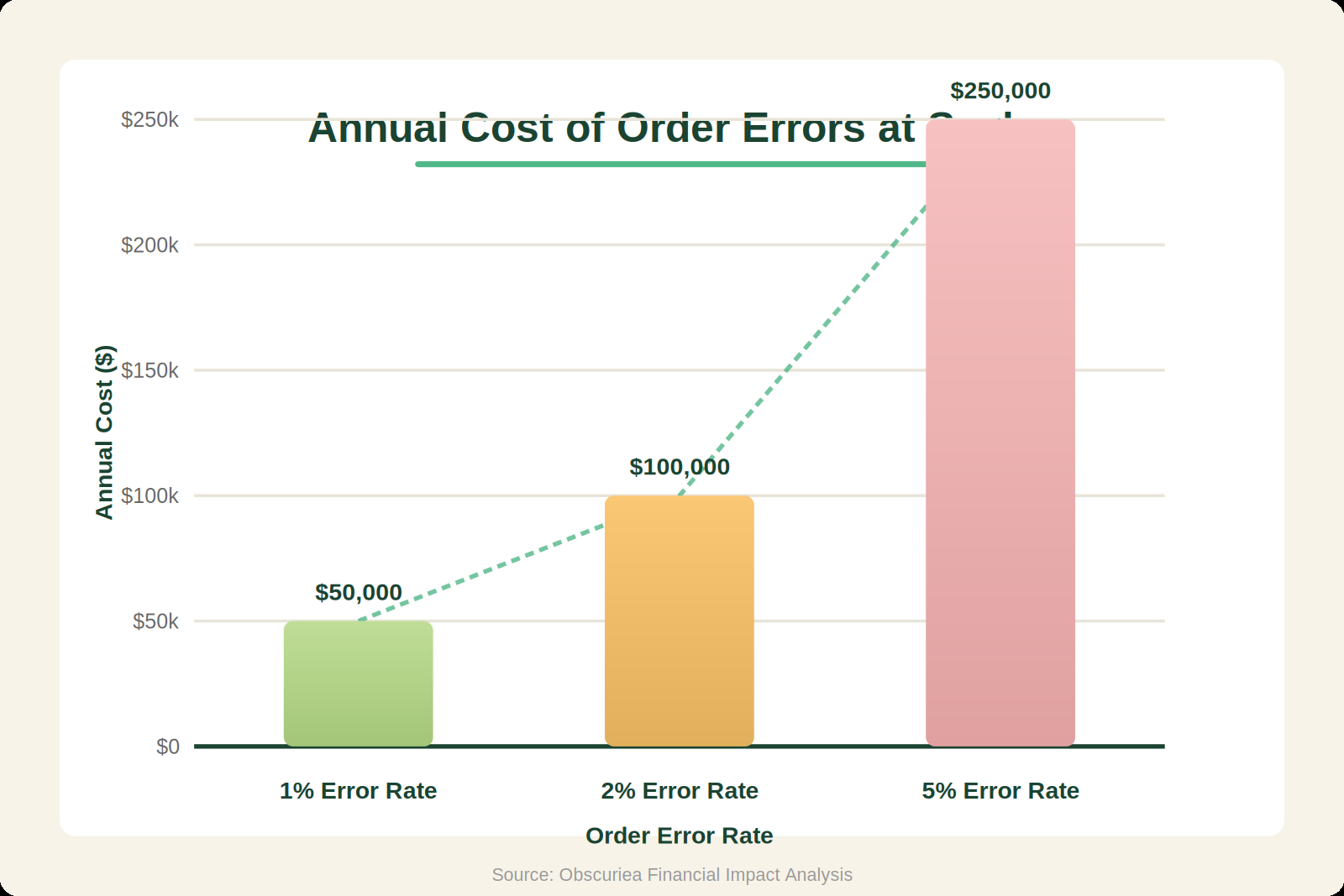
Automation eliminates variability. Machines don’t misread numbers when tired. They don’t skip steps when rushed. For many businesses, eliminating errors is worth more than eliminating labor hours. The math here is straightforward: calculate your current error cost, then estimate the reduction automation brings. Even a 50% error reduction on a $50,000 problem yields $25,000 in real savings.
Speed to Response — The Opportunity Engine
Time-based competitive advantage is underrated. A real estate agent who responds in 5 minutes wins more listings than one who responds in 5 hours. A B2B company that sends quotes within an hour closes more deals than one taking 3 days. The value isn’t saving someone from sending an email — it’s never missing the window when a prospect is engaged.
Automation enables immediate response: appointment scheduling, quote generation, inquiry routing, follow-up sequences. Each minute shaved off response time compounds into more closed deals and higher customer satisfaction. Measure your current response time, benchmark against industry averages, and quantify the revenue gain from improving it.
Consistency and Standardization — The Quality Floor
Every business has processes that work great when the experienced person does them and terribly when anyone else tries. Automation captures the “right way”: every invoice follows the same format, every onboarding email hits the same points, every quality check covers the same criteria. This isn’t about removing human judgment — it’s about ensuring routine stuff always happens correctly so humans focus judgment where it matters.
Data Capture — The Hidden Goldmine
Automated processes generate data. Manual processes often don’t. When a human handles an inquiry, they might not log exactly when it came in, how they classified it, or how long each step took. When automation handles it, all of this gets captured. Over time, you accumulate insights that enable optimization you couldn’t even attempt before.
Where It Breaks: The Hidden Costs Nobody Quotes
Automation ROI collapses when these factors are ignored:
Implementation debt. The time to build, test, and refine automation often exceeds initial projections by 2-3x. A 40-hour setup estimate can easily become 120 hours when edge cases surface.
Maintenance burden. Workflows break. APIs change. Data formats evolve. Someone has to monitor and fix them. That ongoing cost rarely appears in ROI spreadsheets.
Capacity absorption. Without a plan for reclaimed time, savings evaporate. Freed hours get burned on non-productive work. The capacity is created but never deployed.
Scope creep. Automation designed for one process often gets retrofitted to others, increasing complexity and fragility. Each addition multiplies the maintenance surface.
Vendor lock-in. Tooling decisions made today can constrain future flexibility. Switching costs erode the initial ROI.
The Friction Box
- Traditional ROI metrics ignore the gap between time saved and money saved.
- Implementation and maintenance costs are consistently underestimated.
- Error reduction and speed to response are undervalued because they’re harder to measure.
- Data capture is a long-game benefit often dismissed as intangible.
- Without a capacity deployment plan, automation creates slack, not savings.
Frequently Asked Questions About Quantifying Automation ROI
How do I calculate the real ROI of an automation project?
Start by quantifying the current cost of errors, delays, and inconsistencies in the targeted process. Then estimate how much automation can reduce those costs. Include implementation time and ongoing maintenance in your calculation. Use the four drivers: error reduction, speed to response, consistency, and data capture. Time saved is not money saved unless capacity is redeployed.
What percentage of automation projects deliver the promised ROI?
Industry estimates suggest 30-50% of automation initiatives fail to meet initial ROI projections. The main reasons are underestimated maintenance, scope creep, and failure to redeploy freed capacity. Projects that target error reduction and speed to response tend to have higher success rates than those focused solely on labor savings.
Can small businesses benefit from automation ROI?
Yes, but the math changes. Small businesses often cannot dedicate dedicated maintenance staff. Tools like Zapier and Make offer low-cost entry but require savvy setup. The biggest wins for small businesses are error reduction (fewer customer complaints) and speed to response (more leads converted). Avoid complex multi-step workflows until you have a clear capacity plan.
What tools are best for tracking automation ROI?
Use project management tools like Asana or Monday.com to log time spent on manual vs. automated tasks. Pair with a cost-tracking sheet for implementation and maintenance hours. For data capture benefits, most automation platforms (Zapier, Make, n8n) log execution history — analyze that to find efficiency gains.
How often should I reassess automation ROI?
Every quarter at minimum. Automation dependencies change — APIs update, team roles shift, business priorities evolve. Schedule a 30-minute review to check if the projected savings are materializing. If not, either adjust the workflow or consider decommissioning it. There’s no shame in killing an automation that no longer adds value.
The Straight Talk
This framework is for operators who have been burned by vague automation promises and want a realistic method to evaluate ROI. If you’re still in the honeymoon phase where every automation looks like free money, skip this — you’re not ready for the honest math yet. If you’re in the trenches dealing with maintenance costs and wondering if it was worth it, this is for you. Your next move: audit one existing automation project and calculate real savings using the four drivers — error, speed, consistency, data — then compare to the original promised ROI.