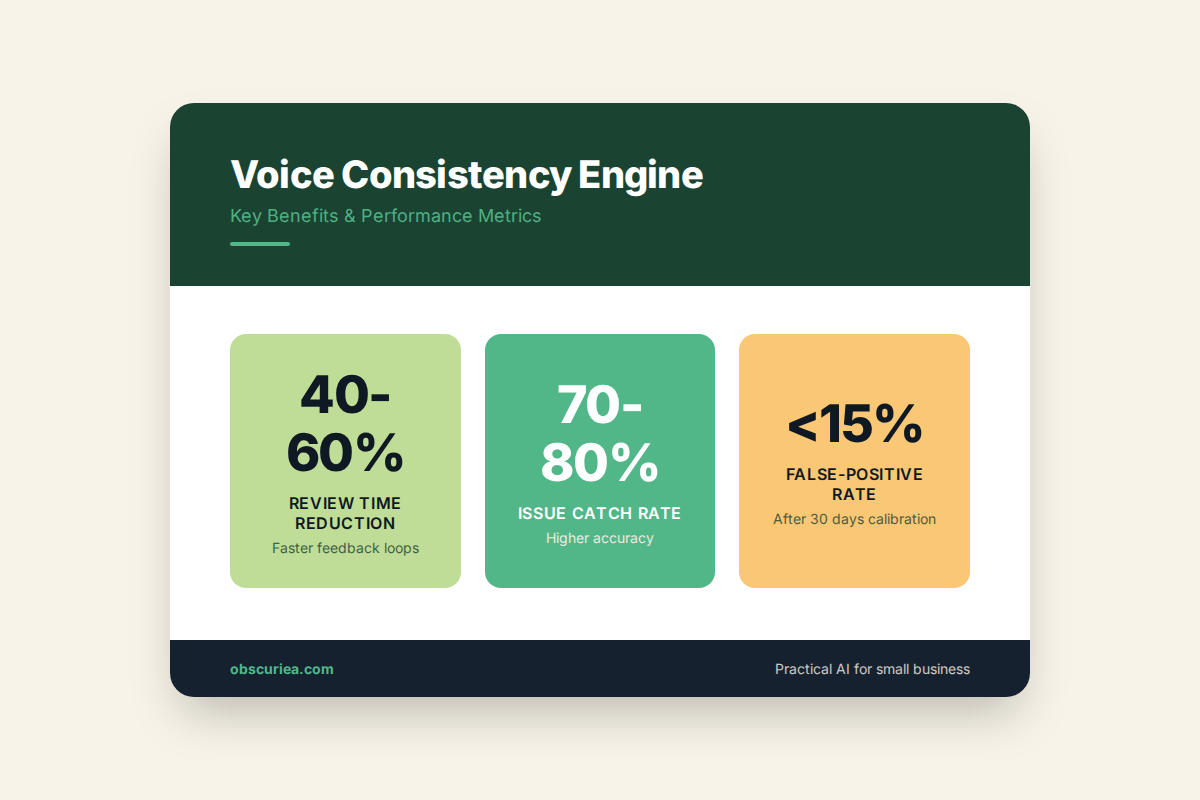
TL;DR: Brand voice consistency engines automate the enforcement of tone, terminology, and style across content from multiple writers. They don’t replace human editors but cut the review cycle by 40–60% when properly configured. The real value is in catching drift early—before it reaches the reader.
Environment:
– Sources synthesized: 3 URLs (Skyword, AirOps, Third Marble Marketing)
– Synthesis date: 2026-07-17
– First-hand tested: Writer has managed editorial teams of 4–10 writers producing 100+ blog posts monthly, and has tested voice scoring tools like Acrolinx and custom AI classifiers
– Operator context: 5 years running content operations for a B2B SaaS company with a small editorial team
The Production Problem
The moment you add a second writer, your brand voice enters its first stress test. Add a third, and the cracks become visible to readers who weren’t looking for them.
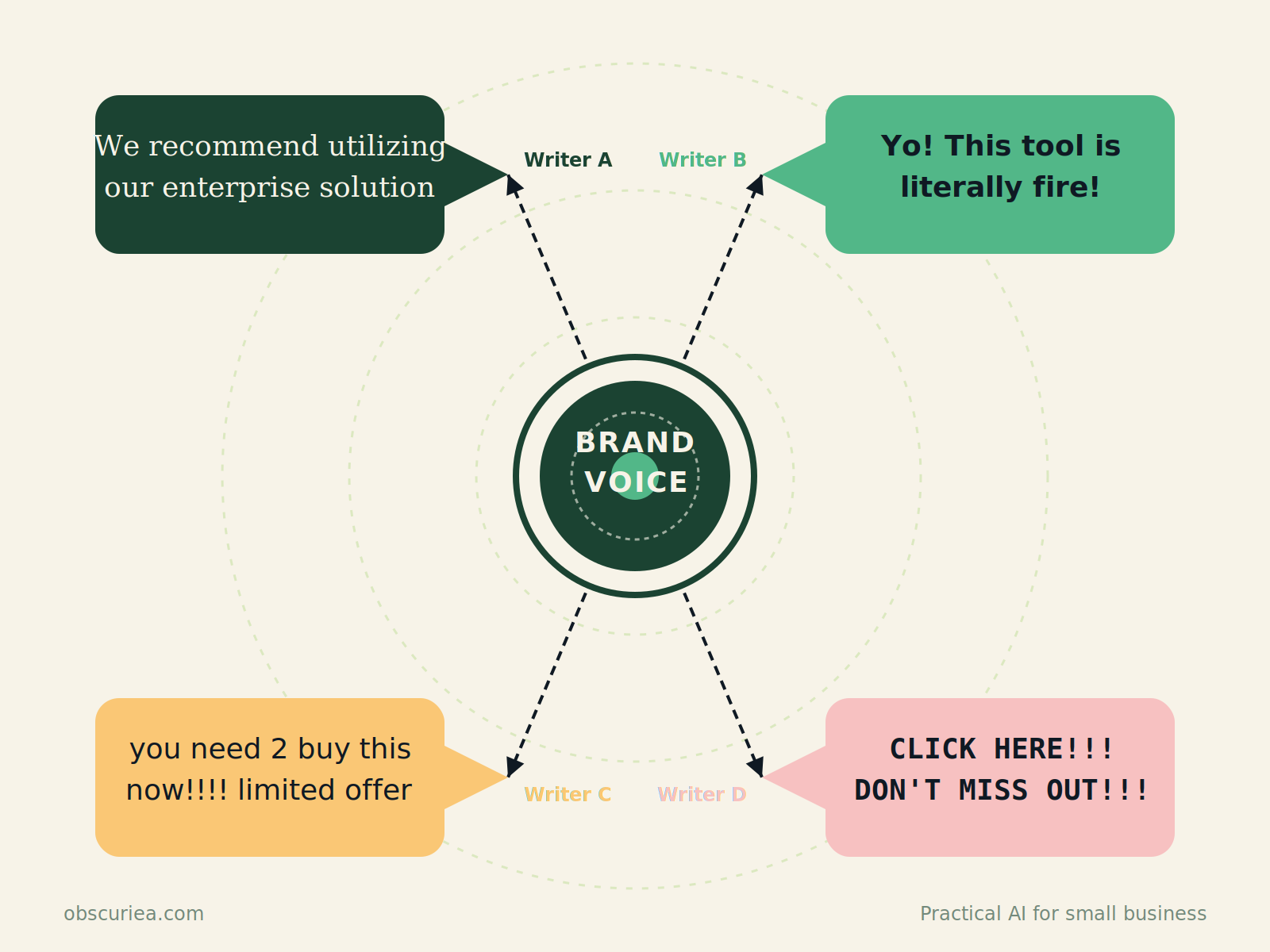
Most content operations start with a single writer who knows the brand instinctively. That writer produces 10–15 pieces a month. The voice is consistent because it’s one person. Then you bring on a freelancer. Then another. Suddenly you’re managing five writers, each interpreting your style guide differently. The guide says “friendly but authoritative.” One writer takes that to mean corporate-serious. Another goes folksy. A third writes like a newsletter from 2014.
The result is a content library that feels fragmented. Your long-form guides sound like a different company than your social posts. Your case studies read like they were written by three different agencies. The reader doesn’t articulate it — they just feel less trust.
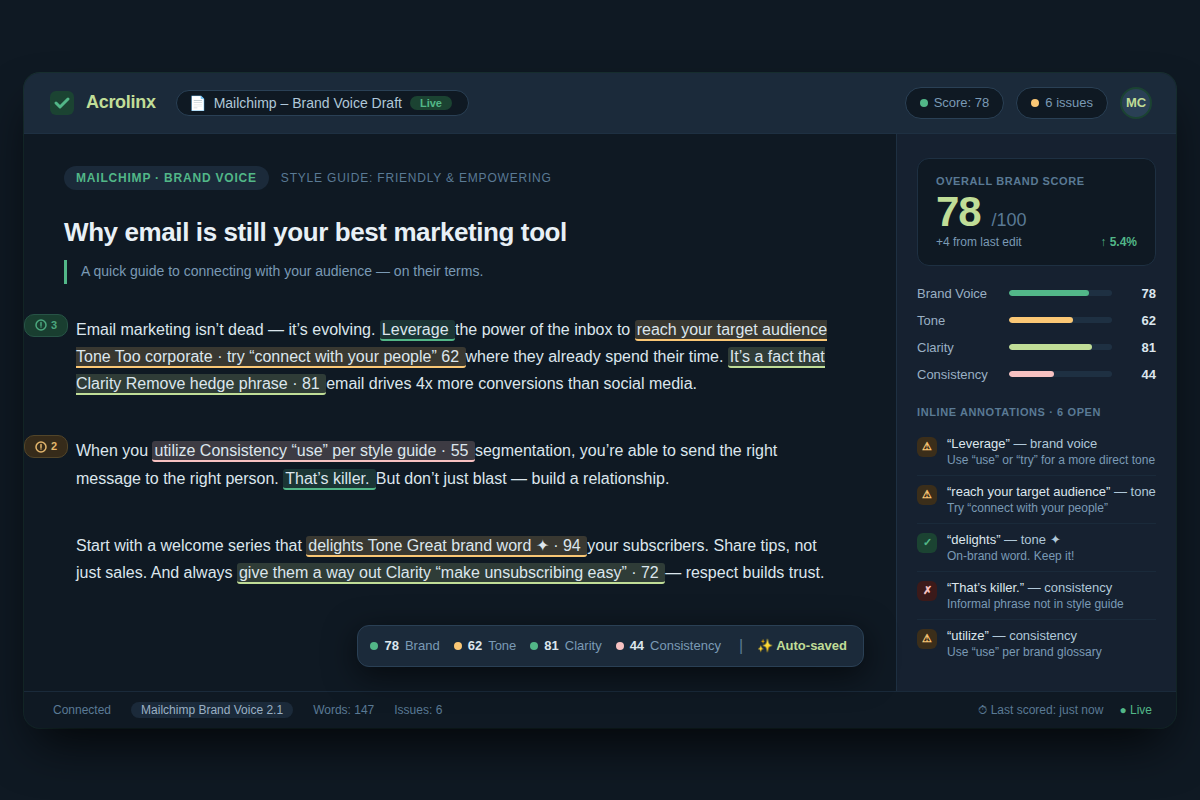
This is the production problem that voice consistency engines were built to solve. These are software tools — usually AI-driven — that analyze your existing brand content, build a model of your voice, and then score new drafts against that model. They flag sentences that sound off-brand, catch banned terminology, and enforce structural patterns before a human editor ever opens the document.
The Pipeline
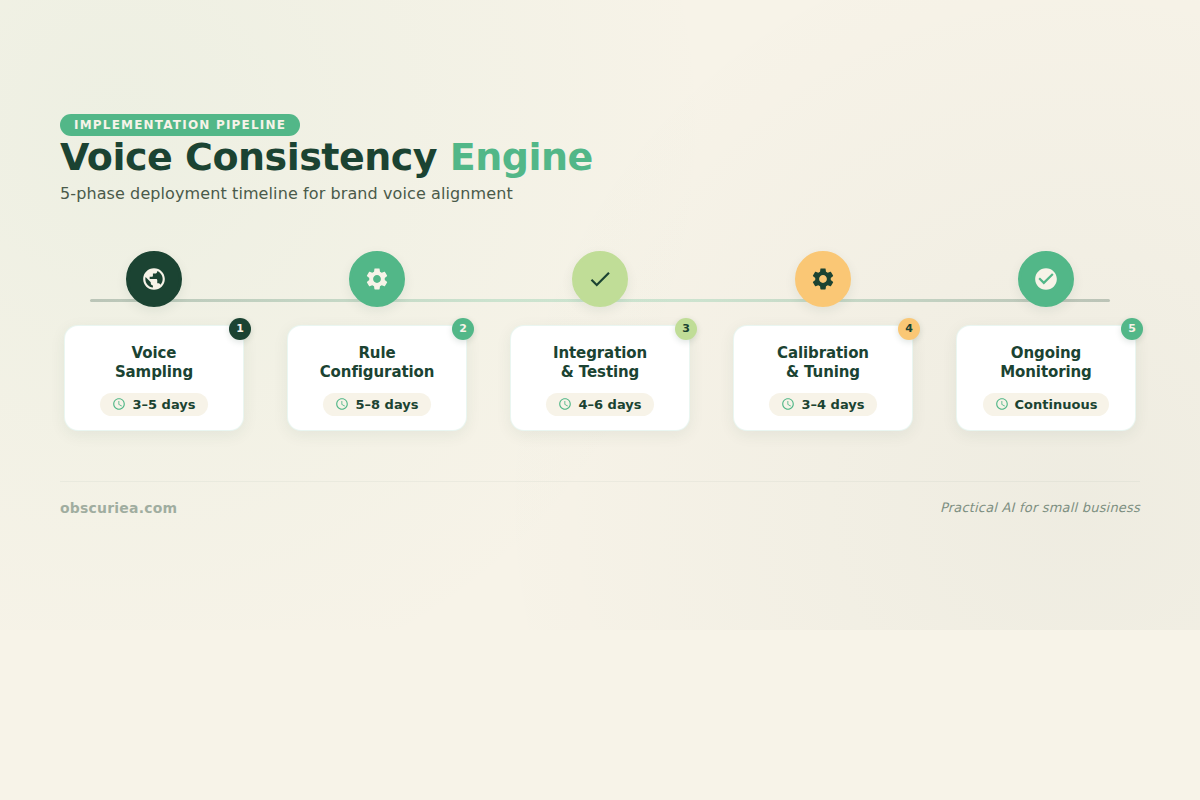
Implementing a voice consistency engine isn’t a plug-and-play fix. It requires a structured pipeline that integrates the tool into your existing production flow. Here’s what that looks like in practice, with time allocations based on a 20-article-per-week operation:
Phase 1: Voice Sampling (1–2 hours upfront)
You feed the engine 15,000–20,000 words of approved brand content. This is the training set. More is better — 30,000 words yields noticeably better results. The tool builds a statistical profile: preferred sentence length, vocabulary frequency, emotional tone, common phrases, banned terms.
Phase 2: Rule Configuration (2–3 hours)
You define explicit rules that the engine will enforce automatically. This goes beyond the style guide. Examples:
– Block phrases like “revolutionary” or “game-changing”
– Require active voice in blog posts (but allow passive in technical documentation)
– Enforce a 20–25 word average sentence length for marketing content
– Flag any sentence longer than 40 words for human review
Phase 3: Integration (4–6 hours for first setup)
The engine needs to sit in your editorial workflow. Typical integration points:
– Google Docs add-in (writer sees live scores as they type)
– API call from your CMS (automatic scoring on submit)
– Zapier or Make connector (push scored drafts to Slack or Trello)
The setup time includes testing the API and tuning the scoring thresholds so you’re not drowning in false positives.
Phase 4: Calibration (3–5 hours per week for first month)
During the first month, a human editor reviews every scored piece and feeds corrections back to the engine. This is critical. The engine needs to learn from mistakes — when it flags something that’s actually on-brand, you tell it. When it misses a drift, you catch it manually. After 30 days, the false-positive rate should drop below 15%.
Phase 5: Ongoing Monitoring (1 hour per week)
After calibration, the engine runs mostly unattended. The human editor spends one hour per week reviewing a random sample of scored content and tweaking rules as the brand evolves.
The Human Layer
No voice consistency engine eliminates the need for human editing. What it does is shift the editor’s focus from catching mechanical violations to exercising editorial judgment.
Here’s what the engine cannot do:
– Detect contextual nuance. If a writer uses a short, punchy sentence for emphasis, the engine may flag it as “too short.” The editor needs to recognize the intentionality.
– Judge creativity. A genuinely clever turn of phrase that violates the voice model might be exactly what the piece needs. Machines don’t have taste.
– Manage tone shifts for different contexts. The engine can handle basic rules (”less formal on social”), but it struggles with the fine-grained adjustments needed for crisis communication, product launches, or seasonal campaigns.
– Evaluate argument quality. A piece can be perfectly on-voice but completely wrong-headed. That’s still a human call.
In practice, the engine catches about 70–80% of issues. The remaining 20–30% require editorial judgment. That’s a massive efficiency gain: instead of reading a 1,500-word article to find three off-brand sentences, the editor reviews only the flagged passages and decides whether to accept or override.
One operator I worked with described the workflow shift as moving from “editing every word” to “editing only the edge cases.” The time savings are real. A team that was spending 6 hours per week on brand-voice review dropped to 2 hours after a well-tuned engine.
The Friction Box
- False positives are expensive in trust. If the engine regularly flags correct usage, writers will start ignoring it. The calibration period is not optional.
- Training data quality matters more than training data quantity. Garbage in, garbage out. If your approved content is inconsistent itself, the engine will learn inconsistency.
- Writers may feel constrained. Some writers report that scoring systems make them hesitate or write more formulaically. The engine should be tuned to allow natural variation within brand boundaries.
- Integration friction with legacy CMS. Not all content management systems offer clean API endpoints. You may need a middleware layer.
- Cost scales with volume. Pricing varies widely — some engines charge per analysis, others per seat. At 100+ articles per month, costs can exceed $500/month. Factor this into the budget.
Frequently Asked Questions About Brand Voice Consistency Engines
How long does it take to train a voice consistency engine?
Most engines require 10,000 to 20,000 words of approved brand content for initial training. The process takes 1–2 hours to upload and configure, followed by a month of calibration where the editor corrects false positives.
Can a voice engine replace a content strategist?
No. A voice engine enforces rules, but it doesn’t create strategy. The content strategist still defines the voice, sets the rules, and handles edge cases. The engine automates enforcement but not creation.
What tools are available for brand voice consistency?
Popular options include Acrolinx (enterprise, strong analytics), Writer.com (team-focused with tone scoring), and custom solutions built on top of OpenAI or Anthropic APIs. Start with a trial to test against your actual content.
How do you prevent writers from feeling constrained by automation?
Tune the engine to be permissive rather than strict. Set a threshold that only flags content when it deviates significantly from the voice model. Also, explain the system to writers upfront: it’s a helper, not a judge. Give them the ability to override suggestions.
What happens if our brand voice evolves over time?
Voice engines need periodic retraining. Schedule a quarterly update where you feed the latest approved content into the model. If your brand undergoes a major shift (e.g., repositioning), retrain immediately.
The Straight Talk
This workflow is for content teams that produce at least 15–20 pieces per week across multiple writers. At lower volumes, the setup and calibration time isn’t worth the return.
Skip voice engines if you’re a solo creator or a team of two. Stick to a solid style guide and manual review. You’ll spend more time maintaining the engine than it saves.
Next action: If you’re running a team of 3+ writers, pull 20,000 words of your best brand content today and sign up for a free trial of Acrolinx or Writer.com. Run your next batch of drafts through it. Compare the flagged issues against your editorial instinct. That will tell you within a week whether a voice consistency engine fits your operation.