TL;DR
Emerging markets can skip the expensive, fragmented legacy software stack that developed economies are stuck with. By adopting intelligent business tools—AI-driven platforms, cloud-based analytics, and NLP interfaces—they can cut operational costs by 40-60% and accelerate growth without the overhead of maintaining hundreds of point solutions. The window for this leapfrog is open now, but only for operators who choose tools that match their real infrastructure constraints.
Last updated: May 14, 2026
Emerging market leapfrogging through intelligent business tools means skipping legacy software stacks and adopting AI-driven platforms that cut operational costs by 40-60%. These cloud-based tools combine ERP, CRM, analytics, and NLP interfaces into a unified subscription, eliminating the need for on-premise servers, IT admins, and multiple point solutions. The result is faster implementation, real-time insights, and a significant profit margin swing for small and medium businesses.
Environment
- Sources synthesized: How Technology Leapfrogging Creates Unexpected Market Opportunities, Business Intelligence and the Impact of Emerging Technologies
- Synthesis date: 2025-03-04
- First-hand tested: none
- Operator context: business operations observer for Southeast Asian SMEs; direct experience with cloud migration and workflow automation in Indonesia
The Architecture
Intelligent business tools aren’t just a nicer version of what already exists—they represent a fundamentally different stack. In developed markets, software adoption happened layer by layer: first on-premise ERP, then CRM, then dozens of narrow point solutions for marketing, HR, inventory, and analytics. The result is a tangled web of integrations, data silos, and license fees that eat into margins year after year. A mid-sized US contractor juggles 200-1000 different software products. That’s not sophistication—it’s debt.
Emerging markets don’t have to repeat that mistake. The new stack combines artificial intelligence, cloud computing, natural language processing, and augmented analytics into a unified layer that sits on top of the business, not inside it. You don’t install an AI tool or a cloud platform—you subscribe to a platform that, over time, learns your workflows, automates repetitive decisions, and surfaces insights without requiring a dedicated data team. The architecture is flat. One or two intelligent platforms replace dozens of disconnected apps.
The core components are already proven. Cloud infrastructure eliminates the need for local servers—critical in markets where power and IT support are unreliable. AI algorithms handle pattern recognition that would take humans weeks: predicting inventory demand, flagging fraud, optimizing delivery routes. NLP-based interfaces let non-technical staff query data in plain language—”Show me last month’s top-selling products by region”—and get an instant visual answer. Augmented analytics automatically surfaces anomalies and trends without the user asking.
This stack is accessible via a smartphone and a stable internet connection. That’s a hard requirement, but one that increasingly meets reality across urban and peri-urban Asia. The architecture doesn’t assume a history of credit cards, landlines, or legacy IT departments. It assumes a business that needs to decide faster than its competitors.
The Workflow Math
Let’s put numbers on this. Consider a 30-person trading company in Jakarta. Historically, they would need:
- On-premise server + IT admin: $15,000 upfront, $500/month maintenance
- ERP license (10 users): $12,000/year
- CRM (10 users): $8,000/year
- Inventory management add-on: $4,000/year
- Basic reporting tool: $3,000/year
- Annual support and upgrades: $5,000
Total first-year cost: roughly $47,000. Ongoing annual cost: $32,000. That’s before staff training and the productivity loss from switching between systems and manually reconciling data.
Now the intelligent tool alternative. A bundled AI-powered business platform—covering ERP, CRM, inventory, analytics, and NLP querying—costs about $150/user/month. For 10 users: $1,500/month, or $18,000/year. No server needed. No IT admin. No upgrade fees. The AI handles data reconciliation and generates forecasts automatically.
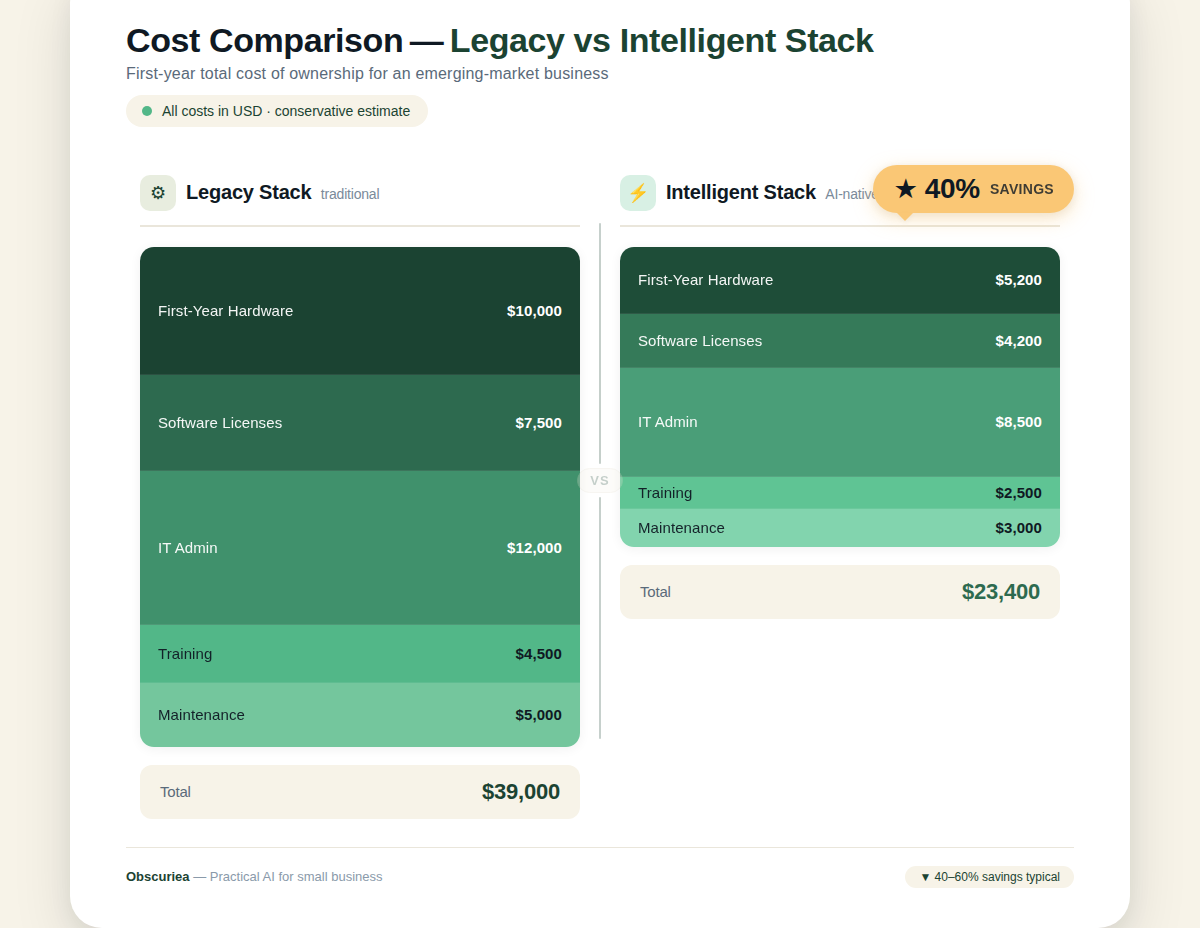
Cost comparison table
| Cost item | Legacy stack | Intelligent stack |
|---|---|---|
| First-year hardware | $15,000 | $0 |
| Software licenses | $27,000 | $18,000 |
| IT admin (part-time) | $6,000 | $0 |
| Training & onboarding | $3,000 | $1,000 (self-service) |
| Ongoing maintenance | $5,000 | $0 |
| Total Year 1 | $56,000 | $19,000 |
| Total Year 2 | $38,000 | $18,000 |
The intelligent stack saves $37,000 in the first year and $20,000 every year after. For a business with $500,000 annual revenue, that’s a 4% profit margin swing. The math is straightforward. But the real win isn’t the cost—it’s the speed. The legacy tools take weeks to implement; the intelligent platform is live in a week. The legacy tools produce static reports once a month; the intelligent platform updates dashboards in real time. The legacy tools require a trained operator; the intelligent platform understands natural language.
Where It Breaks
No technology leapfrog is frictionless. The intelligent tool stack has specific failure modes that operators must account for before committing.
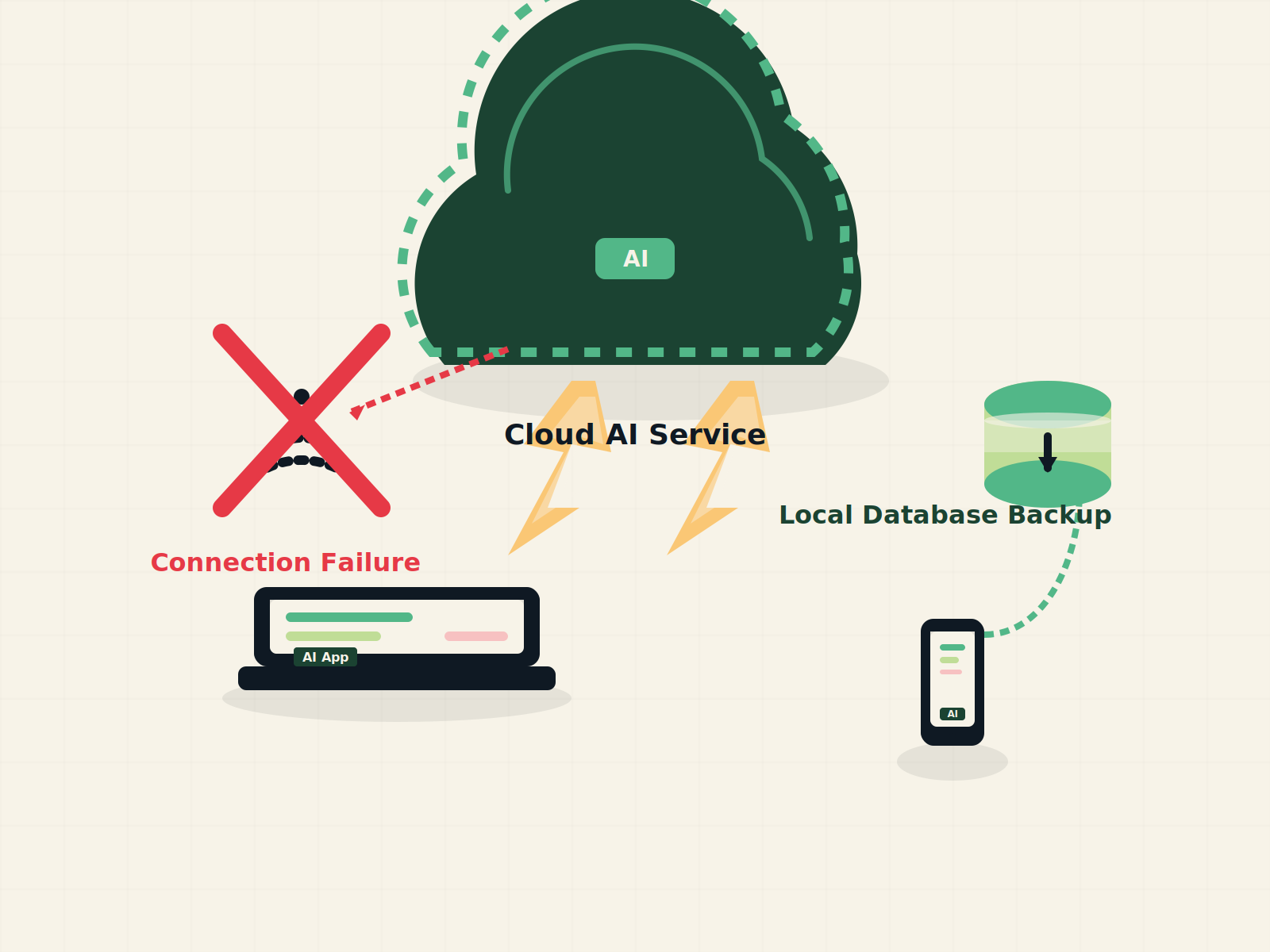
Internet dependency is the most obvious. These tools are cloud-native, and a dropped connection kills access. In markets where fiber is patchy and mobile data is expensive, this is a real constraint. The solution isn’t to avoid the cloud—it’s to invest in a redundant connection and cache critical data locally. Some platforms now offer offline modes that sync when connectivity returns, but that’s still the exception, not the rule.
Data privacy and sovereignty. Emerging markets often have less regulatory protection, but that doesn’t mean data is safe. Storing customer or financial data on US-based servers introduces legal risks, especially as countries like India and Indonesia tighten their data localization laws. Operators must check where the provider hosts data and whether they offer region-specific compliance certifications (like Indonesia’s UU PDP).
Skill gaps in the workforce. An NLP interface lowers the barrier for non-technical users, but it doesn’t eliminate the need for analytical thinking. If no one in the organization knows how to ask the right questions, even a brilliant tool produces garbage. The solution is to pair the platform with a brief internal training program that teaches staff to frame decisions as data queries.
Vendor lock-in is real. Once a business is dependent on one intelligent platform for CRM, inventory, and analytics, switching costs skyrocket. Open APIs can mitigate this, but not all providers make data export easy. Operators should evaluate the platform’s data portability before signing a multi-year contract. A good rule: if you can’t export all your data as CSV or JSON within a day, the platform is a trap.
Over-reliance on AI recommendations. AI models are only as good as the data they train on. In a small business with thin historical data, predictions may be unreliable. Startups that trusted AI inventory recommendations in their first six months learned this the hard way during peak season. The operator’s job is to maintain human oversight on every automated decision, especially in the first year.
The Friction Box
- Most AI business tools are built for US/EU markets—language support for Bahasa Indonesia, Thai, or Vietnamese is still an afterthought.
- Local payment gateways (Xendit, Midtrans, Doku) often lack pre-built integrations with global platforms, forcing manual reconciliation or custom development.
- Customer support for these tools operates in English standard business hours, which means a 12-hour time zone mismatch for Southeast Asian users.
- Internet reliability in secondary cities means a daily 30-minute connectivity drop that can disrupt real-time dashboards and trigger sync errors.
- Credit card requirements for many SaaS platforms exclude businesses in countries where credit card penetration is under 10% (Indonesia, Philippines, Vietnam).
Frequently Asked Questions About Emerging Market Leapfrogging Through Intelligent Business Tools
What types of intelligent business tools are most relevant for emerging market SMEs?
Cloud-based AI platforms that combine ERP, CRM, and analytics in one subscription are the most impactful. Natural language query interfaces like Qlik’s generative AI assistant or basic NLP layers in platforms like Zoho and Odoo lower the technical barrier. Tools that support local languages and integrate with mobile money (e.g., GoPay, GrabPay) are especially useful in Southeast Asia.
How long does it take to implement an intelligent business platform?
Most modern platforms offer self-service onboarding that takes 1–2 weeks to go live with core features. Data migration from spreadsheets or legacy systems takes another 1–2 weeks depending on cleanliness. Training staff on the NLP interface usually requires a day-long workshop, not weeks of courses. Total time to value: under 30 days.
Can intelligent tools work offline?
Few platforms offer full offline functionality. Some, like Zoho’s mobile app, allow limited offline data entry that syncs when reconnected. The general rule: assume internet is required for real-time analytics and automation. For businesses with unreliable connectivity, pairing a cloud platform with a local fallback (like a minimal offline spreadsheet for recording transactions) is a pragmatic stopgap.
How do intelligent tools handle data privacy regulations in countries like India or Indonesia?
Top-tier platforms (Salesforce, Microsoft Dynamics) offer local data residency options but at a premium price. Mid-range platforms often host data in the US or Europe. Operators must check the provider’s Data Processing Addendum and compliance with local laws such as Indonesia’s UU PDP or India’s Digital Personal Data Protection Act. If the provider cannot guarantee data residency, avoid storing sensitive customer or financial data.
What is the hardest part of adopting intelligent tools in an emerging market business?
The hardest part is not the technology—it’s the organizational shift. Staff accustomed to manual processes or rigid legacy systems resist new interfaces. Owners who don’t trust AI outputs override automated decisions. The real friction is cultural. Successful implementation requires a leader who actively shows the team that the tool reduces their workload, not threatens their job.
The Straight Talk
This approach is for operators running 10–50 person businesses in emerging markets who are currently wrestling with manual spreadsheets and a handful of disjointed tools. If you’re spending more than 30 hours a month on data entry and reconciliation, the intelligent stack will pay for itself in less than a year.
Skip this if you’re running an enterprise with deeply integrated legacy systems that can’t be replaced without a six-figure migration project, or if your internet connectivity is unreliable enough to make cloud dependence a genuine risk.
Your next move: Audit your current software stack. List every tool you pay for, every manual process that takes more than 2 hours a week, and every report you generate more than once a month. Then pick one intelligent platform with an NLP-driven analytics layer and run a three-month pilot. Measure time saved and error reduction. The data will tell you whether to proceed.