Tested: June 2025. Five free AI writing assistants. Same prompts. Same evaluation matrix. Here is what the data shows.
TL;DR: ChatGPT (free tier) and Claude (free tier) outperform most mid-tier paid tools on raw output quality. Rytr’s free plan is the most functional for template-driven short-form work. Copy.ai is useful but limited by a 2,000-word monthly cap. Grammarly’s free tier is not a content generator — it is an editing layer, and that distinction matters. None of these replace human editing. All of them reduce the time cost of first drafts.
Environment: Tools tested on free plans only, no paid upgrades. Test prompts included a 500-word blog introduction, a product description, a social media caption set (3 platforms), and a rewrite of a deliberately weak paragraph. Testing conducted June 2025 on desktop browsers, Chrome, MacOS Sequoia.
Why Free AI Writing Assistants Now Match Paid Platforms
Jasper costs $49 per month at its starter tier. Writesonic’s full feature set runs $16–$99 depending on credit consumption. Copy.ai Pro is $29 per month. These are not unreasonable prices if the output justifies them — but for most operators running under 50,000 words per month of AI-assisted content, the free tiers of general-purpose models are producing output that is functionally equivalent, and in some cases structurally superior.
The paid tools built their moats on template libraries and brand voice settings. Those are real features. But in 2025, the underlying models available on free tiers — GPT-4o mini, Claude Sonnet 4.5, Gemini 1.5 — are not significantly weaker than what powers most of the $30-per-month tools. The gap between a dedicated AI writing platform and a free general-purpose model has narrowed to UX and workflow automation. If you do not need those layers, you are paying for interface.
This test evaluated five free AI writing assistants against the output quality benchmarks most operators actually care about: coherence, factual stability, tone controllability, and edit time required before the content is usable.
#1 — ChatGPT Free Tier: Best Free AI Writing Assistant for Controllable Output
Core Function
General-purpose text generation across all content types.
What the Free Plan Gives You
Access to GPT-4o with a usage limit that rolls over every 5 hours. When the flagship model cap is hit, the system drops to GPT-4o mini automatically. For most single-session writing tasks, the cap is not a practical problem unless you are running batch prompts in sequence.
Performance Findings
Of the five free AI writing assistants tested, ChatGPT produced the most controllable output. The instruction-following fidelity is high — when prompted to write in a specific tone, at a specific word count, with a specific structural requirement, it complies with more precision than the template-driven tools. The product description test produced usable copy in two iterations. The blog introduction required one structural redirection prompt before the output matched the brief.
Where It Breaks
ChatGPT is a blank canvas. It has no native SEO tooling, no template library, and no built-in brand voice configuration. If you need a system that constrains output to a repeatable format without prompt engineering, this is not your tool. The free tier also has no memory persistence between sessions on the standard plan — every conversation starts cold.
Credit Architecture
No credit system on the free tier. Usage is time-gated (approximately 10 GPT-4o messages per 5-hour window) rather than credit-depleted. This is significantly more generous than tools that burn credits per word generated.
Edit Time Required
Low to medium. The output is coherent and rarely hallucinates on general writing tasks. Fact-sensitive content still requires verification. For more on ChatGPT’s capabilities, see OpenAI’s official model documentation.
#2 — Claude Free Tier: Best Free AI Writing Assistant for Natural Prose
Core Function
Long-form writing with high context retention and natural prose quality.
What the Free Plan Gives You
Access to Claude Sonnet 4.5 with a rolling 5-hour reset cycle. Message limits fluctuate between 10 and 25 depending on server load — this is not a fixed number and Anthropic does not publish a hard cap. The 200,000 token context window is available on the free tier, which is a meaningful differentiator.
Performance Findings
Claude produced the most natural-sounding prose of all five tools tested. The weak paragraph rewrite test returned output that required the fewest editorial interventions — sentence rhythm varied appropriately, transitions were not mechanical, and the output did not default to the symmetrical list structure that plagues most AI writing tools.
The blog introduction test was the strongest result: Claude produced a 520-word draft with a coherent argument structure, a non-generic opening, and section transitions that did not use “Furthermore” or “In addition.” That is a specific finding, not a general impression.
Where It Breaks
Claude’s free tier is demand-sensitive. During peak usage periods, the available message count drops. If you are mid-project and hit the cap, there is no override — you wait for the reset. This makes it unreliable for time-sensitive batch work. It also lacks any native template system, SEO tooling, or export formatting.
Credit Architecture
Same time-gate model as ChatGPT, not credit-depleted. No cost per word on the free tier.
Edit Time Required
Low. Of all five free AI writing assistants tested, Claude required the least structural editing before output was usable. Fact-checking is still mandatory.
#3 — Rytr Free Plan: Best Free AI Writing Assistant for Template-Driven Work
Core Function
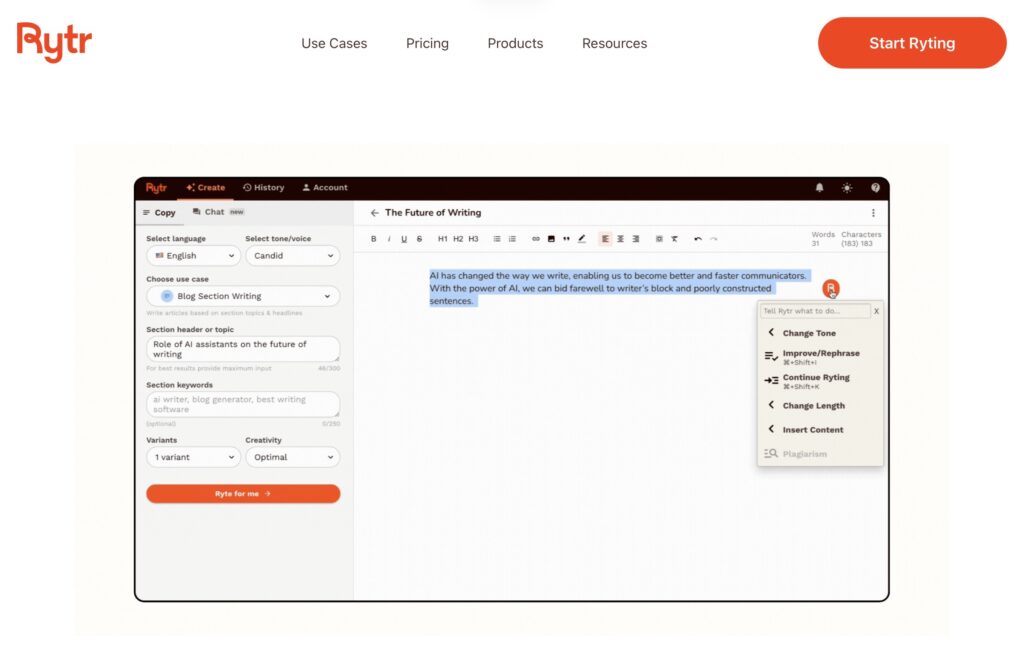
Template-driven content generation for short-form tasks across 40+ use cases.
What the Free Plan Gives You
10,000 characters per month. This translates to roughly 1,500–1,800 words depending on character-to-word ratio of the content type. The full template library is accessible on the free tier, which includes blog outlines, AIDA frameworks, product descriptions, social media captions, email subject lines, and over 40 additional formats. A built-in plagiarism checker is included at no cost — this is uncommon at the free tier.
Performance Findings
Rytr performed best on constrained short-form tasks. The social media caption set (three platforms, one product) was the strongest result — output was platform-appropriate and required minimal editing. The AIDA product description template produced a usable first draft in a single generation.
The 10,000-character monthly cap is the hard constraint. At that limit, Rytr is not a primary content tool — it is a supplement for specific formats. A single 1,500-word article consumes the entire monthly allocation. Operators running regular blog output will exhaust the free plan inside a week.
Where It Breaks
The character cap. Full stop. Beyond that, tone calibration on the free tier is limited, and output on longer-form prompts (500+ words) loses coherence in the second half more frequently than Claude or ChatGPT. The plagiarism checker is a real feature but returns results slowly.
Credit Architecture
Hard monthly character cap, not resettable. No rollover. Once 10,000 characters are consumed, the account is locked until the next billing cycle.
Edit Time Required
Medium. Short-form output is usable with light editing. Long-form output requires structural work.
#4 — Copy.ai: Most Accessible Free AI Writing Assistant, Harshest Cap
Core Function
Marketing copy generation with a clean chat-based interface and 90+ templates.
What the Free Plan Gives You
2,000 words per month. Access to the template library and chat interface. No credit card required to activate the free account.
Performance Findings
Copy.ai’s interface is the most beginner-accessible of the five free AI writing assistants tested. The chat-based input lowers the prompt engineering requirement — operators who are not comfortable writing structured prompts will find it easier to use than ChatGPT or Claude. The template output for ad copy and social captions was clean and platform-appropriate.
The 2,000-word monthly limit is a severe constraint. This is not enough for any operator running regular content production. A single 1,500-word blog post consumes 75% of the monthly allocation. Copy.ai’s free tier is accurately described as a trial, not a functional free plan.
Where It Breaks
The word cap makes this a tool for occasional short-form tasks only. The output on longer formats also requires more fact-checking than Claude or ChatGPT — claims made in marketing copy contexts tend toward superlatives without grounding.
Credit Architecture
Hard 2,000-word monthly cap. The most restrictive of all five tools tested. Upgrading to Pro ($29/month) removes the cap and adds five user seats.
Edit Time Required
Medium to high on longer content. Low on short-form copy tasks.
#5 — Grammarly Free Tier: Best Free AI Writing Assistant for Editing Existing Content
Core Function
Grammar and clarity checking, with AI-assisted generation via 100 free monthly prompts.
What the Free Plan Gives You
Unlimited grammar, spelling, and basic clarity checking. 100 AI generation prompts per month for tasks like rewriting, tone adjustment, and short-form drafting. Available as a browser extension, desktop app, and in-editor integration for Google Docs and Microsoft Word.
Performance Findings
Grammarly belongs on this list under one condition: you understand what it is and what it is not. It is not a content generator in the same class as ChatGPT or Claude. It is an editing layer with generation capabilities bolted on. The 100 monthly AI prompts are best deployed for sentence-level rewrites, tone adjustments, and clarity improvements — not full article generation.
For that specific function, it outperforms every other tool on this list. The grammar checking is the most accurate of any free tool tested. The clarity suggestions consistently reduce sentence complexity without stripping meaning. The rewrite prompts on the weak paragraph test produced the cleanest structural improvements of all five tools — because it is optimizing existing text rather than generating from scratch.
Where It Breaks
Generation at scale. The 100-prompt monthly limit is consumed quickly if used for full drafts. The AI generation quality on long-form content is noticeably behind ChatGPT and Claude. Grammarly’s strength is editing — using it as a primary content generator is fighting the tool.
Credit Architecture
100 AI prompts per month on the free tier. Grammar checking is unlimited and does not consume prompts.
Edit Time Required
Low for rewrites and edits of existing text. Medium to high for generated content.
Free Plan Comparison: What You Actually Get
| Tool | Free Limit | Reset Cycle | Output Quality | Best Use Case |
|---|---|---|---|---|
| ChatGPT | ~10 GPT-4o msgs / 5hr | Time-gated | High | Long-form drafts, varied tasks |
| Claude | 10–25 msgs / 5hr | Time-gated | High | Long-form prose, rewrites |
| Rytr | 10,000 characters/month | Monthly | Medium | Short-form, templates |
| Copy.ai | 2,000 words/month | Monthly | Medium | Ad copy, captions |
| Grammarly | 100 AI prompts/month | Monthly | Medium (edits only) | Editing existing content |
Frequently Asked Questions About Free AI Writing Assistants
What are free AI writing assistants?
Free AI writing assistants are text generation or editing tools available on no-cost plans, ranging from general-purpose chat interfaces like ChatGPT and Claude to template-driven platforms like Rytr and Copy.ai. In June 2025 testing, the underlying models powering these free tiers — GPT-4o mini, Claude Sonnet 4.5 — produced output functionally close to what drives most $15–$30/month dedicated writing platforms. The primary difference is workflow tooling, not prose quality.
How do free AI writing tools compare to paid AI writing platforms?
The gap has narrowed to UX and workflow automation, not raw output quality. In June 2025 testing, ChatGPT and Claude free tiers matched most mid-tier paid tools on coherence, tone controllability, and edit time before content is usable. Paid platforms retain real advantages in template libraries, brand voice settings, CMS integrations, and team collaboration — operators who need those layers should pay for them. Operators who do not are paying for interface.
Which free AI writing assistant produces the best output for blog content?
Claude’s free tier produced the strongest long-form blog output in June 2025 testing — fewest editorial interventions required, natural sentence rhythm, coherent argument structure. ChatGPT is the functional fallback when Claude’s daily message cap is reached mid-session. Used in rotation, these two free AI writing assistants outperform most $15–$30/month dedicated writing platforms on raw prose quality.
What are the main limitations of free AI writing assistants?
Each tool has a different hard constraint. Claude and ChatGPT are time-gated with rolling 5-hour resets — no override when the cap hits. Rytr’s 10,000-character monthly cap has no rollover; one blog post exhausts it. Copy.ai’s 2,000-word monthly limit functions as a trial, not a working free plan. None of the five tools tested offer API access, CMS integrations, or team features on free tiers — those require paid upgrades across the board.
How much editing does AI content generation from free tools actually require?
It depends on tool and content type. Claude required the least structural editing of the five tools tested — low intervention before output was usable. ChatGPT required low to medium editing on varied tasks. Rytr’s short-form output needed light editing; long-form output required structural work. Grammarly required minimal editing for rewrites, medium to high for generated drafts. Fact-checking is mandatory before publication regardless of tool or output quality — none of these eliminate that requirement.
Do I need prompt engineering skills to use free AI writing tools effectively?
ChatGPT and Claude require structured prompts to produce reliable on-format output — specifying tone, word count, and structure produces substantially better results than open-ended requests. Rytr and Copy.ai’s template interfaces lower this requirement significantly, making them more accessible to operators new to AI writing tools. Grammarly requires no prompt skills for its core editing function. If you are new to AI content generation, start with a template-based tool before moving to open-ended prompt interfaces.
For the companion piece on structuring AI prompts for blog output, see How to Write AI Prompts for Blog Content. For a direct head-to-head on the top two tools from this test, see ChatGPT vs Claude for Content Production. For a breakdown of when free AI writing tools no longer cover your volume needs, see Free vs Paid AI Writing Tools: When to Upgrade.
The Friction Box
- ChatGPT free tier drops to GPT-4o mini without warning — output quality shifts mid-session and most users do not notice.
- Claude’s message cap varies with server demand — it is not a fixed number you can plan around.
- Rytr’s 10,000-character cap sounds generous until you calculate that one blog post exhausts it.
- Copy.ai’s 2,000-word monthly limit is a trial disguised as a free plan — budget accordingly.
- Grammarly’s generation prompts and editing functionality are frequently conflated in marketing — the generation side is a secondary feature.
- None of these tools eliminate fact-checking requirements. Every piece of generated content requires verification before publication.
- Free tiers on all five tools exclude API access, CMS integrations, and team collaboration features.
The Straight Talk
If you are running solo content production and need the best free output quality, use Claude for long-form drafts and ChatGPT when Claude hits its cap. These two tools, used in rotation on free tiers, will outperform most $15–$30 per month dedicated writing platforms on raw prose quality.
Rytr is the right call if you need template-driven short-form content and want a structured system rather than a blank prompt interface — just accept the character cap as a hard monthly ceiling, not a flexible budget.
Skip Copy.ai’s free plan for any real production volume. The 2,000-word cap makes it a demo, not a tool.
Grammarly free is non-negotiable as an editing layer regardless of what you use to generate. Install it, use the 100 AI prompts for rewrites only, and do not try to use it as your primary generator.
The next concrete action: open a Claude account and a ChatGPT account today, run the same prompt through both, and decide which output style matches your editing preference. That decision takes 20 minutes and costs nothing.