AI Search Visibility (GEO): The New Strategy for Winning in a Post-Google Discovery Era
ChatGPT became the number one referral source for Tally — a bootstrapped form builder that competes against tools with ten times the budget. Not through paid ads. Not through a viral campaign. Because ChatGPT started recommending it when users asked which form tool to use.
That is GEO in one sentence. Generative Engine Optimization — AI search visibility — is the practice of structuring your brand and content so that AI platforms — Google AI Overviews, ChatGPT, Perplexity — cite you when a user asks a question you should own.
The math here is straightforward. ChatGPT clears 800 million weekly users. Google’s AI Overviews appear in at least 16% of all searches, skewing significantly higher for high-intent and comparison queries — exactly the queries where purchase decisions get made. If your brand is invisible to these systems, you are losing discovery to competitors who understand how AI citation actually works.
This is not a trend to monitor. It is infrastructure to build now.
TL;DR
GEO is the discipline of making your brand citable by AI systems. It builds on existing SEO foundations but shifts the optimization target from rankings to citations. The operators who invest in AI search visibility in 2025 will own AI-driven discovery by 2026. The ones who wait will spend that year trying to claw back ground from whoever moved first.
Environment: Research synthesized from Semrush AI Visibility Index tracking (2,500 prompts across Google AI Mode and ChatGPT), Google Search Central guidance (May 2025), and controlled large-scale GEO studies published via arXiv (2025). Findings reflect AI search behavior as observed through mid-2025.
Last updated: May 14, 2026
Generative Engine Optimization (GEO) is the practice of structuring your brand and content so that AI platforms like Google AI Overviews, ChatGPT, and Perplexity cite you when users ask questions you should own. It shifts optimization from rankings to extractable claims, requiring entity clarity, self-contained paragraphs, and multi-platform presence to earn AI citations.
The Architecture: How AI Discovery Actually Works
Traditional search returns a ranked list. You optimized for position one. The user clicked. Traffic arrived.
AI search does something structurally different. It constructs an answer. It pulls a paragraph from your blog, a statistic from your whitepaper, a product description from a review platform, and assembles them into a synthesized response. Your brand either appears inside that answer or it does not.
This changes the unit of optimization. In traditional SEO, you optimized a page. In GEO, you optimize an extractable claim.
Here is what that means operationally. When an AI system processes a query like “best project management tool for a five-person agency,” it scans accessible content for specific, fact-dense passages it can cite with confidence. It does not award points for keyword density. It rewards clarity, specificity, and structural extractability — can this paragraph stand alone and answer the question without the surrounding context?
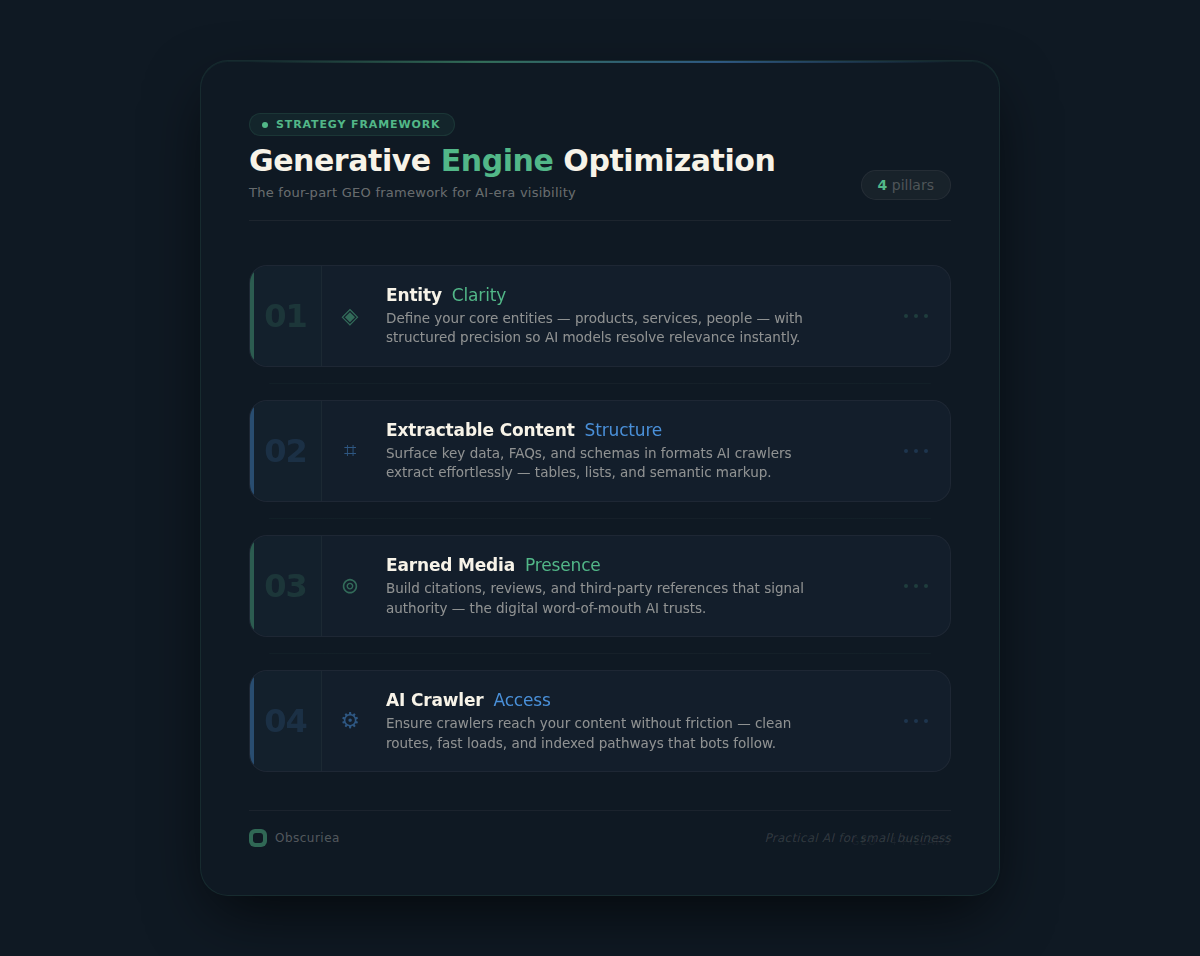
Research tracking AI citation behavior identified three structural characteristics that consistently appear in cited sources: entity clarity (the AI knows exactly what your brand is and does), content extractability (individual paragraphs deliver complete answers), and multi-platform presence (the brand appears across multiple independent sources, not just its own website).
Volatility is real — between 40% and 60% of cited sources change month-to-month across major AI platforms. But the brands that maintain consistent presence in AI search visibility share those three characteristics. The instability is not random. It is a signal about what the system values.
The Workflow Math: GEO vs. SEO Cost and Return
Before committing to this transition, calculate your actual bottleneck. GEO is not a replacement for SEO. It is an extension of it, with a different labor allocation.
| Activity | Traditional SEO Focus | GEO Adaptation | Estimated Additional Effort |
|---|---|---|---|
| Content writing | Keyword-targeted long-form | Self-contained paragraphs with extractable claims | +20% editing time per article |
| Link building | Domain authority via backlinks | Earned media placements on third-party platforms | Ongoing, 3–5 hours/week |
| Technical SEO | Crawlability, site speed, structured data | All of the above + AI crawler access, schema validation | 1–2 hour audit per quarter |
| Brand presence | Website and blog | Reddit, YouTube, industry publications, review platforms | Depends on current gaps |
| Metrics tracking | Rankings, traffic, CTR | AI visibility score, share of voice, citation sentiment | New tooling required |
The earned media line is where most operators underestimate the cost. AI systems — particularly ChatGPT and Perplexity — show a systematic and disproportionate bias toward third-party authoritative sources over brand-owned content. One controlled study across multiple verticals documented this as an “overwhelming bias toward earned media.” Your blog is not enough. A respected industry publication writing about your tool carries more citation weight than ten articles on your own domain.
If you are running a lean operation, the prioritization looks like this: fix technical extractability first (low cost, immediate impact), then invest in two or three earned media placements in high-authority outlets before spending time on social platform presence.
Where GEO Breaks: Specific AI Visibility Failure Points
The three places GEO investment fails to produce citation visibility:
1. Content that requires context to make sense. AI systems extract passages. If your best explanation of what your product does is buried in paragraph six of a 2,000-word article and relies on the preceding five paragraphs to make sense, it will not get cited. The fix is to front-load every section with a self-contained claim. Answer the question in the first sentence of each section, then support it.
2. Single-platform presence. An operator who publishes exclusively on their own blog is asking an AI system to cite a source with minimal third-party validation. The research is unambiguous here: AI platforms weight earned media heavily. A brand with no presence on Reddit threads, review platforms, or independent publications will lose citation share to competitors who have it, even if the competitor’s owned content is weaker.
3. Blocking AI crawlers without realizing it. Some bot-blocking configurations that were implemented years ago to reduce server load are now preventing AI indexing. Googlebot access is table stakes. Specifically checking that AI-associated crawlers are not being blocked in robots.txt is a five-minute audit that a surprising number of operators have not run. Google’s official guidance confirms that technical accessibility requirements for classic search carry directly into AI search experiences — there is no separate AI-specific crawl allowance.
There is also a harder structural problem for niche operators. Research documents a “big brand bias” in AI citation behavior — larger, more established brands get cited more frequently simply because they appear across more independent sources. This is not insurmountable, but it means niche operators have to be more deliberate about earned media than an established brand does. The path is not to compete for citation share on broad queries. It is to dominate citation on narrow, specific queries where the big brand has not bothered to build presence.
The Friction Box
- Metric visibility is a gap. Most analytics setups do not track AI citation share or brand mentions in AI-generated answers. You need new tooling — Semrush’s Enterprise AIO, Brandwatch, or similar — to measure whether GEO investment is producing results.
- Volatility makes attribution hard. Citation patterns shift monthly. A single earned media placement that drives citations in March may not produce the same lift in April. Sustained presence requires ongoing investment, not one-time execution.
- Earned media has a long lead time. An outreach campaign to industry publications does not produce placements in week one. Budget three to six months before expecting measurable citation impact from this channel.
- Big brand bias is real. Niche operators face a structural disadvantage in broad-query citation. The counterstrategy is specificity, not volume.
- AI-specific structured data guidelines are still evolving. Google’s formal guidance as of May 2025 still ties AI performance to the same structured data principles as traditional search. The schema best practices for AI-native citation are not fully codified yet. For deeper reading on how GEO differs from traditional SEO frameworks, the [arXiv GEO study](https://arxiv.org/html/2509.08919v1) is the most rigorous empirical source available. For current Google guidance, see [Google Search Central’s AI experiences post](https://developers.google.com/search/blog/2025/05/succeeding-in-ai-search).
The Straight Talk
This strategy is for operators running content-driven businesses — SaaS tools, agencies, consultancies, niche publishers — where discovery drives the top of the funnel and AI search visibility is now a meaningful share of that discovery channel.
If you are running a purely transactional business where customers find you through paid channels and direct referrals, GEO is a lower-priority investment for right now.
If you are in the first category: run the technical audit this week, identify two earned media targets in your space this month, and restructure your next five articles so that every section opens with a self-contained, extractable claim.