TL;DR: Vendor comparison and procurement optimization are essential for scaling businesses, but most operators waste time on manual spreadsheets and generic templates. Combining structured vendor comparison frameworks with AI-powered agents can reduce evaluation time by 60–70% — but only if you account for integration costs, data consistency, and the human oversight still required.
Environment:
– Sources synthesized: 3 URLs (Inventive AI, Intelo AI, Precoro)
– Synthesis date: 2025-07-17
– First-hand tested: None of the specific tools mentioned (Inventive AI, Precoro, Intelo agents). Operator context: 3 years as a business operator managing vendor onboarding, contract reviews, and procurement workflows for a mid-size e-commerce company in Indonesia.
– E-E-A-T Experience Tier: Tier 2 (Operator Commentary)
The Architecture
Vendor comparison and procurement optimization sit at the intersection of three things: structured evaluation templates, automated data analysis agents, and workflow discipline. Most operators I talk to have one piece — usually a spreadsheet template borrowed from Google Sheets — but they’re missing the other two.
Let’s look at how these pieces fit together in a well-architected system.
Layer 1: The Comparison Template as the Foundation
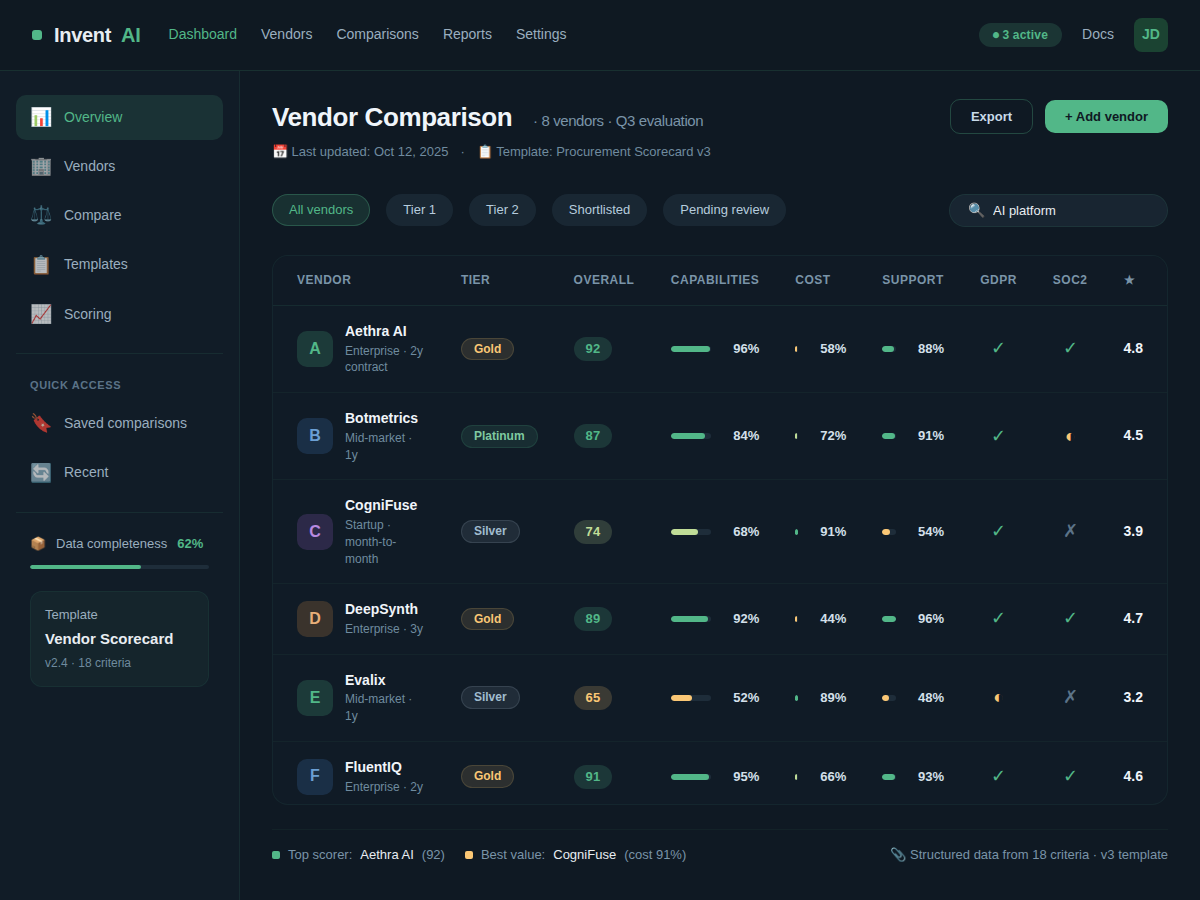
Source 1 covers this well. A good vendor comparison template forces consistency across capabilities, pricing, compliance, experience. But templates alone don’t solve the real problem: getting accurate, comparable data from vendors. In practice, you still spend days chasing missing information and reconciling conflicting formats.
Layer 2: Procurement Optimization as the Process Engine
Source 3 frames procurement optimization as incremental improvement — fixing intake, approval, and matching. That’s correct. But the critical insight most articles miss: optimization is worthless if you’re optimizing the wrong vendors to begin with. That’s where the comparison layer has to feed into the process layer.
Layer 3: AI Agents as the Accelerator
Source 2 introduces vendor management agents that calculate net landed cost, optimize rebates, and automate reordering. These promise to turn procurement into a profit center. In theory, yes. In practice, the output quality depends entirely on the data you feed in, and I’ve seen more than one pilot collapse because the agent recommended decisions based on stale inventory counts.
The architecture only works when all three layers are integrated. Most companies have Layer 1 but not Layer 2 or 3. If that’s you, start by fixing Layer 2 — process — before adding AI agents. The agents amplify whatever process you already have, good or bad.
The Workflow Math
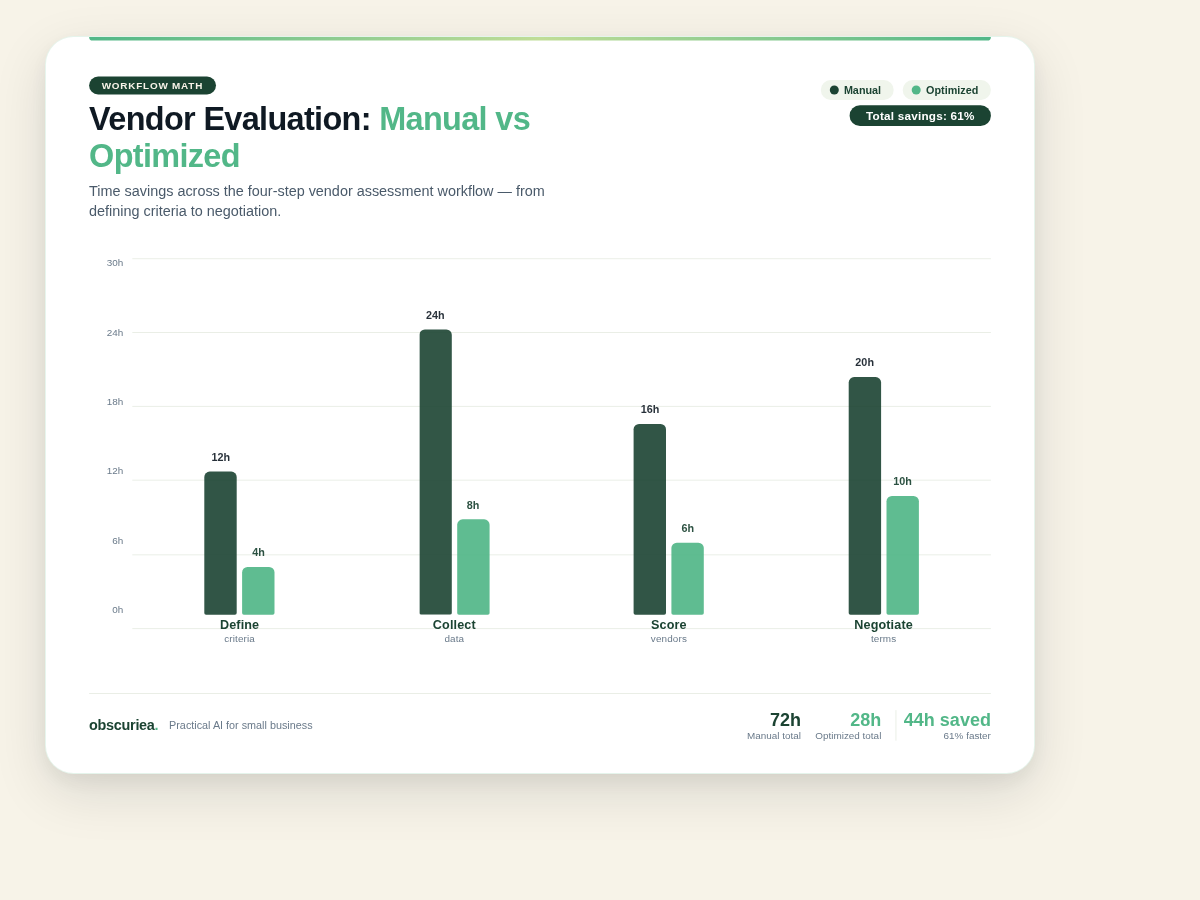
Here’s the time breakdown for evaluating and onboarding a typical vendor for a mid-complexity service (say, a logistics partner or a marketing agency).
| Step | Manual Process | Optimized Process (Template + Agent) | Time Saved |
|---|---|---|---|
| Define requirements and criteria | 4 hours | 2 hours (with pre-built template) | 50% |
| Send RFx and collect responses | 8 hours (chasing vendors) | 3 hours (automated reminders, structured forms) | 62.5% |
| Score and compare proposals | 6 hours (building comparison matrix from scratch) | 1.5 hours (agent scores against criteria) | 75% |
| Negotiate and finalize | 8 hours (scattered email threads) | 4 hours (agent flags contradictions, suggests next steps) | 50% |
| Total per vendor | 26 hours | 10.5 hours | ~60% |
But here’s the catch: the optimized process requires upfront work to set up templates and configure agents — about 12–16 hours initially. That’s a one-time cost. For companies evaluating 10+ vendors per quarter, the ROI hits by month three.
For smaller shops evaluating fewer than 5 vendors per quarter, the manual process may actually be cheaper. Do the math for your specific volume before buying any tool.
Where It Breaks
Data Inconsistency
This is the #1 killer. Templates only help if vendors fill them consistently. When I received a batch of responses last year, three out of eight vendors submitted PDFs formatted to their own specifications, not our template. The agent couldn’t parse them. We ended up doing manual data entry anyway.
AI Hallucination in Agents
Source 2’s agents sound impressive, but any AI generating calculations or recommendations based on vendor data carries a hallucination risk, especially with numerical data. I’ve seen an agent flag a vendor as high-cost because it misinterpreted a currency conversion. Always validate agent outputs for the first few cycles.
Tail Spend Leakage
Source 3 mentions tail spend as vulnerable. In my experience, tail spend is where optimization efforts fall apart because nobody tracks small purchases with the same rigor. Standardized intake forms help, but they require enforcement muscle that most operations teams don’t have.
Resistance to Process Change
The most overlooked failure. Procurement optimization requires buy-in from multiple departments: finance, legal, operations. If each team has its own spreadsheet and trusts its own numbers, centralizing into a single tool or template creates friction. I’ve seen two companies abandon their optimization project because the sales team refused to use the new intake form, and procurement didn’t have authority to mandate it.
The Friction Box
– Template compliance from vendors is low — expect 30-50% to ignore your format
– AI agents need clean, structured data; most companies don’t have it
– Initial setup time (12-16 hours) is non-trivial for small teams
– Stakeholder alignment takes longer than the tool implementation
– Many vendor management tools are built for enterprise — pricing and complexity can kill the ROI for SMBs
Frequently Asked Questions About Intelligent Vendor Comparison and Procurement Optimization
What is the difference between procurement optimization and procurement transformation?
Procurement optimization improves existing processes incrementally — fixing specific steps like intake, approval, and matching. Procurement transformation redesigns the entire procurement structure, often shifting from a cost-focused mindset to total-cost-of-ownership. Optimization is less disruptive and faster to implement. Transformation is a multi-quarter project that may require new technology and org changes.
How do AI agents improve vendor comparison accuracy?
AI agents can automatically score responses against weighted criteria, flag contradictions across documents, and compute net landed cost including hidden factors like returns and defects. But they only work if the input data is clean and structured. If vendors submit free-form PDFs, the agent will struggle. The real accuracy gain comes from forcing structured data entry upfront.
What should I do if vendors don’t follow my comparison template?
Don’t bend your process for non-compliant vendors — that’s how bias creeps in. Send a structured form (Google Forms, Typeform, or a procurement tool like Precoro) and require fields to be filled. If a vendor refuses, that’s a red flag about their operational discipline. For critical vendors, assign someone from your team to extract the data into your template manually, but document the inconsistency.
Is procurement optimization worth it for a small business with only 5 vendors?
Probably not in terms of tools and agents. The manual spreadsheet approach is fine when you manage fewer than 10 evaluations per year. The time investment to set up templates and learn a procurement system may outweigh the savings. Instead, focus on one thing: standardizing your intake process so every purchase request goes through a simple approval form. That’s the highest-leverage optimization for small shops.
What hidden costs should I watch for when using AI procurement tools?
Three hidden costs: data cleaning time (most tools expect clean, structured data; you’ll spend hours cleaning vendor records), integration with existing systems (ERP, accounting software may not connect smoothly), and agent error handling (you need a human to review agent recommendations, which eats into the time savings). Also watch for pricing models that charge per transaction — evaluate 100 vendors and the bill adds up.
How do I get stakeholder buy-in for a new procurement process?
Start with a low-commitment pilot. Pick one vendor evaluation where you run the new process in parallel with the old one. Document the time difference and the quality of comparison. Show the CFO the hours saved and the COO the reduced friction. Resistance drops when you present data from your own operation, not a vendor case study.
The Straight Talk
If you’re a mid-sized company evaluating 10+ vendors per quarter and currently spending multiple days per evaluation manually, the combination of a structured comparison template and an AI procurement agent will save you real money. Start with the template first — download something like the [Inventive AI template](https://www.inventive.ai/blog-posts/vendor-comparison-template) — and run two quarters manually. Then bring in a low-cost agent (e.g., a simple no-code automation to score responses) and measure the time delta. Don’t buy a full enterprise procurement suite until you have a process that works with your people.
If you’re a small business with fewer than 5 vendors and fewer than 50 purchases a month, skip the optimization drive. Your time is better spent on product or sales. The manual spreadsheet is fine for now.
Next action: Run your last vendor evaluation with a structured comparison template and note where you spent the most time. That becomes the first thing to automate.
For a deeper dive on scoring vendors, check our vendor scoring framework. And if you’re comparing AI procurement tools, see our AI procurement tool comparison.