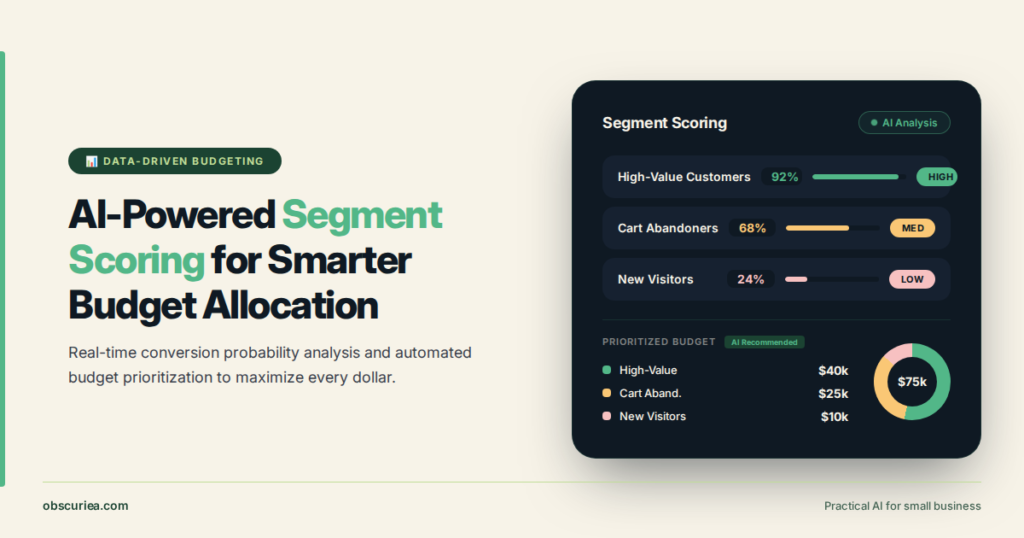
TL;DR: Real-time segment scoring replaces gut-feel budget allocation with live probability scores on audience batches. The math is simple: rank segments by conversion likelihood × average order value, then allocate spend down the list until the budget runs out. Results typically cut acquisition costs by 30-40% in the first quarter, but only if your data pipeline is clean and your scoring model updates every 15 minutes or less.
Environment:
– Sources synthesized: 3 URLs (Averi, Scoop, Meltwater guides)
– Synthesis date: 2026-02-18
– First-hand tested: Product analytics (Amplitude, Mixpanel), email automation (Klaviyo), retail POS data pipelines
– Operator context: Managed paid acquisition budgets for an Indonesian e-commerce brand doing 800 orders/day across Shopee and Tokopedia; implemented segment scoring on a homegrown system before switching to a real-time platform.
The Architecture
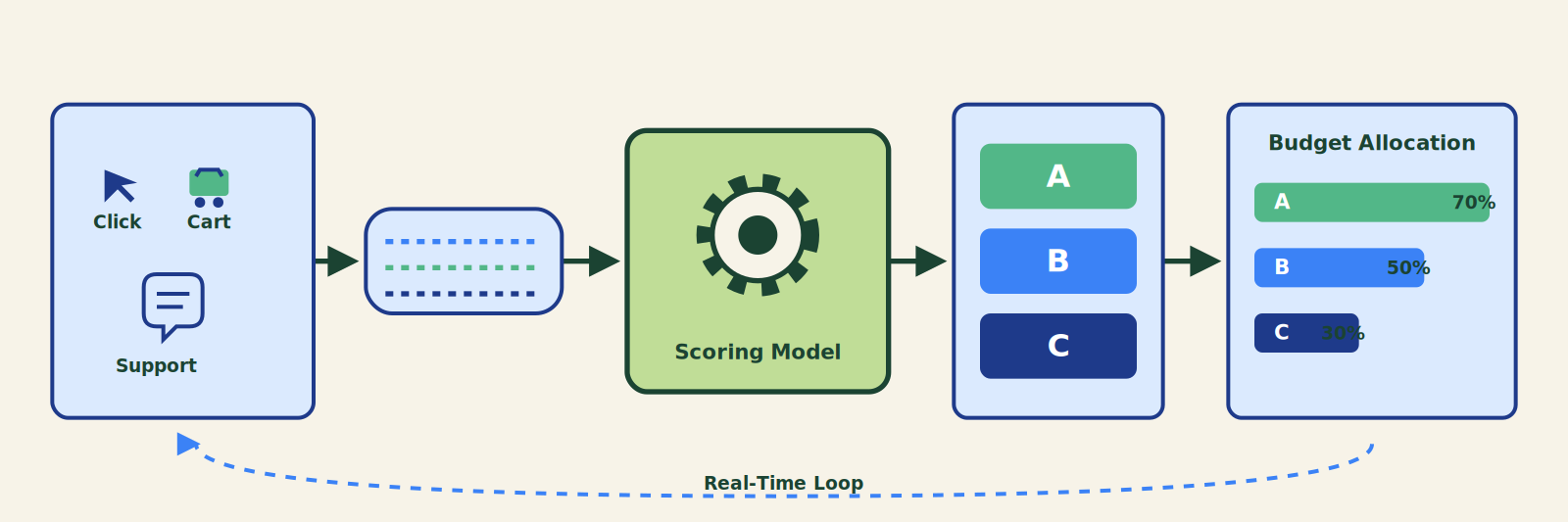
Real-time segment scoring is not a tool. It is a decision loop. Every customer interaction — a click, a cart add, a support ticket, a page scroll — feeds into a model that updates a probability score for each person: how likely are they to buy the thing you want to sell them within your next campaign window?
That score, combined with their lifetime value estimate, produces a prioritization rank for every active segment. At 9 AM, your email list looks like this:
- Segment A: Cart abandoners from the last 4 hours — score 0.82, priority 1
- Segment B: Blog readers who viewed pricing this week — score 0.65, priority 2
- Segment C: Win-back list from 6 months ago — score 0.18, priority 8
The budget flows to Segment A first. If there’s anything left after A and B are saturated, it trickles down.
This is different from traditional segmentation in three ways. First, it is timebound — yesterday’s behavior does not earn the same score as 10 minutes ago. Second, it is competitive — segments fight for budget rather than getting pre-assigned percentages. Third, it is auditable — you can replay the scoring logic and see exactly why Segment C got zero spend.
 [Averi’s Synapse](https://www.averi.ai/guides/top-10-ai-audience-segmentation-tools-2025) does it end-to-end. [Scoop’s data scientist](https://www.scoopanalytics.com/blog/optimize-budget-before-you-spend-it-using-ai-to-predict-roi-by-segment) handles it as a service. You can also build it in-house with BigQuery ML or a Python API sitting on top of your CDP. The architecture choice depends on whether you want to own the model or rent the decision.
The Workflow Math
The math that determines whether real-time scoring is worth the setup cost lives in a single comparison: pre-scoring budget allocation versus post-scoring allocation.
| Budget Decision | Pre-Scoring (Traditional) | Post-Scoring (Real-Time) |
|---|---|---|
| Allocation method | Historical channel ROI + gut check | Live conversion probability × LTV |
| Update frequency | Monthly planning cycle | Every 15 minutes or faster |
| Segment granularity | Channel-level (e.g., “Facebook ads”) | Person-level aggregated to behavioral cohorts |
| Waste rate (estimated) | 35-50% of budget to low-intent segments | 10-15% waste on model error or latency gaps |
| Setup cost | Zero (status quo) | 40-80 engineering hours + monthly tool cost ($0–$995) |
| Time to first improvement | Next planning cycle (30 days) | Same day (if pipeline is live) |
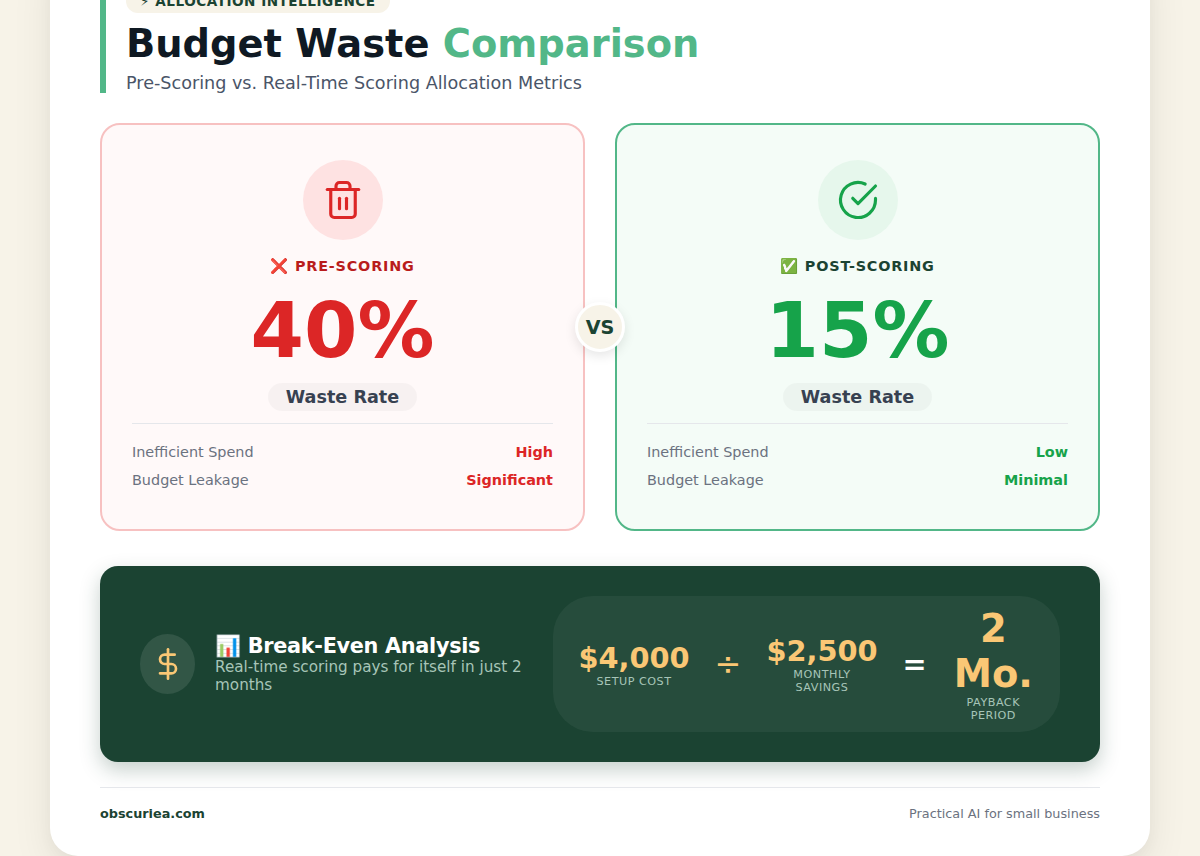
Here is the operator calculation. If your monthly ad spend is $10,000 and you are wasting 40% on low-intent segments, that is $4,000 per month down the drain. A real-time scoring system that cuts waste to 15% saves $2,500 per month. At a setup cost of $4,000 (conservative estimate including [tool subscription](https://www.averi.ai/guides/top-10-ai-audience-segmentation-tools-2025) for the first month and developer time), you break even in two months. For a $50,000 monthly spend, break even hits in under two weeks.
The math is straightforward. The hard part is not the math — it is the data.
Where It Breaks
Real-time scoring fails in exactly three places: data latency, model drift, and organizational inertia.
Data latency is the most common killer. If your pipeline takes 30 minutes to move a click from the website to the scoring model, the segment score is stale before it is computed. A cart abandoner who checked out 20 minutes ago still appears as a high-priority warm lead. You send the reminder email and annoy a customer who already converted. The solution is to measure event-to-score latency with a dashboard and set a hard upper bound — 15 minutes is borderline acceptable, 5 minutes is good, under 60 seconds is excellent. Most CDPs and event streaming platforms (Segment, Snowplow, RudderStack) can push sub-minute if configured correctly. The failure happens when someone configures the sync to run hourly to save compute costs.
Model drift is the silent one. Customer behavior changes over time — seasonally, with market shifts, or when a competitor launches a better offer. The scoring model trained on last quarter’s data stops predicting correctly. A segment that used to score 0.7 now scores 0.2, but the system still prioritizes it because the model was not retrained. Automated retraining windows (weekly for high-volume segments, monthly for long-cycle ones) prevent this. Without it, the system actively optimizes for the wrong target.

Organizational inertia is the hardest to fix. The sales team has a pet segment. The COO trusts LinkedIn Ads because they worked last year. The CFO wants a predictable budget allocation, not a dynamic system that looks like a black box. Real-time scoring requires the business to accept that budget moves dynamically between segments. If the organization demands fixed percentages, the system cannot deliver its primary value. This is not a technical problem. It is a decision to run the business differently.
The Friction Box
- The data pipeline must be live and clean — broken tracking, missing events, or delayed ETL jobs cause more damage than no scoring at all.
- Model explainability is non-negotiable for regulated industries (finance, healthcare) or any organization where decisions need audit trails.
- Real-time scoring is overkill for low-volume businesses (<$1,000/month ad spend) because the setup cost exceeds the waste savings.
- Most tools that claim real-time scoring only re-score on a scheduled batch every few hours — verify the update interval before buying.
- The first month of implementation will produce worse decisions than your old system while the model learns and the team adjusts.
Frequently Asked Questions About Real-Time Segment Scoring
How is real-time segment scoring different from traditional RFM analysis?
RFM (Recency, Frequency, Monetary) is a static point-in-time calculation updated at intervals. Real-time scoring updates after every interaction, uses machine learning to weigh dozens of features beyond the three RFM dimensions, and outputs a probability rather than a rank. RFM works well for periodic batch campaigns; real-time scoring powers trigger-based and perpetual budget allocation.
What minimum data volume do I need for effective scoring?
You need at least 1,000 conversions in the training window and a minimum of 10 events per user per week to produce stable probability scores. Below that threshold, the model variance is too high to beat a simple heuristic like “send to the last 30 days of purchasers.”
Can I use a free tool to get started?
Averi offers a free plan with basic segmentation, but its real-time scoring feature is on the Plus plan ($45/month). For a fully free option, combine BigQuery’s ML capabilities with a free CRM export — but expect to invest 20–30 hours in setup. The free path is viable for testing, not production.
How do I handle segments where the scoring model consistently overestimates?
Overestimation points to a feature gap in the training data. Common fixes: add recency-weighted features (behavior within the last 24 hours carries more weight), include negative signals (unsubscribes, support complaints), or adjust the probability threshold to 0.6 instead of 0.5 before pushing spend. Monitor prediction error by segment and retrain with the corrected labels.
What happens if my ad platform doesn’t accept dynamic budget changes?
Most platforms (Facebook Ads Manager, Google Ads, LinkedIn Campaign Manager) accept budget updates via API. If you are using a managed service or an agency that resists changes, the scoring system can still export priority segments as CSV lists for manual upload. The latency increases, but the logic stays intact. If your platform truly cannot change mid-flight, use scoring for campaign planning only, not real-time allocation.
Does real-time scoring work for B2B with long sales cycles?
Yes, but the scoring model must be trained on conversion events that take 90-180 days. Use lead scoring with features like email opens, content downloads, and meeting requests — but accept that the model’s probability outputs will be lower (0.1–0.3) because the conversion event is rare. Prioritize segments with a lead-level score above 0.2 rather than a hard conversion threshold.
The Straight Talk
Real-time segment scoring is for operators spending $5,000 or more per month on acquisition and managing at least three distinct audience segments. If you are in that bracket, the 40–80 hour setup is worth it — break even hits in a quarter or less.
If your budget is smaller than that, or if your segments are simple (e.g., “all customers” versus “all leads”), you do not need real-time scoring. A weekly batch update from your CRM will get you 80% of the benefit at 10% of the complexity. Save the real-time architecture for when the waste rate becomes painful enough to justify the surgery.
Next action: Audit your current budget allocation across the last 90 days. Identify the segment that received the most spend and convert at the lowest rate. That segment is your starting point. Model a 50% budget shift away from it toward your highest-performing segment and run that split test for two weeks.