TL;DR
Moving from gut feeling to data-driven decisions with AI isn’t about replacing intuition—it’s about building a structured pipeline that feeds insights into your existing operational expertise. The most successful implementations achieve accuracy improvements from 10% variance down to 2-3% while preserving human judgment for local context and exception handling. This article breaks down the architecture, the math, and the failure modes you need to know before investing.
Last updated: May 14, 2026
Moving from gut feeling to data-driven decisions with AI means building a structured pipeline that feeds AI-generated forecasts into your existing operational expertise. The most successful implementations achieve accuracy improvements from 10% variance down to 2-3% by combining AI baseline forecasting with human override for local context and exception handling.
Environment
- Sources synthesized: 3 URLs (Board.com Whataburger case study, Narratic.ai RevOps journey, Dragonfly AI creative decisions article)
- Synthesis date: 2026-04-01
- First-hand tested: None for the specific tools mentioned; operator context in SME and SEA e-commerce operations
- Operator context: 4 years running operations for a small B2B SaaS team, including transition from spreadsheet-based forecasting to basic AI-assisted projections
The Architecture
Every business that has successfully migrated from gut feel to data-driven decisions follows the same three-layer architecture. It does not matter whether you are running a fast-food chain, a B2B revenue team, or a creative studio. The shape of the pipeline is identical.
Layer 1: Data Collection and Hygiene
Before any AI can produce useful projections, you need raw material. This is where most attempts fail before they begin. The Whataburger case study shows that even a sophisticated forecasting model depends on clean, consistent historical data. If your CRM is full of duplicate contacts and missing fields, or your sales team manually logs calls when they remember to, the AI baseline will be built on sand.
The rule is simple: automate data capture wherever possible. Calendar events, email threads, call transcripts, transaction logs—if a human has to type it in, it will be incomplete or wrong within a month. The [RevOps playbook](https://www.narratic.ai/blog/from-gut-feel-to-data-driven) makes this explicit: your CRM must become the single source of truth, and the only way to achieve that is to remove manual entry from the critical path.
Layer 2: AI Baseline Forecasting
Once you have clean data, the AI layer generates a baseline. This is not a single number—it is a probability distribution with explicit headwinds and tailwinds. The Whataburger team uses Board Foresight to analyze macroeconomic indicators, regional sales patterns, and market drivers. In more straightforward contexts, a simple linear regression on your last twelve months of data may be sufficient.
What matters is that the AI does not produce a black-box number. It must produce an explainable baseline that your operators can challenge. If the model says “next quarter revenue will be between $240K and $270K with 80% confidence,” your operations team needs to understand which factors are driving that range. The AI is a forecasting engine, not a decision engine.
Layer 3: Human Override and Local Knowledge
This is the layer that separates a genuinely useful data-driven operation from a theoretical one. The AI baseline gets handed to the people who live inside the business—store managers, sales leads, production heads. They adjust the forecast based on things the model cannot see.
Whataburger’s finance leader puts it clearly: operations managers factor in a competitor opening across the street, a planned remodeling project, or a local holiday that does not appear in national economic data. The AI accuracy improves from 10% variance to 2-3% not because the AI got smarter, but because humans injected context the model had no way to capture.
This hybrid architecture is the only model that works at scale. Pure intuition fails because it cannot process enough variables. Pure AI fails because it cannot see local reality. The bridge between them is the operational layer.
The Workflow Math
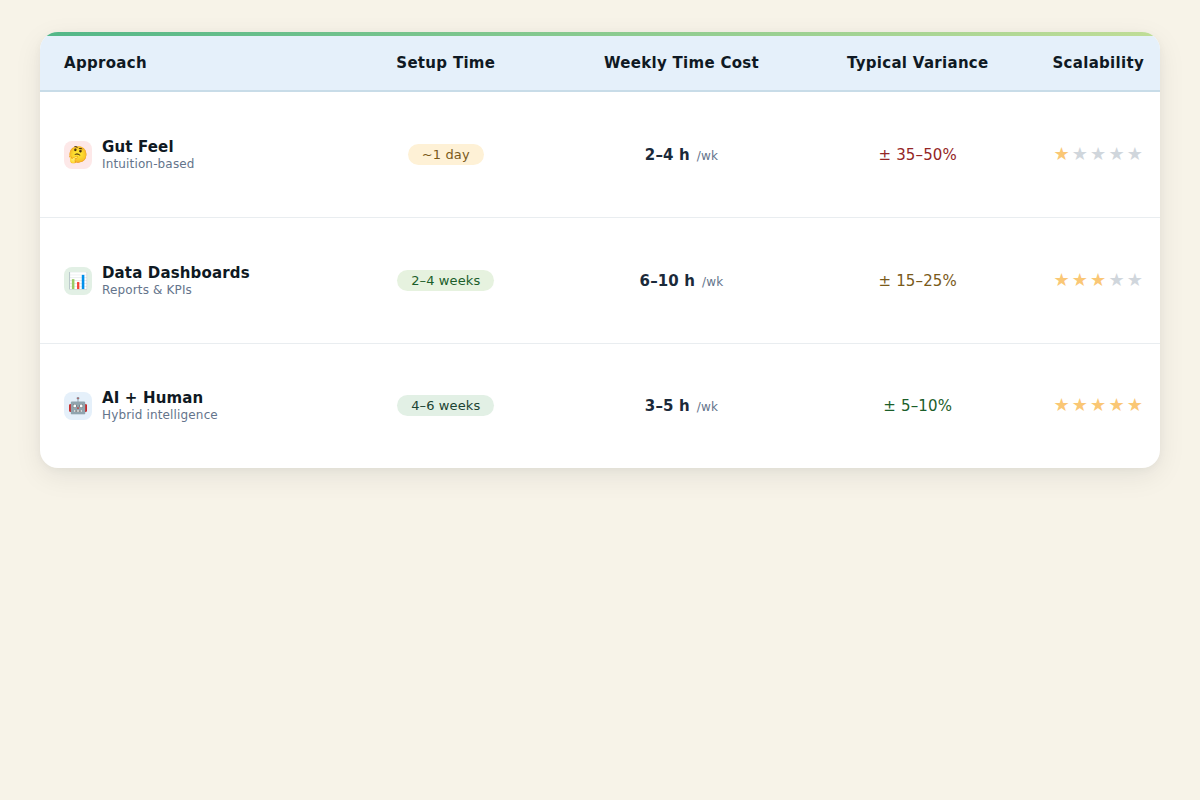
Let us compare the time and accuracy profiles of three decision-making approaches at a typical small-to-medium business making a weekly revenue forecast.
| Approach | Setup Time | Weekly Time Cost | Typical Variance | Scalability |
|---|---|---|---|---|
| Pure gut feel (spreadsheet + guess) | 0 hours | 1-2 hours | 15-25% | Low |
| Data dashboards (manual CRM + BI tool) | 20-40 hours initial | 3-5 hours | 10-15% | Medium |
| AI baseline + human override | 60-100 hours initial (training + integration) | 3-4 hours (review + adjust) | 2-5% | High |
The initial investment for the AI route is substantial—60 to 100 hours of setup time, including data cleanup, model training, and operator training. But the weekly time cost is comparable to manual dashboards, while accuracy improves by a factor of 2-5x.
Here is the math that matters for a small business: if you currently make a weekly inventory decision that affects $5,000 in potential waste or lost sales, a 5% improvement in forecast accuracy saves roughly $250 per week—$13,000 per year. The setup investment pays for itself in about 5-6 weeks.
For larger operations, the multiplier is bigger. Whataburger’s accuracy improvement from 10% to 2-3% variance translates into millions in reduced waste and missed revenue. But the principle scales all the way down to a three-person e-commerce store.
Where It Breaks
Despite the compelling math, the transition to data-driven decisions fails in predictable ways. Understanding these failure modes upfront can save you months of wasted effort.
Failure Mode 1: Garbage-In, Garbage-Out
The most common failure. A company buys an expensive AI forecasting tool but has not cleaned its CRM or POS data. The model produces nonsense, leadership loses faith, and everyone goes back to gut feel. The fix is boring: fix your data hygiene before you buy the tool.
Failure Mode 2: The AI Black Box Mistrust
If operators cannot understand why the AI made a prediction, they will not trust it. A model that outputs “72% probability” with no explanation is useless in an operational meeting. The Whataburger approach—where the AI explains the headwinds and tailwinds it is factoring in—is non-negotiable.
Failure Mode 3: Overfitting to Historical Patterns
AI models trained on past data will fail when the environment shifts. The 2022 volatility that broke Whataburger’s previous trend-based forecasting is a classic example. If your model only learned from years of stable growth, it will be useless in a downturn or a supply chain disruption. Regular retraining and manual override capability are the only safeguards.
Failure Mode 4: Operational Resistance
The people who make decisions daily will resist a system that overrides their authority. If the AI generates a forecast and finance hands it to operations as a mandate, operators will find ways to game the numbers or ignore the system. The solution demonstrated in the Whataburger case—give operators the ability to adjust the forecast and make the adjustments visible—turns resistance into ownership.
Failure Mode 5: Cost Creep at Scale
The initial investment is one thing. The ongoing cost of cloud compute, API calls, and model retraining can catch you off guard. Always model the year-2 cost, not just the setup cost.
The Friction Box
- Data quality is the silent budget killer. Most companies underestimate how much cleanup is needed before any AI tool works. Plan for 60-100 hours of prep, not 10.
- The AI baseline is only as good as the data it trains on. If your business is new or your data history is less than 12 months, the model will be weak and you should lean more on human judgment.
- Getting operators to trust and use the system takes 2-3 forecasting cycles of visible success. One miss can kill adoption for months.
- Vendor lock-in is real. Once you build your pipeline around a specific AI platform, switching costs are high. Evaluate for data portability from day one.
- Legal and compliance issues around data sovereignty are often overlooked. If your customer data crosses borders, make sure your AI tool complies with local regulations (e.g., Indonesia’s UU PDP).
Frequently Asked Questions About From Gut Feeling to Data-Driven Decisions With AI
How long does it take to see results from AI-driven forecasting?
Most teams see measurable accuracy improvements within 2-3 forecasting cycles (weeks to months, depending on cycle length). The biggest gains come after operators learn to trust and integrate their local knowledge with the AI baseline.
What’s the minimum data history needed for AI forecasting to work?
For statistical models, 12-18 months of consistent weekly data is ideal. With less history, you can still use AI, but you need more frequent human override. Some tools can work with as little as 6 months if you incorporate external market signals.
Do I need a data scientist on staff?
Not necessarily—modern AI forecasting tools are designed for operators. However, you need someone on the team who can clean data, set up integrations, and interpret model outputs. This could be an operations manager with basic analytics skills.
How do I get my team to trust AI predictions instead of their gut?
Let them adjust the forecasts and track their adjustments separately. When they see their own improvements beat the baseline, trust builds organically. Never force an AI prediction as a mandate. This is the Whataburger playbook.
Can small businesses with limited budgets afford AI forecasting?
The setup cost (60-100 hours) is the real barrier—tools themselves can start at $100-500/month for SMBs. The payback depends on the size of the decisions you are making. For a small e-commerce store managing $10K monthly inventory, the ROI may be borderline; for a $100K monthly revenue business, it almost always pays back within a quarter.
What’s the biggest mistake companies make when adopting AI for decisions?
Skipping the data hygiene step. Companies rush to buy a tool without cleaning their existing data, then blame the AI when it performs poorly. Data preparation is 80% of the work.

The Straight Talk
This approach is for operators who are still using spreadsheets and intuition for decisions that affect cash flow, inventory, or staffing. If your weekly variance on revenue forecasts is consistently above 15%, you will benefit from the shift. If you have already implemented a solid data pipeline with BI dashboards and your variance is under 10%, the marginal gain from adding AI baseline forecasting may not justify the setup cost yet.
Skip this if you are a one-person shop with fewer than 10 recurring decisions per week—your time is better spent on execution than on building forecasting infrastructure. The 60-100 hour setup investment will not pay back fast enough.
Next action: Audit your data quality this week. Export your CRM, accounting, or POS data for the last 12 months and check three fields: completeness, consistency, and recency. If any field has more than 15% missing values, start there.