
TL;DR: Manual keyword research builds lists. Topical cluster mapping builds authority. AI can generate a full content architecture – pillar pages, supporting articles, intent-labeled clusters – in minutes. The setup cost is low. The compounding SEO payoff is not.
Environment: Tested workflows using HackTheSEO Topical Map, SEOcluster.ai, and ChatGPT-4o as a cluster scaffolding layer. Testing period: Q1 2025. Site types: niche content blog (180 published posts) and a local service site (42 pages). All cluster maps generated between January and March 2025.
The Broken Workflow: Why You Need Topical Cluster Mapping
Here is the current state for most content operators: you open a keyword tool, export a list of 200 phrases sorted by volume, drop them into a spreadsheet, and spend three hours trying to figure out which ones belong on the same page. Then you write a post targeting one keyword. Google indexes it. It ranks for eleven keywords you never planned for – and three of your other posts are now competing with it for the same query.
This is not a research problem. It is an architecture problem.
The weekly time cost of the broken workflow is real. For a solo operator publishing four posts a month, manual keyword-to-cluster assignment runs approximately 4 to 6 hours per content cycle. That is time spent on a task that produces a structural output – a content map – not actual content. And it is a task that AI can now execute in under ten minutes.
The shift is not from keywords to no keywords. It is from keyword lists to semantic architecture. Google does not rank pages in isolation anymore. It ranks sites that demonstrate topical depth. Twenty well-clustered pages around a single subject send a stronger topical authority signal than twenty pages each targeting a different unrelated keyword.
The Automated Replacement: How AI Topical Cluster Mapping Actually Works
The semantic SEO workflow has three decision points: what is your seed topic, what is your existing coverage, and what does each article need to accomplish in the funnel. AI handles all three if you feed it the right inputs.
Trigger : Operator identifies a pillar topic (e.g., “AI content workflows”).
Action : Feed the seed keyword into a topical map tool or run a structured prompt through an LLM to generate semantic clusters grouped by intent.
Output : A full content architecture – pillar page, 15 to 30 supporting article ideas, each labeled by intent (informational, commercial, transactional), with suggested titles ready for brief generation.
Two tools execute this reliably right now.
HackTheSEO Topical Map takes a single keyword or a competitor URL and generates topic clusters grouped by semantic category. Each row is a future article – keyword, intent label, suggested title. You can export the full table as a CSV and drop it directly into a content calendar. The reverse-URL input is particularly useful: paste a competitor’s pillar page and the tool maps every subtopic they are covering. You see the gaps before you write a single word.
SEOcluster.ai operates from a different data source. Instead of a seed keyword, it ingests your Google Search Console data and clusters your existing queries by semantic intent. The output is a Target Pages list: which pages to create, which to optimize, which to merge because they are cannibalizing each other. The cannibalization detection alone is worth the setup time. Most sites with more than 80 published posts have at least six to ten pages competing against themselves for the same query. This tool surfaces that before it costs ranking positions.
A third layer – using Claude or ChatGPT directly – works well as a scaffolding step before you move into a dedicated tool. The prompt structure matters here. Vague prompts produce vague clusters.
Useful prompt structure:
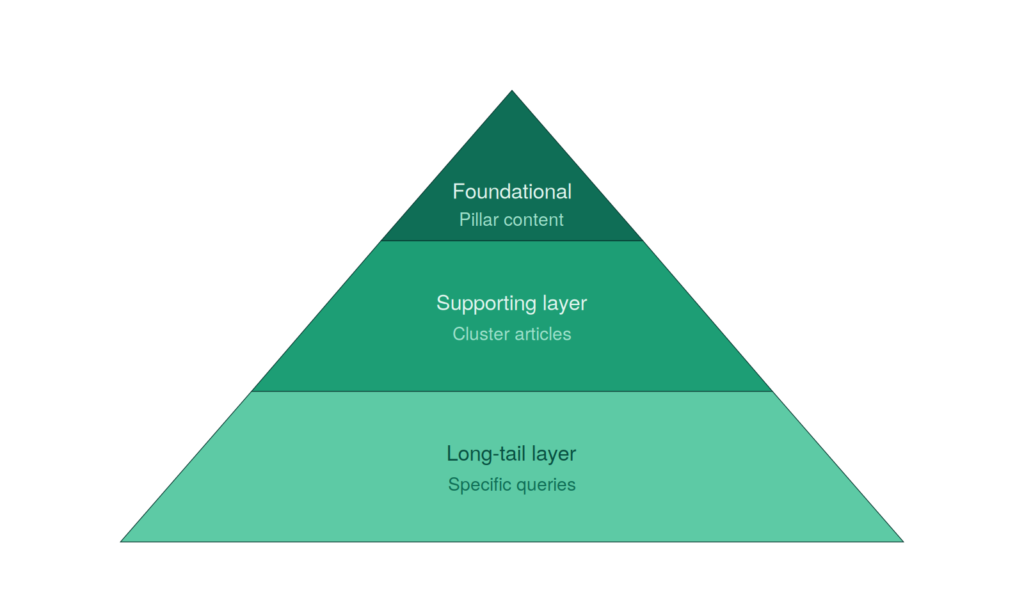
“Act as a semantic SEO strategist. Given the pillar topic [X], generate a topical cluster map. Group article ideas into three tiers: foundational (definitional, high-volume informational), supporting (how-to, comparison, use-case), and long-tail (specific question-based, low competition). Label each article by search intent. Output as a table with columns: Tier, Article Title, Primary Keyword, Intent.”
This prompt produces a usable cluster scaffold in under 60 seconds. It is not SERP-validated the way dedicated tools are, but it is a fast first pass before you run the list through a tool with live data.
Setup Requirements for Topical Cluster Mapping: Time, Tools, Prerequisites
Time investment : First cluster map – 20 to 40 minutes including tool setup, input configuration, and CSV export. Subsequent maps – 8 to 12 minutes each once you understand the input parameters.
Technical skill required : Low. Both HackTheSEO and SEOcluster.ai are UI-driven. The ChatGPT scaffolding layer requires the ability to write a structured prompt, which this article just gave you.
Prerequisites :
- Google Search Console connected to your site (required for SEOcluster.ai; optional but useful for HackTheSEO)
- At least one clearly defined pillar topic before you start – do not input a vague seed keyword like “marketing.” Input something specific: “email marketing automation for e-commerce,” not “email marketing.”
- A content calendar or project management tool to receive the output – Notion, Airtable, or even a Google Sheet. The cluster map is only useful if it connects to an execution system.
Pricing architecture : SEOcluster.ai’s free tier caps at 1,500 keywords and 5 briefs per month – workable for a solo operator doing one cluster build. The Essential plan at the next tier runs 50 clustering sessions per month with up to 25,000 keywords, which covers agency-level workloads. HackTheSEO’s topical map is bundled inside their broader SEO platform. Evaluate both against your actual monthly cluster volume before committing to either.
What a Completed Topical Cluster Map Actually Produces
Here is what a completed cluster map looks like in practice. Pillar topic: “AI workflow automation for content creators.”
The tool generates three to five semantic categories. Each category contains six to twelve article ideas. Total output: roughly 25 to 40 article titles, each with a primary keyword and an intent label.
Category example — Foundational Layer (Informational) :
- What is AI workflow automation? (Informational)
- How does AI content automation work? (Informational)
- AI automation vs. manual content production: what’s the difference? (Informational)
Category example — Supporting Layer (Commercial) :
- Best AI tools for content workflow automation in 2025 (Commercial)
- Zapier vs. Make vs. n8n for AI content pipelines: which runs better? (Commercial)
- How to choose an AI automation platform for a solo content operation (Commercial)
Category example — Long-Tail Layer (Specific/Low Competition) :
- How to automate blog publishing from Google Docs to WordPress with AI (Informational/Transactional)
- AI workflow automation for weekly newsletter production: a step-by-step system (Informational)
This is a 6-month editorial calendar. Not a rough sketch — a calendar with titles, keywords, and intent classification, ready for brief generation. The operator’s job shifts from research to prioritization: which cluster tier do you build first based on your current domain authority and your monetization funnel.
Low domain authority sites should build the foundational informational layer first — these articles are easier to rank and they establish the topical authority signal for Google before you compete on commercial terms. Higher authority sites can move directly into commercial and comparison content where the conversion value is higher.
Failure Modes: What Breaks Topical Cluster Mapping
Three things reliably break the topical cluster mapping workflow.
Seed keyword quality. A vague or overly broad seed produces a cluster that is too wide to build topical authority in. “Marketing” produces a map with 40 loosely related article ideas across 12 different subfields. “Email marketing automation for SaaS onboarding sequences” produces a tight cluster you can actually dominate. Specificity is the input variable that determines whether the output is useful.
Skipping the cannibalization check. Generating a new cluster on top of an existing content library without running a cannibalization audit first creates new problems while trying to solve old ones. If you have 80 published posts, run SEOcluster.ai against your GSC data before you build any new cluster. Merge and consolidate first. Then expand.
Treating the map as the final output. The cluster map is a blueprint, not published content. Operators who generate the map, celebrate the efficiency win, and then let the CSV sit in a Google Drive folder for three weeks have not automated anything. The map must connect to a brief generation step and a publishing schedule within 48 hours of creation, or it decays into another abandoned content plan.
The Friction Box
- LLM-generated clusters are not SERP-validated. Treat them as scaffolding. Run any AI-generated topic list through a tool with live search data before committing to a content calendar.
- SEOcluster.ai requires a site with 1,000+ GSC queries to produce meaningful clusters. Under that threshold, the data is too thin. Use HackTheSEO or the ChatGPT prompt method instead.
- Topical cluster maps generate article volume fast. Most operators are not equipped to execute 30 articles in 90 days. Build the map for 6 months, publish at a pace your quality review process can sustain.
- Neither tool handles internal linking automatically after publication. The semantic cluster map tells you which articles should link to each other. Executing those links still requires a human or a separate automation layer.
- HackTheSEO’s AI-generated articles inside the topical map tool require editing before publishing. The cluster architecture is solid. The generated prose requires a human review pass.
The Straight Talk
This workflow is built for content operators who already have a publishing system and are losing ground because their content architecture is fragmented — not because they are not writing enough. If your site has 50-plus posts with no clear topical clustering, this is your highest-leverage SEO move right now.
Skip this if you are still figuring out your niche or publishing fewer than two posts per month. A cluster map requires execution volume to pay off. Below that publishing cadence, the compounding topical authority signal does not accumulate fast enough to matter.
Next action: Pick one pillar topic you want to own this quarter. Run it through HackTheSEO’s topical map or the ChatGPT prompt above. Export the output. Block two hours this week to prioritize the first six articles by intent tier and assign publish dates. The map without a calendar is just a list.
Frequently Asked Questions About Topical Cluster Mapping
What is topical cluster mapping?
Topical cluster mapping is the practice of grouping related article ideas into semantic categories around a single pillar topic, rather than targeting each keyword as an isolated page. The output is a content architecture – a pillar page supported by 15 to 30 related articles, each labeled by search intent. Google does not rank pages in isolation; it ranks sites that demonstrate topical depth across a subject.
How is topical cluster mapping different from standard keyword research?
Standard keyword research produces a list of phrases sorted by volume. Topical cluster mapping produces a structure – which articles belong together, how they relate to the pillar page, and what role each one plays in the funnel. The shift, as described in this workflow, is not from keywords to no keywords. It is from keyword lists to semantic architecture.
How long does it take to build a topical cluster map using AI?
The first map takes 20 to 40 minutes, including tool setup, input configuration, and CSV export. Once you understand the input parameters, subsequent maps run in 8 to 12 minutes. The ChatGPT scaffolding prompt produces a first-pass cluster scaffold in under 60 seconds, though it requires SERP validation before committing to a content calendar.
Does topical cluster mapping work for a new site with little existing content?
The LLM prompt method and HackTheSEO’s keyword-input mode work regardless of site age. SEOcluster.ai requires a site with 1,000+ Google Search Console queries to produce meaningful clusters – below that threshold, the data is too thin to cluster reliably. New sites should use HackTheSEO or the ChatGPT prompt structure until their GSC query volume crosses that threshold.
What is the most common mistake operators make after building a topical cluster map?
Treating the map as the final output. The cluster map is a blueprint, not published content. Operators who export the CSV and let it sit in a Google Drive folder for three weeks have not automated anything. The map must connect to a brief generation step and a publishing schedule within 48 hours of creation, or it becomes another abandoned content plan.